Thailand Key Figures
- Population:
- 71.7 million
- GDP growth rate:
- 2.53 %/year
- Energy independence:
- 47.5%
Data of the last year available: 2024
- Total consumption/GDP:*
- 77.7 (2015=100)
- CO2 Emissions:
- 3.49 tCO2/cap
- Rate of T&D power losses:
- 5.35%
* at purchasing power parity
View all macro and energy indicators in the Thailand energy report
Thailand Energy News
View all news, archive your new and create your own daily newsletters only on your topics/countries of interest with Key Energy Intelligence
Thailand Energy Research
- Thailand's Energy & Climate Policy Framework: Thailand aims for 30% GHG reduction by 2030 and carbon neutrality by 2050, with 68% renewables in its electricity mix by 2040. The Ministry of Energy oversees policy, supported by the Energy Regulatory Commission. Recent draft plans target 73 GW of renewable capacity by 2037, with solar and wind leading. The country employs feed-in tariffs, auctions, and direct PPAs to support renewables. Energy efficiency measures and a carbon tax are also in place to meet climate goals.
- Thailand's Energy Companies: EGAT is Thailand's largest power generator, with 44% of total capacity. PTTEP leads oil and gas production, supplying 70% and 80% respectively. Key players include EGCO, RATCH, and Glow Energy in electricity, and PTT in oil and gas. Transmission and distribution are managed by EGAT and PEA/MEA.
- Thailand's Energy Supply & Demand: Thailand's energy supply relies heavily on fossil fuels, with natural gas dominating electricity generation. Total energy consumption has declined since 2019, while per capita consumption remains low. Gas reserves are depleting, and the country imports significant amounts of LNG. Electricity generation has increased, with gas accounting for the largest share, though emissions remain high. Thailand aims for carbon neutrality by 2050 but faces challenges in reducing its CO₂ intensity.
- Thailand's Energy Use & Price by Sector: In 2024, final energy consumption in Thailand remained stable at 96 Mtoe, with oil products (55%) and electricity (21%) as the primary sources. Transport (33%) and industry (29%) were the largest consuming sectors. Electricity's share in households and services surged since 2010, while biomass declined. Energy prices varied, with industrial electricity prices returning to 2022 levels and transport fuel prices slightly decreasing.
- Thailand's Issues & Prospects: Thailand plans to phase out coal by 2050, with a draft PDP 2024 targeting 600 MW of SMRs by 2037. Peak electricity demand is projected to reach 56 GW by 2037, with new capacity from renewables, gas, and SMRs. Gas and solar projects are under development, alongside hydrogen and CCS initiatives to support decarbonisation.
Benefit from up to 2 000 up-to-date data series for 186 countries in Global Energy & CO2 data
A data overview is available in the global energy statistics app
Thailand Total Energy Production & Consumption
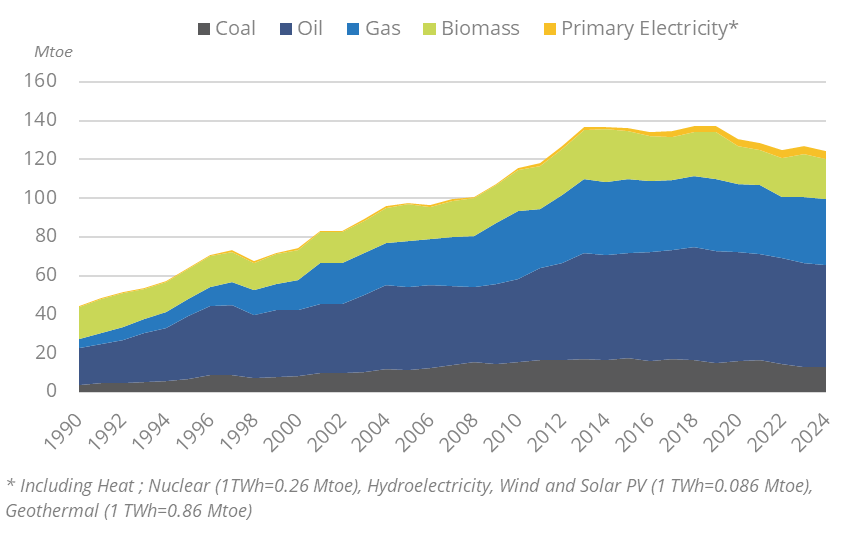
Total energy consumption has been decreasing since 2019 (-1.9%/year), reaching 124 Mtoe in 2024. It remained rather stable between 2013-2019 at around 135 Mtoe, after nearly doubling between 2000 and 2013 (+5%/year), reaching a peak at 136 Mtoe. Consumption per capita is low, 1.7 toe in 2024, around the same as the Asian average.
Graph: Primary Consumption Trends by Energy Source
Source: Thailand energy report
Interactive Chart Thailand Total Energy Production & Consumption
Source: Global Energy & CO2 data
Benefit from up to 2 000 up-to-date data series for 186 countries in Global Energy & CO2 data
View the detailed fondamentals of the market at country level (graphs, tables, analysis) in the Thailand energy report
Thailand Oil Production & Consumption
The production of liquid hydrocarbons (crude oil and NGL) increased in 2024 (+11%), reaching 13.6 Mt, after decreasing from 2016 to 2023 (-6.5%/year). Previously, it had increased rapidly between 2000 and 2016 (+6%/year).
The country is an importer of crude oil and NGL; exports have grown by 1.4%/year since 2015, reaching 50 Mt in 2024. Exports have increased since 2022 (+14%/year), reaching 1 Mt in 2024. Crude oil and NGL domestic consumption have been rising since 2022 (+2%/year), reaching 62 Mt in 2024, after decreasing by 2%/year from 2016 to 2022.
Source: Thailand energy report
Interactive Chart Thailand Crude Oil Production & Consumption
Source: Global Energy & CO2 data
Interactive Chart Thailand Refined Oil Products Production & Consumption
Source: Global Energy & CO2 data
Benefit from up to 2 000 up-to-date data series for 186 countries in Global Energy & CO2 data
Additionally, for more detailed information on refineries, you can request a sample of our Asia Refineries Dataset
Thailand Natural Gas Production & Consumption
The marketed gas production jumped by 9% in 2024 to 23 bcm, after remaining steadyin 2022 and 2023 as PTTEP boosted production from maturing fields. Prior to this, gas production had also decreased by around 30% between 2014 and 2021. It increased rapidly from 17 bcm in 2000 to 35 bcm in 2014.
Natural gas domestic consumption has been declining by around 3%/year since 2018, reaching 38 bcm in 2024.
Source: Thailand energy report
Interactive Chart Thailand Gas Production & Consumption
Source: Global Energy & CO2 data
Benefit from up to 2 000 up-to-date data series for 186 countries in Global Energy & CO2 data
Additionally, for more detailed information on the LNG trade, you can request a sample of our Asia LNG Trade Dataset
Thailand Coal and Lignite Production & Consumption
The production of lignite decreased by 5%/year between 2021 and 2023, reaching 13 Mt; it remained steady in 2024. This decrease was at the same rate as over 2011-2020, rebounding by 7% in 2021.
The country's coal imports slightly increased (+1%) in 2024, reaching 18.6 Mt. Previously, they decreased by 9%/year between 2019 and 2021 because of a fall in industrial consumption, while increased competition from gas and renewables reduced the share of coal and lignite in the country's power mix.
Source: Thailand energy report
Interactive Chart Thailand Coal and Lignite Production & Consumption
Source: Global Energy & CO2 data
Benefit from up to 2 000 up-to-date data series for 186 countries in Global Energy & CO2 data
View the detailed consumption trends at country level (graphs, tables, analysis) in the Thailand energy report
Thailand Renewable in % Electricity Production
The Draft AEDP 2024-2037 (2024) aims to increase the share of renewables in the energy mix to achieve carbon neutrality by 2050. The plan targets 73 GW of renewable capacity by 2037, i.e. 45 GW more than in the previous AEDP (2018-2037); over half of this capacity will rely on ground-mounted and floating solar (39 GW), the rest being distributed as follows: 9 GW wind, 5.5 GW biomass, and 3 GW hydropower.
Source: Thailand energy report
Interactive Chart Thailand Share of Renewables in Electricity Production (incl hydro)
Source: Global Energy & CO2 data
Benefit from up to 2 000 up-to-date data series for 186 countries in Global Energy & CO2 data
Learn more about renewables in the Mini grid Africa & Asia markets for village electrification
Thailand GHG emissions and CO2 emissions
In its last updated NDC (2022), the country raised its target to a 30% reduction in GHG emissions from a BAU scenario by 2030 (20% before) and up to 40% subject to international support. It also included the objectives of carbon neutrality by 2050 and net zero GHG emissions by 2065-2070.
Source: Thailand energy report
Interactive Chart Thailand CO2 emissions
Source: Global Energy & CO2 data
Benefit from up to 2 000 up-to-date data series for 186 countries in Global Energy & CO2 data
View the detailed consumption trends at country level (graphs, tables, analysis) in the Thailand energy report