NEW: EU ETS + ETS2 Coverage
Gaining insight into carbon emission costs and taking proactive steps to reduce them is not only imperative but essential for the sustainability of businesses, the environment and the economy. As decarbonisation efforts accelerate across Europe, carbon pricing is increasingly extending its influence across a wider range of activities — from road transport to buildings and smaller industrial operations. However, the question remains: how can businesses effectively approach this challenge? As the world heads towards decarbonisation goals, it becomes essential for businesses to understand how carbon costs are expected to evolve, especially for all actors that are exposed — directly or indirectly — to carbon pricing mechanisms.
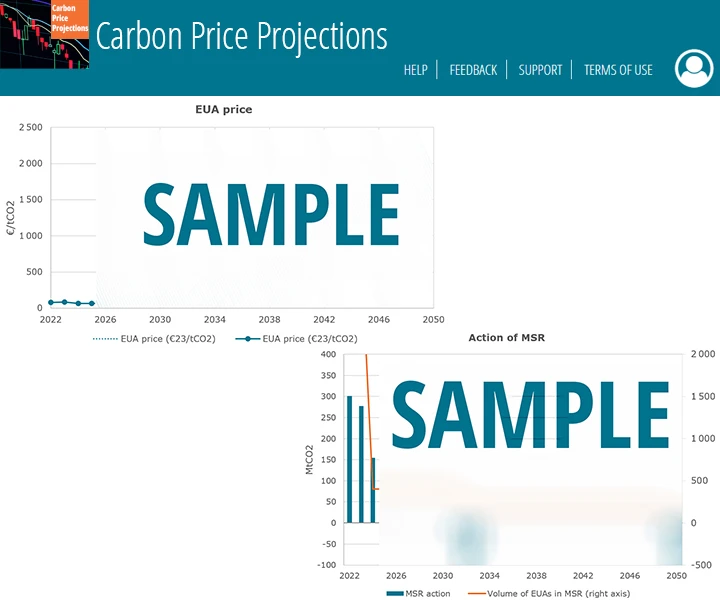
The deliverables are a CO2 price database updated every quarter and/or a custom analysis: Get a free sample here.
Why Enerdata
Fully Integrated Energy System Modelling
Our carbon price projections are derived from our world-class, globally integrated energy models. We capture the complex world interactions between power generation, industrial sectors, fuel prices, and technology development to ensure highly accurate CO2 emissions forecasting.
Explicit Coverage of Market Design
We go beyond high-level supply and demand by simulating the specific regulatory plumbing of carbon markets. Our models explicitly integrate complex mechanisms like the Market Stability Reserve (MSR), emissions cap trajectories, and banking/borrowing rules to reflect true market behaviour.
Robust, Fundamental Long-Term Vision
Our projections taken from our EnerFuture scenarios provide a realistic and highly stable foundation for long-term strategic planning. Grounded in hard techno-economic fundamentals rather than short-term financial noise, we deliver reliable insights for investment and risk assessment out to 2030, 2040, and 2050.
The EU ETS carbon price and MSR reserve evolution until 2050
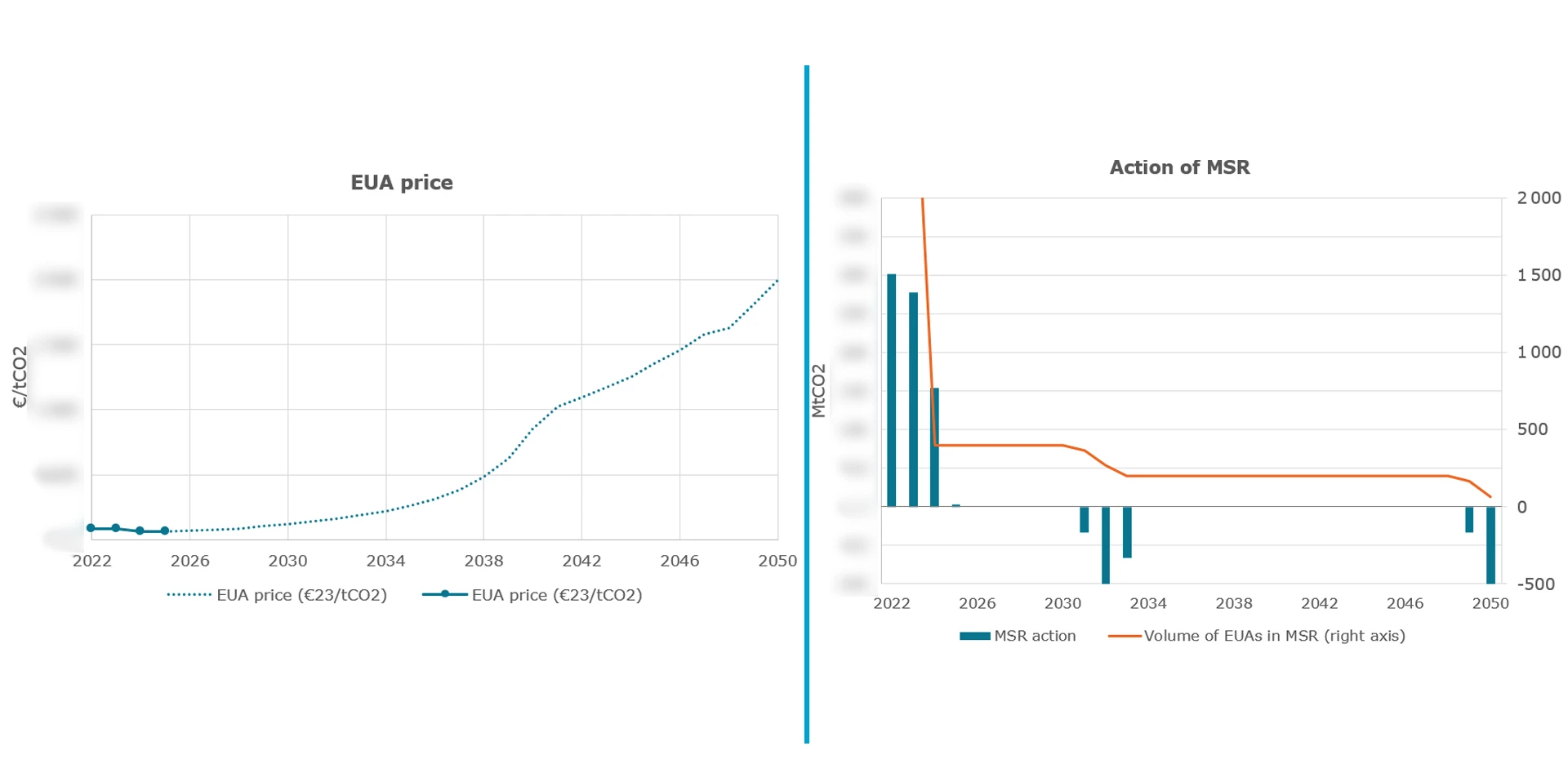
Source: Enerdata, POLES model sample - this data is not up-to-date
ETS2 outlook – price forecast and MSR2 operations to 2040
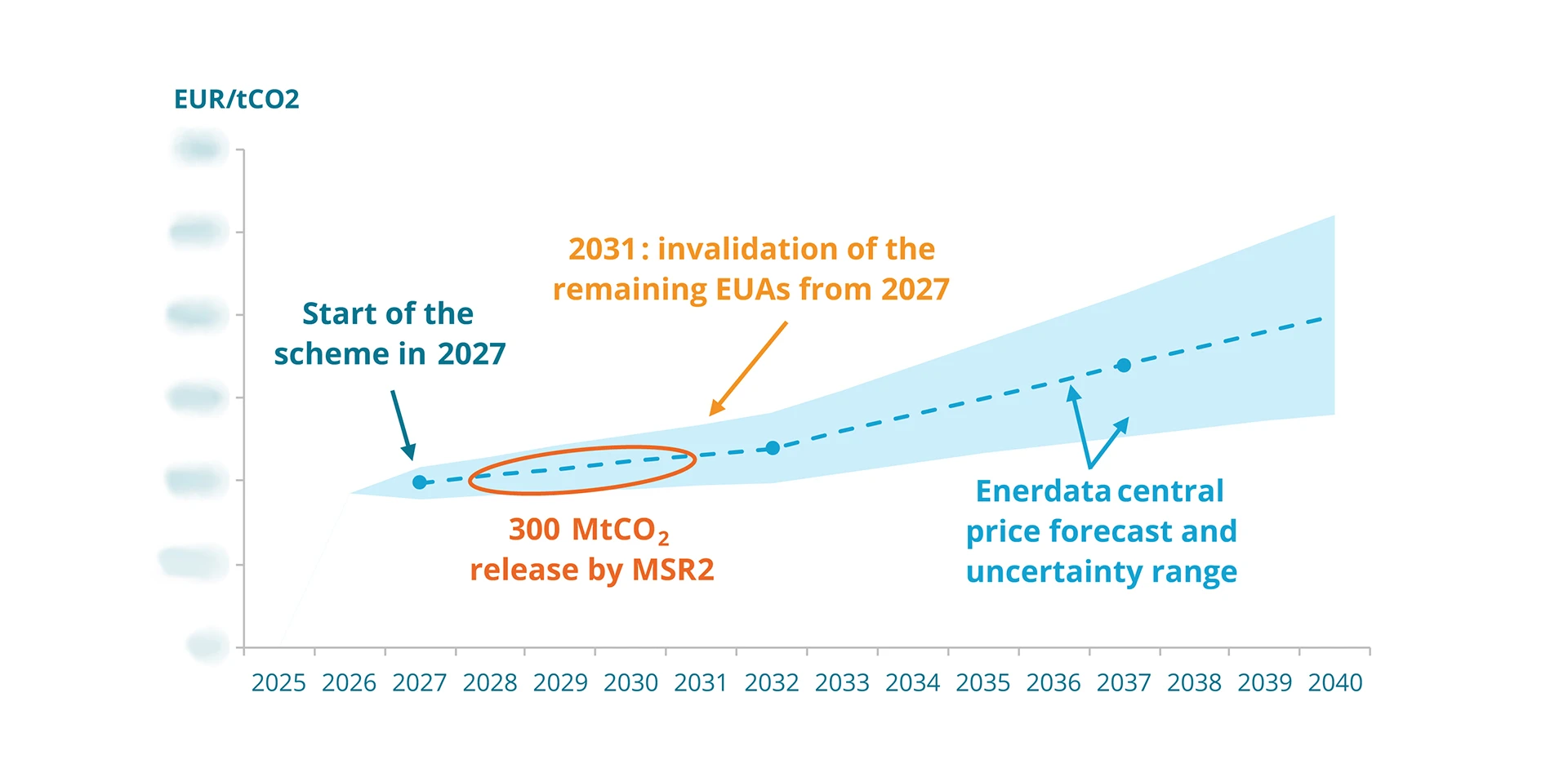
Source: Enerdata, Carbon Price Projections
- Energy-Intensive Actors: Benefit from robust quantitative projections of carbon prices in the long term, enabling you to evaluate your potential investments based on reliable data. Plan and invest in greener technologies, such as renewable energy, energy efficiency, and clean technologies, to mitigate future carbon emissions costs. Evaluating strategic decisions and anticipating potential risks and financial impacts in the present is essential.
- Financial Institutions: Evaluate the long-term profitability of your investment portfolio using robust carbon price projections. Make informed decisions by anticipating future carbon price increases. Assess the financial risks associated with climate change and build strategies against those risks.
- Governments: Shape your climate policies and incentives with informed decisions supported by the assessment of carbon pricing trends and their financial impact on the economy.
Sectors Covered Under ETS 1:
Power Generation
Gain visibility on carbon prices that will directly influence electricity generation prices. Reliable carbon price projections help utilities and energy suppliers assess long-term costs, optimise their generation mix, and prioritise decarbonisation, renewable deployment, fuel switching, and hedging strategies.
Energy-Intensive Industries
Understand how evolving carbon prices may impact production costs in sectors such as steel, cement, chemicals, refining, and glass. Robust projections support risk assessment, competitiveness analysis, and long-term investment planning, as well as anticipate compliance costs, evaluate low-carbon technology pathways, and identify opportunities to reduce emissions while maintaining operational efficiency.
Air and Maritime Transport
Prepare for rising carbon emissions-related expenses as aviation and shipping progressively integrate into the EU ETS. Forward-looking carbon price insights help airlines, cargo operators, and shipping companies anticipate future fuel cost impacts, optimise routes, and plan fleet decarbonisation strategies including SAF, alternative maritime fuels and emissions-reduction technologies.
Sectors Covered Under ETS 2:
Road Transport
Anticipate fuel-related carbon costs by relying on robust price projections. These insights help transport operators, mobility providers, and logistics actors adapt their strategies, optimise fleet decisions, and reduce long-term exposure to rising carbon expenses.
Buildings (Residential & Commercial)
Use reliable carbon price forecasts to evaluate the future cost of heating and building-energy consumption. Building owners, property managers, and service providers can plan efficiency improvements, prioritise renovations, and manage operational budgets with greater foresight.
Small Industries
Strengthen long-term planning by understanding how carbon pricing may affect smaller industrial sites. Solid projections help guide energy-efficiency upgrades and help anticipate financial risks linked to increasing carbon-related operating costs.
Enerdata leverages its superior POLES model with its dedicated carbon market simulation module to produce detailed, reliable & annual Carbon Price Projections until the year 2050. This unique methodology can be replicated to get customisable results. Our methodology relies on an actual detailed and robust representation of the energy systems from the POLES model, a feature unique to Enerdata, enabling an in-depth analysis of the market fundamentals driving the evolution of the price.
We produce Carbon Price Forecasts for a central trajectory derived from our EnerFuture scenarios, but our capabilities go beyond that. We can customise the model and the represented market design to meet your specific scenario requirements, providing data tailored to your business needs.
References
- For the European Commission (DG CLIMA):
- Impact assessment modelling for the EU ETS evaluation, in preparation for the 2026 MSR Directive revision. Enerdata was specifically responsible for the Market Stability Reserve (MSR) modelling and evaluating market linking dynamics (2024-2026);
- Impact assessment modelling on the potential linking of the EU ETS and the UK ETS (2025-2026).
- For a large European utility: Recurring contract on long-term EU ETS modelling & analysis (since 2008).
- For Carbon Pulse: Since January 2024, Enerdata has been participating in the "Quarterly Carbon Pulse EUA & UKA Price Poll", which benchmarks insights from a dozen institutions. Enerdata provides Carbon Pulse with projections of EU ETS prices up to 2030, based on EnerFuture scenarios. These projections are also accompanied by a detailed analysis from our experts.
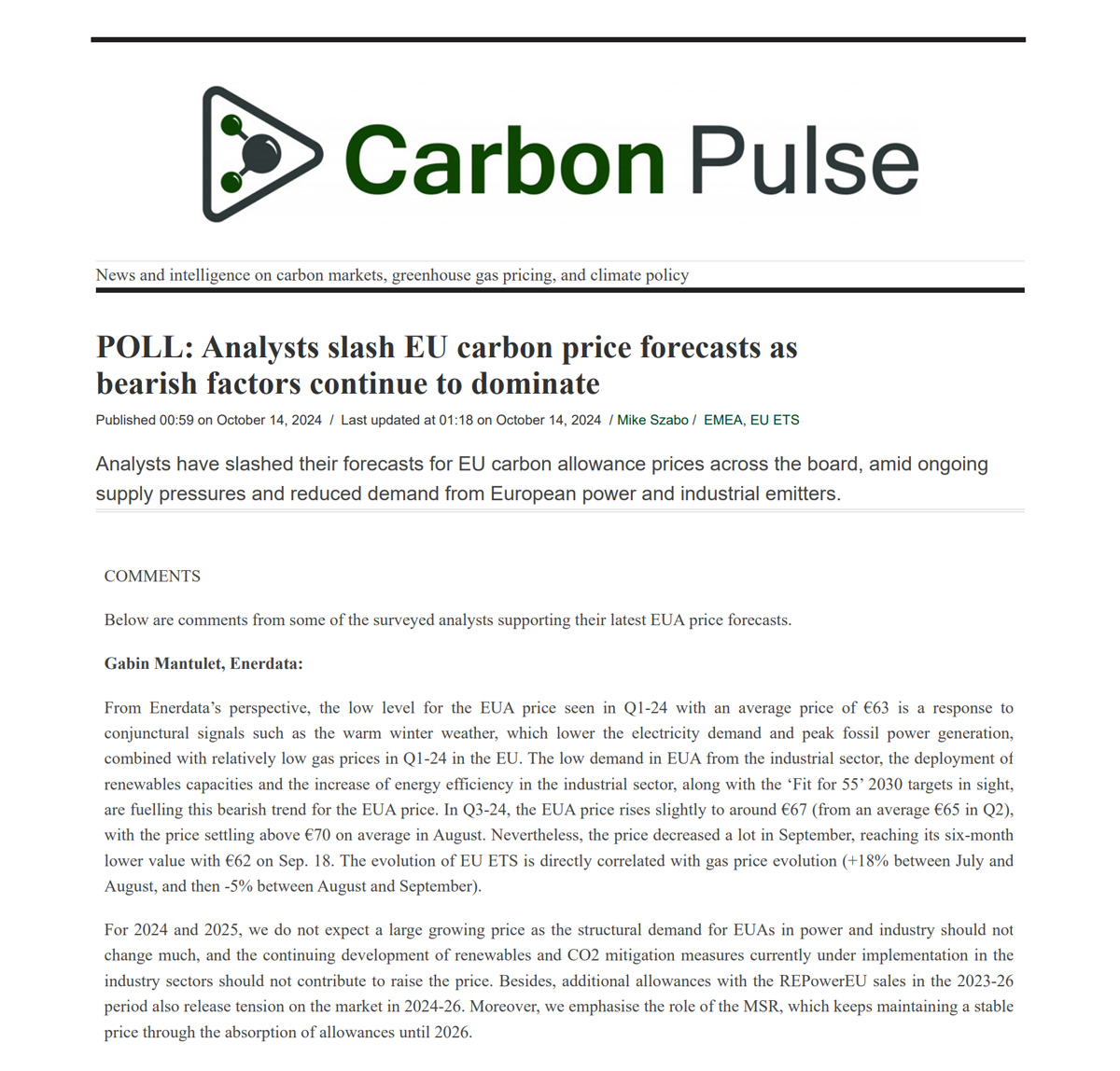
Source: Carbon Pulse, POLL: Analysts slash 2024 EU carbon price forecasts, October 14, 2024
- For a major European utility: Since 2012, Enerdata has been collaborating with this utility under a research partnership to explore future scenarios for the EU Emissions Trading System (EU ETS) and energy systems. This research considers various assumptions, including economic growth, EU policies and regulations, the design of the EU ETS and Market Stability Reserve (MSR). A unique methodology for modelling the EU ETS market has been developed by Enerdata, enabling analysis of the evolution of EU ETS prices and key market design parameters.