Japan Key Figures
- Population:
- 123 million
- GDP growth rate:
- 1.19 %/year
- Energy independence:
- 17.5%
Data of the last year available: 2025
- Total consumption/GDP:*
- 82.8 (2015=100)
- CO2 Emissions:
- 7.35 tCO2/cap
- Rate of T&D power losses:
- 5.22%
* at purchasing power parity
View all macro and energy indicators in the Japan energy report
Japan Energy News
View all news, archive your new and create your own daily newsletters only on your topics/countries of interest with Key Energy Intelligence
Japan Energy Research
- Japan's Energy & Climate Policy Framework: Japan targets 73% GHG reduction by 2040, with 40-50% renewables in power mix. METI oversees energy policy via ANRE and EGC. Nuclear and renewables prioritised for net-zero by 2050.
- Japan's Energy Companies: Japan’s energy sector is led by JERA (power), ENEOS (oil), and Tokyo Gas (gas), with shifting dynamics post-2016 deregulation and JERA’s renewable/LNG expansion.
- Japan's Energy Supply & Demand: Japan remains a major energy importer, with 30% carbon-free power in 2025, led by nuclear recovery and renewables growth.
- Japan's Energy Use & Price by Sector: Japan’s energy use is declining, with subsidies extended for gas, electricity, and gasoline. Electricity’s share in final consumption is rising, while oil dominates transport. Industry and residential sectors show varied energy trends.
- Japan's Issues & Prospects: Japan aims to boost nuclear and offshore wind energy to cut GHG emissions, targeting 40-50% renewables in power mix by 2040.
Benefit from up to 2 000 up-to-date data series for 186 countries in Global Energy & CO2 data
A data overview is available in the global energy statistics app
Japan Total Energy Production & Consumption
Total energy consumption has been decreasing by 1.4%/year on average since 2010, reaching 383 Mtoe in 2025. Energy consumption per capita was 3.1 toe in 2025; it is about 20% lower than the average for OECD Asia and Pacific.
Graph: Primary Consumption Trends by Energy Source
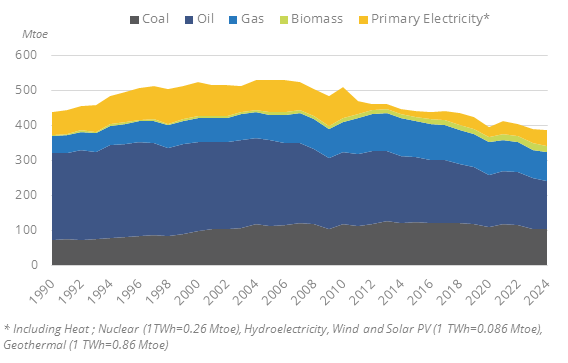
Source: Japan energy report
Interactive Chart Japan Total Energy Production & Consumption
Source: Global Energy & CO2 data
Benefit from up to 2 000 up-to-date data series for 186 countries in Global Energy & CO2 data
View the detailed fondamentals of the market at country level (graphs, tables, analysis) in the Japan energy report
Japan Oil Production & Consumption
Japan is the world's fifth largest oil importer, as it has nearly no production. Crude oil imports remained quite stable in 2025 at 120 Mt. Imports fluctuated between 115-130 Mt over2020-2025 (123 Mt average), 27% lower below their 2015 level.
Source: Japan energy report
Interactive Chart Japan Crude Oil Production & Consumption
Source: Global Energy & CO2 data
Interactive Chart Japan Refined Oil Products Production & Consumption
Source: Global Energy & CO2 data
Benefit from up to 2 000 up-to-date data series for 186 countries in Global Energy & CO2 data
Additionally, for more detailed information on refineries, you can request a sample of our Asia Refineries Dataset
Japan Natural Gas Production & Consumption
The country has nearly no gas production. Gas imports have remained quite stable since 2023 (93 bcm in 2025). Previously it has decreased sharply between 2016 and 2022(-3%/year), mainly because of a higher nuclear availability and the expansion of renewables. Gas imports have been decreasing since 2014 (-3.5%/year over 2014-2023). Japan is the world's largest LNG importer (16% of world's LNG imports). Between 2010 and 2014, imports had increased rapidly to compensate for the drop in nuclear production.
Source: Japan energy report
Interactive Chart Japan Gas Production & Consumption
Source: Global Energy & CO2 data
Benefit from up to 2 000 up-to-date data series for 186 countries in Global Energy & CO2 data
Additionally, for more detailed information on the LNG trade, you can request a sample of our Asia LNG Trade Dataset
Japan Coal and Lignite Production & Consumption
The country does not produce any coal. Hard coal imports have decreased by 4%, reaching 160 Mt in 2025. Previously it had remained quite stable between 2023-2025, after a sharp decrease in 2023 (-9%). They decreased regularly over 2013-2022 (1%/year), from a peak at 198 Mt. Japan is the world's third largest coal importer, behind China and India.
Coal consumption decreased slightly in 2025 (-3%), reaching 160 Mt. Previously it had dropped by 6% in 2023 and declined by around 1.4%/year between 2013 and 2022.
Source: Japan energy report
Interactive Chart Japan Coal and Lignite Production & Consumption
Source: Global Energy & CO2 data
Benefit from up to 2 000 up-to-date data series for 186 countries in Global Energy & CO2 data
View the detailed consumption trends at country level (graphs, tables, analysis) in the Japan energy report
Japan Renewable in % Electricity Production
By formulating the 7th Strategic Energy Plan (2025), METI aims to raise the share of renewables in the power mix to 40-50% (including hydropower) in 2040, with plans to make renewables the main power source in 2050 (30% carbon free in 2025).
Feed-in tariffs (FiTs) were removed in 2020 for large solar PV (>250 kW) and in 2023 for wind (>50 kW). They were replaced by a tendering program initiated by METI. The country awarded a total of 348 MW of solar PV in FY2025 (24th to 27th auctions) compared to 276 MW in FY2024.
Source: Japan energy report
Interactive Chart Japan Share of Renewables in Electricity Production (incl hydro)
Source: Global Energy & CO2 data
Benefit from up to 2 000 up-to-date data series for 186 countries in Global Energy & CO2 data
Japan GHG emissions and CO2 emissions
In 2025, Japan updated its NDC target to a 73% reduction in GHG emissions by 2040 compared to 2013 (60% by 2035). This would correspond to reaching an emission level of 570 MtCO2eq in 2035 and 380 MtCO2eq in 2040. The 2013 reference corresponds to Japan's peak of GHG emissions in the aftermath of the Fukushima disaster and when thermal power generation was at its highest level. The long-term goal, announced in 2019 in the long-term growth strategy under the Paris Agreement, is to become carbon neutral in 2050. The previous goal set in 2021 in its NDC was a 46% reduction by 2030.
Source: Japan energy report
Interactive Chart Japan CO2 emissions
Source: Global Energy & CO2 data
Benefit from up to 2 000 up-to-date data series for 186 countries in Global Energy & CO2 data
View the detailed consumption trends at country level (graphs, tables, analysis) in the Japan energy report