Greece Key Figures
- Population:
- 10.4 million
- GDP growth rate:
- 2.27 %/year
- Energy independence:
- 22.4%
Data of the last year available: 2024
- Total consumption/GDP:*
- 69.5 (2015=100)
- CO2 Emissions:
- 4.51 tCO2/cap
- Rate of T&D power losses:
- 11.5%
* at purchasing power parity
View all macro and energy indicators in the Greece energy report
Greece Energy News
View all news, archive your new and create your own daily newsletters only on your topics/countries of interest with Key Energy Intelligence
Greece Energy Research
- Greece's Energy & Climate Policy Framework: Greece aims to cut GHG emissions by 58% by 2030 and reach net zero by 2050, transitioning from lignite to renewables. The government coordinates energy policy through various ministries and agencies, with ambitious targets for wind, solar, and energy efficiency. Significant EU funding supports this green transition, including investments in electricity networks and residential energy efficiency. The electricity market is competitive, with plans to expand battery storage and offshore wind. Greece also promotes green hydrogen and energy efficiency measures to meet its climate goals.
- Greece's Energy Companies: PPC leads Greece's power sector, dominating generation (34%) and distribution. Helpe controls two-thirds of refining, while Italgas is the top gas distributor. Key players include Mytilineos, Elpedison, and GEK Terna in electricity, and Helleniq Energy in oil.
- Greece's Energy Supply & Demand: In 2024, Greece's energy mix saw renewables at 46%, with declining lignite use and full reliance on imports for gas and oil. Primary energy consumption rebounded to 19.8 Mtoe, with oil leading at 52%. Electricity generation increased by 11%, driven by renewables and gas, while lignite's share dropped to 6%. Greece aims for net-zero carbon intensity by 2050.
- Greece's Energy Use & Price by Sector: Greece's energy consumption per capita is 31% below the EU average, with oil dominating at 55%. Electricity prices surged in 2021-2022 but have since decreased, though remaining higher than pre-2019 levels. The transport sector is the largest energy consumer, followed by households and services. Industry and residential sectors have seen shifts towards electricity and gas, while transport remains heavily reliant on oil. Subsidies have been implemented to mitigate price volatility.
- Greece's Issues & Prospects: Greece aims to phase out lignite power by 2028, expanding gas and solar capacity (44 GW under development). Electricity demand is projected to rise, with significant growth in wind and solar generation. The country is exploring nuclear options, including small modular reactors (SMRs), and developing gas, hydro, and renewable projects. Transmission infrastructure is being upgraded to connect islands and enhance interconnections with neighbouring countries. Additionally, Greece is advancing green hydrogen initiatives and exploring CO2 capture and storage solutions.
Benefit from up to 2 000 up-to-date data series for 186 countries in Global Energy & CO2 data
A data overview is available in the global energy statistics app
Greece Total Energy Production & Consumption
Primary energy consumption, which declined by 2.7%/year between 2010 and 2023, rebounded by 2.2% in 2024 to 19.8 Mtoe. It had increased by 2.4%/year between 1990 and 2005 to 30 Mtoe, before declining by 3.2%/year until 2013, when it stabilised around 23 Mtoe until 2019 (11% fall in 2020).
Graph: Primary Consumption Trends by Energy Source
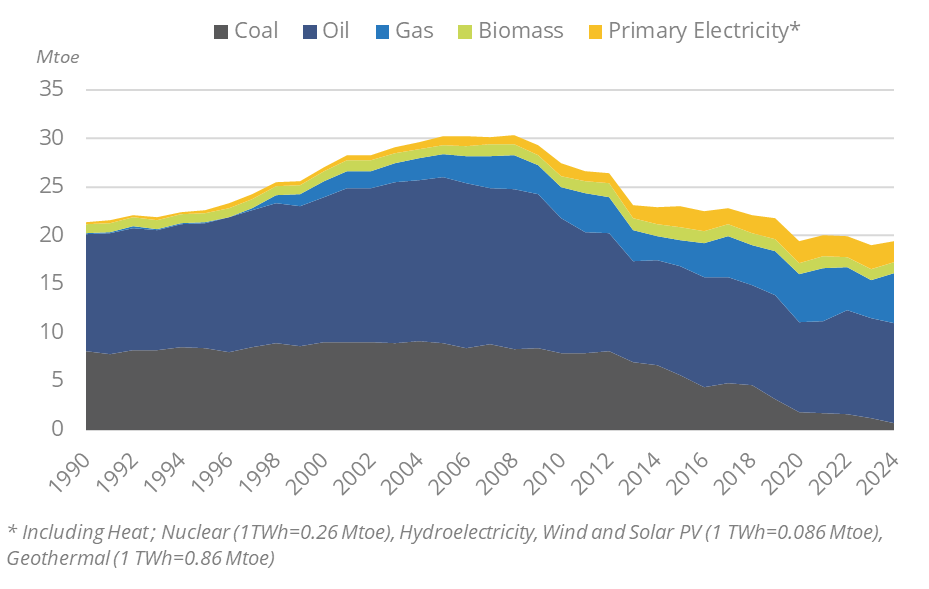
Source: Greece energy report
Interactive Chart Greece Total Energy Production & Consumption
Source: Global Energy & CO2 data
Benefit from up to 2 000 up-to-date data series for 186 countries in Global Energy & CO2 data
View the detailed fondamentals of the market at country level (graphs, tables, analysis) in the Greece energy report
Greece Oil Production & Consumption
All crude oil is imported (28 Mt in 2024). The main suppliers are Iraq (33% in 2024), Kazakhstan (26%), and Libya (15%). Until 2021, Russia was one of the top three exporters to Greece, but imports fell by 76% in 2022 (0 in 2023 and 2024).
Source: Greece energy report
Interactive Chart Greece Crude Oil Production & Consumption
Source: Global Energy & CO2 data
Interactive Chart Greece Refined Oil Products Production & Consumption
Source: Global Energy & CO2 data
Benefit from up to 2 000 up-to-date data series for 186 countries in Global Energy & CO2 data
Additionally, for more detailed information on refineries, you can request a sample of our EMEA Refineries Dataset
Greece Natural Gas Production & Consumption
A large part of the natural gas consumed is imported. Natural gas imports fell by 11% in 2022 and by 16% in 2023, in a context of soaring prices, and rebounded by 29% in 2024 to 6.2 bcm. They doubled between 2014 and 2021 to 6.4 bcm. Imports from Russia via pipeline have historically accounted for most gas imports and, despite EU rules, the share of gas imports from Russia increased from 44% in 2021 (64% of piped gas imports, no LNG) to 54% in 2024 (67% of piped gas imports and 12% of LNG imports). Other major natural gas importers are the United States, Qatar, and Algeria.
Source: Greece energy report
Interactive Chart Greece Gas Production & Consumption
Source: Global Energy & CO2 data
Benefit from up to 2 000 up-to-date data series for 186 countries in Global Energy & CO2 data
Additionally, for more detailed information on the LNG trade, you can request a sample of our EMEA LNG Trade Dataset
Greece Coal and Lignite Production & Consumption
The country produced 6.5 Mt of lignite in 2024 (-40%, after a 24% decrease in 2023). Lignite production has fallen by 14%/year since 2010 (56.5 Mt).
Lignite consumption reached an all-time high in 2004 (72 Mt) and has been falling since then, reaching 5.8 Mt in 2024 (-40% in 2024 alone), i.e. 10 times below its 2010 level. Nearly all the lignite consumption is used by the electricity sector and the current decrease in demand is explained by changes in the power mix (rising gas-fired and renewable generation) and the closure of the last lignite-fired power units.
Source: Greece energy report
Interactive Chart Greece Coal and Lignite Production & Consumption
Source: Global Energy & CO2 data
Benefit from up to 2 000 up-to-date data series for 186 countries in Global Energy & CO2 data
View the detailed consumption trends at country level (graphs, tables, analysis) in the Greece energy report
Greece Renewable in % Electricity Production
The country fell 4 pp short of the national target of 22% of renewables in the final energy consumption in 2021, according to the EU Directive on renewables (17% in 2021).
Source: Greece energy report
Interactive Chart Greece Share of Renewables in Electricity Production (incl hydro)
Source: Global Energy & CO2 data
Benefit from up to 2 000 up-to-date data series for 186 countries in Global Energy & CO2 data
Learn more about renewables in the European Battery Market Analysis
Greece GHG emissions and CO2 emissions
The updated NECP (2025) aims to cut net GHG emissions (including LULUCF) by over 58% by 2030 (compared to 1990 level), to 43.2 MtCO2eq in 2030 and to zero in 2050, thanks to a sharp reduction in emissions from power generation and transport, increased LULUCF removals, and the use of direct air capture to store CO2.
Source: Greece energy report
Interactive Chart Greece CO2 emissions
Source: Global Energy & CO2 data
Benefit from up to 2 000 up-to-date data series for 186 countries in Global Energy & CO2 data
View the detailed consumption trends at country level (graphs, tables, analysis) in the Greece energy report