POLES is used and developed by Enerdata in collaboration with the European Commission’s JRC IPTS and University of Grenoble-CNRS (GAEL – Grenoble Applied Economics Lab).
It provides quantitative, scenario-based, empirical and objective analysis of the energy sector for key stakeholders: private companies, governments, international organisations...
POLES input data is updated each year, allowing users to describe full development pathways of the energy sector up to 2050 with worldwide coverage.
Key benefits:
Outcomes:
- Long-term (2070) projections of world energy system and international energy markets
- World energy supply scenarios by main producing country / region with consideration of reserve development and resource constraints (88 producing countries / regions)
- EU Member States: estimates of ETS and Non-ETS splits
- CO2 emission marginal abatement cost curves and emissions trading system analysis by region and/or sector, under different market configurations and trading rules
- Energy trade: oil (global pool), gas (bilateral trade from 41 exporters to 14 importing markets), coal (bilateral trade from 26 exporters to 15 importing markets), import needs for solid biomass, liquid biofuels, uranium and electricity; global markets for hydrogen, steel, and cement production
- Outlook for energy prices at international, national and sectoral levels
Price and cost projections:
- Impacts of energy prices and tax policies on regional energy systems, national greenhouse gas emissions and abatement strategies
- Costs of national and international GHG abatement scenarios with different regional targets/endowments and flexibility systems
Specificities:
- Full power generation system (and feedback effect on other energies): 30 explicit technologies, load curve simulation with typical days, annual capacity planning and dispatch based on LCOE, centralised and decentralised, potentials associated to renewables, and CCS
- Transformations: 14 technologies accounted for hydrogen production, district heating, biofuels, and biomethane productions
- Endogenous developments in energy technologies, with impacts of public and private investment in R&D and cumulative experience with “learning by doing”
- Technology development based on cost competition and technology features
Coverage:
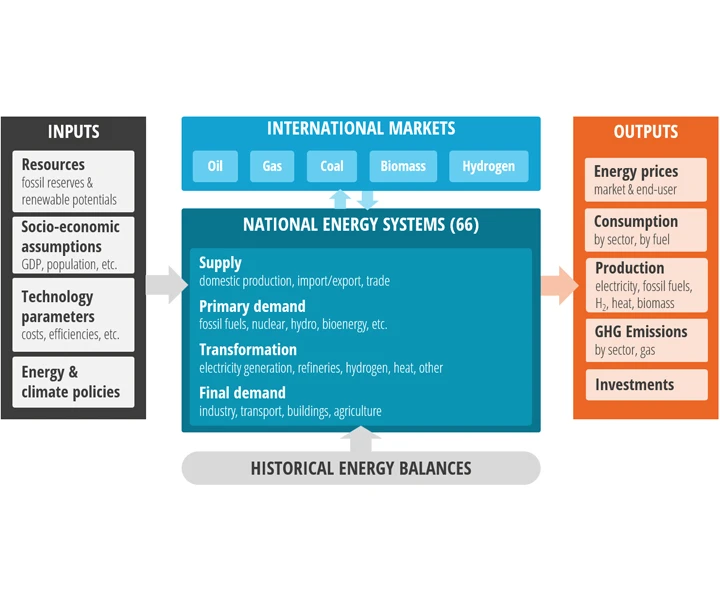
- 54 consuming countries + 12 regions; including all 27 EU Member States and EU surroundings (Norway, Iceland, Switzerland, Türkiye)
- Detailed national/regional energy balances and emissions, integrating primary production, primary demand, transformation & power, losses and final energy demand
- Disaggregation into a dozen energy sectors with over 40 technologies, including industrial sectors, buildings, transport, power generation and hydrogen production
POLES is a world energy-economy partial equilibrium simulation model of the energy sector until 2050, with complete modelling from upstream production to final user demand and greenhouse gas emissions.
The simulation process uses year-by-year dynamic recursive modelling with endogenous international energy prices and lagged adjustments of supply and demand by world region.
Well-adapted to forecast the effects of different energy-related issues (energy policies, promotion of renewables and energy efficiency, energy security issues, etc.) as well as climate-related issues (GHG emissions limitations, effort sharing between countries), POLES captures all impacts of the energy system thanks to endogenous fuel prices and national forecasts coherent within the global environment.
References
- Since 2007, the UK government has commissioned our modelling experts to support them in the assessment of the impacts of climate action and NDCs under the Paris Agreement. To do so, our experts develop a bespoke business-as-usual scenario up to 2060 and derive MACCs at the global level.
- The European Commission’s Directorate General for Climate Action (DG CLIMA) required a study on energy-climate trajectories within the EU. The outcomes of this study would serve as input for the Impact Assessment for a 2040 Climate Target. The project aimed to evaluate three distinct partial equilibrium models: POLES-Enerdata, TIMES-EU, and the AMADEUS-METIS model cluster.
- The World Energy Council (WEC) commissioned Enerdata to build an updated quantified scenario set, leveraging our recognised expertise and our in-house POLES model: "Jazz Clubs" and "Hard Rocks" scenarios. The results of these two quantitative scenarios have been presented at the World Energy Congress in April 2024.
- Schneider Electric commissioned Enerdata to build several custom scenarios, tailored to fit the detailed vision of the company for each sector and geographic region, while relying on Enerdata’s insights.
- Enerdata worked with EDF R&D to develop prospective scenarios to explore EU carbon market research. Various hypotheses have been examined, including policy measures and market evolutions.
- The Canadian Department for Natural Resources (NRCan) asked Enerdata to explore their policy and program strategies and assess long-term impacts on the energy system. In this context, NRCan has commissioned Enerdata to study the potential of energy efficiency to impact various sectors of the Canadian economy.
Academic Acknowledgment
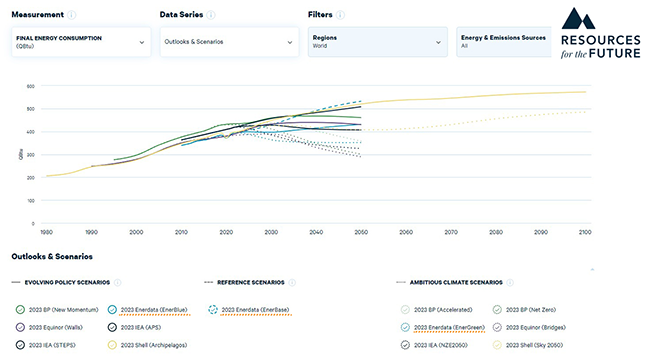
Resources for the Future, a reputable, independent, and non-profit research institution, has listed Enerfuture's scenarios as world's top scenario, to realise a comprehensive benchmark on various energy items, including primary & final energy consumption, power generation, energy production and CO2 emissions.