Bangladesh Key Figures
- Population:
- 171 million
- GDP growth rate:
- 5.78 %/year
- Energy independence:
- 61.6%
Data of the last year available: 2023
- Total consumption/GDP:*
- 79.0 (2015=100)
- CO2 Emissions:
- 0.67 tCO2/cap
- Rate of T&D power losses:
- 8.63%
* at purchasing power parity
View all macro and energy indicators in the Bangladesh energy report
Bangladesh Energy News
View all news, archive your new and create your own daily newsletters only on your topics/countries of interest with Key Energy Intelligence
Bangladesh Energy Research
- Bangladesh's Energy & Climate Policy Framework: Bangladesh aims for 4.1 GW of renewables by 2030, with 7% GHG reduction. The MPEMR oversees energy policy, while BERC regulates the sector. The Perspective Plan targets 57 GW grid capacity by 2041, diversifying fuel use and enhancing private investments. The 8th Five-Year Plan (2021-2025) focuses on expanding power capacity and improving investment conditions.
- Bangladesh's Energy Companies: Bangladesh's energy sector is dominated by state-owned entities like BPDB and Petrobangla, alongside private players. Chevron leads gas production, while BPDB oversees electricity generation, transmission, and distribution. Key players include Summit Power and foreign IPPs. Gas supply is primarily managed by Petrobangla subsidiaries, with Chevron contributing significantly. The sole coal mine, Barapukuria, faces production declines due to local protests.
- Bangladesh's Energy Supply & Demand: Bangladesh's energy demand is rising, with gas dominating supply but reserves insufficient. Electricity capacity has quadrupled since 2010, though reliance on fossil fuels persists, and GHG emissions are increasing.
- Bangladesh's Energy Use & Price by Sector: Energy consumption grows slower than GDP, with biomass and gas leading usage. Residential sectors dominate demand, while industrial and transport sectors show varied trends. Government controls energy prices, with recent fluctuations in electricity and fuel costs.
- Bangladesh's Issues & Prospects: Bangladesh aims to triple its power capacity by 2040, with ambitious renewable energy targets and significant gas, nuclear, and solar projects underway. However, delays and funding issues persist.
Benefit from up to 2 000 up-to-date data series for 186 countries in Global Energy & CO2 data
A data overview is available in the global energy statistics app
Bangladesh Total Energy Production & Consumption
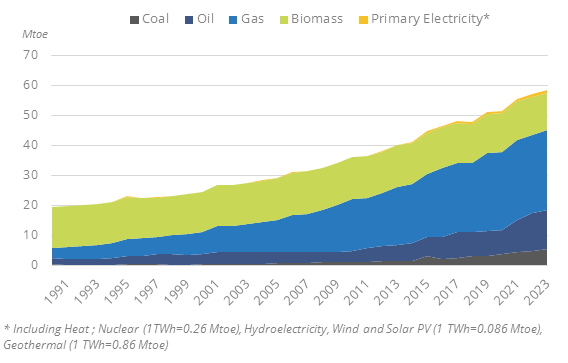
The country's primary energy consumption is rising steadily (4%/year on average since 2010), reaching 58 Mtoe in 2023.
Natural gas accounted for 46% of consumption in 2023, while oil and biomass each accounted for 22%. Coal only accounts for 9%.
Graph: Primary Consumption Trends by Energy Source (Mtoe)
Graph: Total Consumption Market Share by Energy (2023, %)
Source: Bangladesh energy report
Interactive Chart Bangladesh Total Energy Production & Consumption
Source: Global Energy & CO2 data
Benefit from up to 2 000 up-to-date data series for 186 countries in Global Energy & CO2 data
View the detailed fondamentals of the market at country level (graphs, tables, analysis) in the Bangladesh energy report
Bangladesh Oil Production & Consumption
The country imports over 5 times its oil production (1.4 Mt of imports for a production of 0.3 Mt in 2023).
The country has a limited refining capacity of 35.5 kb/d (2020) distributed in 2 refineries: Chittagong (33 kb/d, commissioned in 1968) and Mongla (2.5 kb/d, 2013). Production of oil products covers around 15% of the consumption. Oil product imports have quadrupled since 2010, reaching 12.5 Mt in 2023.
Graph: Crude Oil Production & Consumption (Mt)
Source: Bangladesh energy report
Interactive Chart Bangladesh Crude Oil Production & Consumption
Source: Global Energy & CO2 data
Interactive Chart Bangladesh Refined Oil Products Production & Consumption
Source: Global Energy & CO2 data
Benefit from up to 2 000 up-to-date data series for 186 countries in Global Energy & CO2 data
Additionally, for more detailed information on refineries, you can request a sample of our Asia Refineries Dataset
Bangladesh Natural Gas Production & Consumption
Natural gas production has been declining slightly since a peak at 28 bcm in 2017 and reached 27 bcm in 2023 (-3%/year on average). It was increasing rapidly previously (5%/year over 2010-2017).
Gas is mainly consumed for the production of electricity (60% in 2023); the rest is used in industry (24%, including 6% for non-energy uses for fertiliser production), in buildings (residential-tertiary sector) (12%), and in transport (4%).
Source: Bangladesh energy report
Interactive Chart Bangladesh Gas Production & Consumption
Source: Global Energy & CO2 data
Benefit from up to 2 000 up-to-date data series for 186 countries in Global Energy & CO2 data
Additionally, for more detailed information on the LNG trade, you can request a sample of our Asia LNG Trade Dataset
Bangladesh Coal and Lignite Production & Consumption
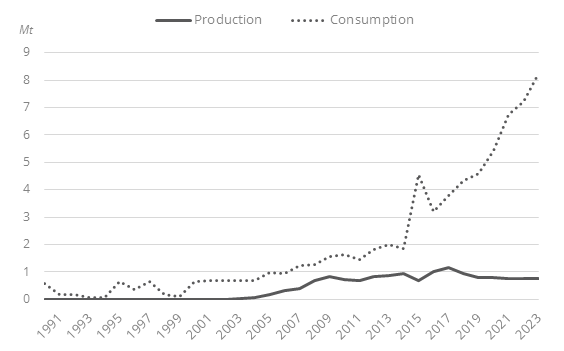
The country's first and only coal mine (Barapukuria) started production in 2005. Production has been declining since a peak at 1.2 Mt in 2017 to around 0.8 Mt in 2023. The country imports most of its coal needs to meet its demand, with 7.5 Mt of coal imported in 2023.
Graph: Coal Production & Consumption (Mt)
Source: Bangladesh energy report
Interactive Chart Bangladesh Coal and Lignite Production & Consumption
Source: Global Energy & CO2 data
Benefit from up to 2 000 up-to-date data series for 186 countries in Global Energy & CO2 data
View the detailed consumption trends at country level (graphs, tables, analysis) in the Bangladesh energy report
Bangladesh Renewable in % Electricity Production
In 2021, Bangladesh set the objective of reaching 4.1 GW of renewable capacity by 2030 as part of its new NDCs, including nearly 2.3 GW of solar capacity (conditional contribution). Only 0.75 GW of solar has been added as of 2016 and no wind capacity.
In 2023, the government set a target of covering 40% of its power generation with clean energy by 2041 (including 10% of renewables). The Ministry for Power, Energy, and Mineral Resources aims to reach an installed capacity of 40 GW by 2030 and 60 GW by 2041.
Source: Bangladesh energy report
Interactive Chart Bangladesh Share of Renewables in Electricity Production (incl hydro)
Source: Global Energy & CO2 data
Benefit from up to 2 000 up-to-date data series for 186 countries in Global Energy & CO2 data
Learn more about renewables in the Mini grid Africa & Asia markets for village electrification
Bangladesh GHG emissions and CO2 emissions
In its updated NDC (2021), Bangladesh set an unconditional GHG emission reduction target of 6.7% by 2030, leading to emissions of 382 MtCO2eq in 2030, i.e. -28 MtCO2eq compared with the BAU scenario. The conditional reduction target is an additional 15% (i.e. 21.85%, i.e. -89 MtCO2eq), which would limit GHG emissions to 320 MtCO2eq. In the previous version, the reduction targets were, respectively, 5% and 10%.
Source: Bangladesh energy report
Interactive Chart Bangladesh CO2 emissions
Source: Global Energy & CO2 data
Benefit from up to 2 000 up-to-date data series for 186 countries in Global Energy & CO2 data
View the detailed consumption trends at country level (graphs, tables, analysis) in the Bangladesh energy report