State-owned Solar Energy Corporation of India (SECI) has released a tender to select developers, which would supply 5 GW of round-the-clock power from on-grid renewable projects under tariff-based competitive bidding. The minimum bid capacity is set at 500 MW but bidders can submit plans for up to 5,000 MW. Project developers will have to supply at least 51% of renewable electricity (including energy storage systems, in order to reach at least 80% of availability on an annual basis), with the remainder coming from coal-fired power projects. Bidders will have to quote a single tariff for the two sources of energy. Successful bidders will be offered a 25-year power purchase agreement with SECI. Interested project developers have until 4 May 2020 to submit their offers.
Earlier in March 2020, the Ministry of New and Renewable Energy (MNRE) of India issued a new regulation authorising the tendering agencies and state utilities to remove tariff cap from wind and solar tenders, in an attempt to boost investment in wind and solar power projects. The upcoming federal tender (Round Ten) should not include a tariff cap.
According to the government of India, installed renewable power capacity in India crossed the 84 GW threshold in December 2019 (84.4 GW), with wind power capacity reaching 37,280 MW, solar capacity 32,530 MW, biomass capacity 9,940 MW and small hydropower capacity 4,650 MW. India has set a target of 175 GW of renewable power capacity by 2022, including 100 GW from solar, 60 GW from wind, 10 GW from biomass and 5 GW from small hydropower.
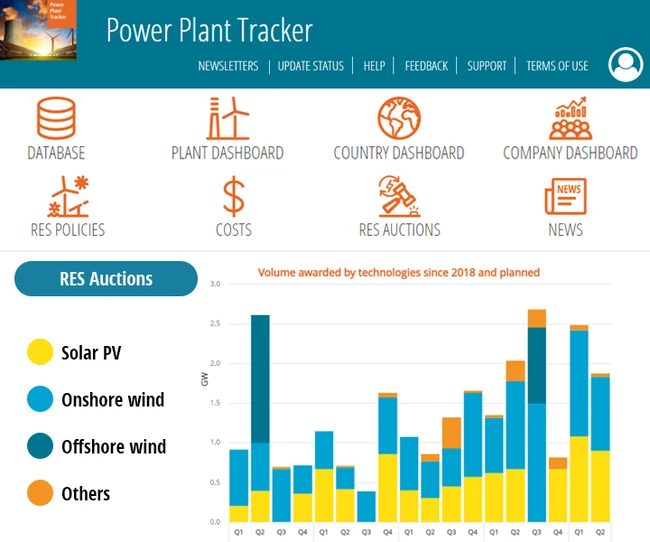
Do you want to become an expert on renewable energies auctions?
Discover our very detailed and regularly updated RES auctions database with worldwide coverage and a technical focus backed by academic research.
With our renewable energies auctions service you will be able to monitor auctions at a global level. Its (expanding) scope notably includes all major G20 countries and offers an especially fine tracking on Europe and South America.