The governor of the State of New York (United States) has confirmed that the New York State Energy Research and Development Authority (NYSERDA) would issue a second solicitation for offshore wind capacity in 2020. The state will seek to yield at least 1 GW of offshore wind power and to benefit from falling offshore wind costs. In addition, NYSERDA will make competitive awards to 21 large-scale solar, wind and energy storage projects totalling over 1 GW of renewable capacity and 40 MW of energy storage capacity, corresponding to around US$2.5bn of private investments.
In January 2019, the governor of New York announced a new offshore wind capacity target of 9 GW for 2035, which is a nearly fourfold increase compared with the previous target of 2.4 GW by 2030. The additions in offshore wind capacity are essential in order to achieve its renewable electricity target of 70% by 2030, up from the previous target of 50%. The state also committed to 6 GW of solar capacity (up from 3 GW) and to double its onshore wind capacity by 2025. The state also committed itself to move to 100% carbon-free electricity by 2040 in December 2018, shortly after the notice of a new policy setting an electricity storage objective of 3 GW by 2030 with an interim goal of 1.5 GW by 2025.
In the first offshore wind solicitation, the NYSERDA selected Equinor's 816 MW Empire Wind and Bay State Wind's 880 MW Sunrise Wind offshore wind projects. It finalised 25-year contracts with the projects developers in October 2019. Subject to final investment decisions (FIDs), the two offshore wind projects are expected to be commissioned in 2024. With a combined capacity of 1,696 MW, they should produce enough electricity to power more than 1 million New York homes.
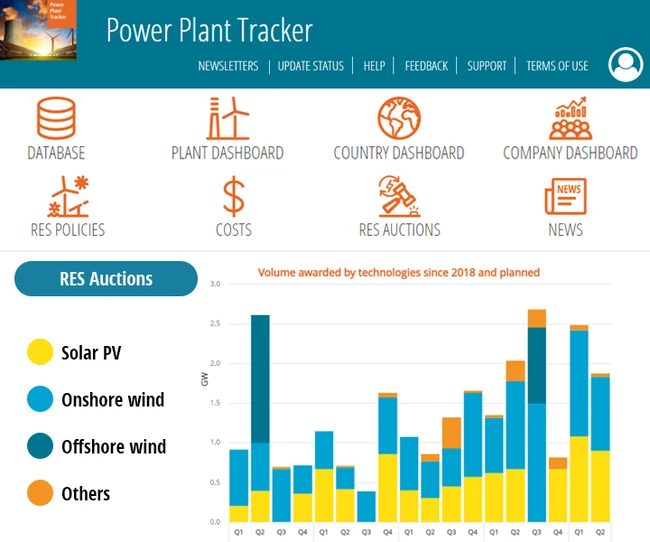
Do you want to become an expert on renewable energies auctions?
Discover our very detailed and regularly updated RES auctions database with worldwide coverage and a technical focus backed by academic research.
With our renewable energies auctions service you will be able to monitor auctions at a global level. Its (expanding) scope notably includes all major G20 countries and offers an especially fine tracking on Europe and South America.