The Ministry of New and Renewable Energy (MNRE) of India has transferred the implementation of the second phase of the 12 GW Central Public Sector Undertaking (CPSU) scheme from the Solar Energy Corporation of India (SECI) to the Indian Renewable Energy Development Agency (IREDA). Under this scheme, India plans to add 4 GW per year of new solar capacity between 2019-2020 (April 2019-March 2020) and 2022-2023. Solar PV projects will have to be commissioned within 24 months from the date of letter of award (plus another 6 months for balance capacity for projects over 500 MW), extending the commissioning period (18 months previously). The IREDA will be allowed to sanction and approve solar PV projects up to 50 MW under the CPSU scheme Phase II to any willing government entity at the lowest rate discovered in the most recent auction, within 4 months of the last bidding, without requiring the entity to take part in bids.
Meanwhile, SECI has launched a tender for 2.5 GW of solar projects in the Koppal District of the southwestern state of Karnataka, under Tariff-based Competitive Bidding (ISTS-X). The minimum size of projects is 50 MW. Successful bids will obtain a 25-year power purchase agreement (PPA) from SECI.
According to the government of India, installed renewable power capacity in India crossed the 84 GW threshold in December 2019 (84.4 GW), with wind power capacity reaching 37,280 MW, solar capacity 32,530 MW, biomass capacity 9,940 MW and small hydropower capacity 4,650 MW. India has set a target of 175 GW of renewable power capacity by 2022, including 100 GW from solar, 60 GW from wind, 10 GW from biomass and 5 GW from small hydropower.
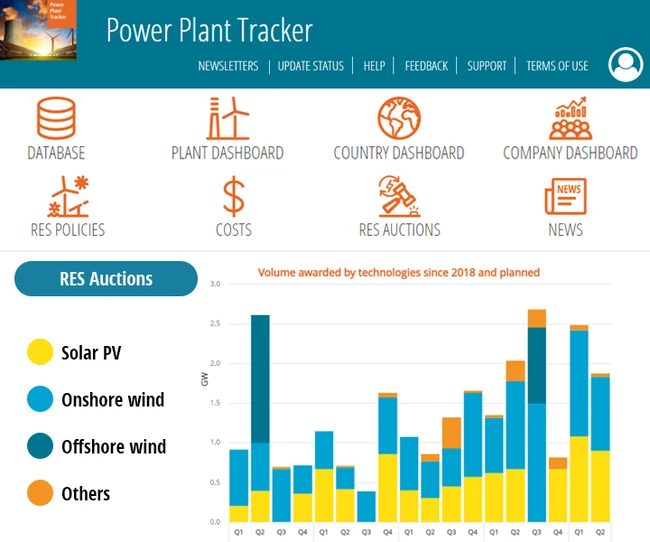
Do you want to become an expert on renewable energies auctions?
Discover our very detailed and regularly updated RES auctions database with worldwide coverage and a technical focus backed by academic research.
With our renewable energies auctions service you will be able to monitor auctions at a global level. Its (expanding) scope notably includes all major G20 countries and offers an especially fine tracking on Europe and South America.