The German Federal Network Agency (Bundesnetzagentur or BNetzA) will cut subsidies for onshore wind turbines by 2.4% starting from October 2018 as per the EEG 2017 regulation (Erneuerbare-Energien-Gesetz). This means that since the beginning of 2017, they have decreased by 17% in total.
The BNetzA estimates that the newly onshore wind added capacity between May 2017 and April 2018 - 5,308 MW - is well above the planned capacity expansion path. The regulator will therefore implement a slight reduction of the subsidies. The BNetzA adjusts the funding rates for onshore wind power on a quarterly basis: in September 2017, it already announced a 2.4% cut starting from 1 January 2018 and another 2.4% cut for April 2018.
Starting from 2019, the amount of compensation for electricity from offshore wind turbines that do not participate in tenders (small plants up to 750 kW and pilot plants) will be calculated from the surcharge values for previous tenders. An average of the highest deferred bids will be calculated for this purpose in 2019, which means that the tariff for installations commissioned under this special regulation in 2019 will be €4.63c/kWh.
Germany is shifting from a subsidy-based system to an auction-based one. Since the beginning of 2017, solar and wind power projects over 750 kW have to compete in tenders in order to secure power purchase deals, as feed-in tariff (FiT) contracts are no longer available. However, projects that were approved in 2016 are still eligible.
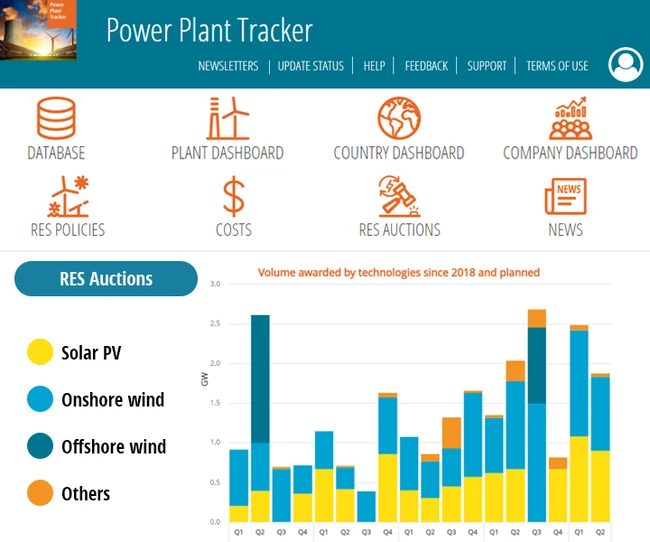
Do you want to become an expert on renewable energies auctions?
Discover our very detailed and regularly updated RES auctions database with worldwide coverage and a technical focus backed by academic research.
With our renewable energies auctions service you will be able to monitor auctions at a global level. Its (expanding) scope notably includes all major G20 countries and offers an especially fine tracking on Europe and South America.