Vietnam Key Figures
- Population:
- 102 million
- GDP growth rate:
- 8.02 %/year
- Energy independence:
- 52.7%
Data of the last year available: 2025
- Total consumption/GDP:*
- 90.7 (2015=100)
- CO2 Emissions:
- 3.27 tCO2/cap
- Rate of T&D power losses:
- 6.68%
* at purchasing power parity
View all macro and energy indicators in the Vietnam energy report
Vietnam Energy News
View all news, archive your new and create your own daily newsletters only on your topics/countries of interest with Key Energy Intelligence
Vietnam Energy Research
- Vietnam's Energy & Climate Policy Framework: Vietnam aims for 74-75% renewables in its power mix by 2050, with accelerated biofuel use and energy efficiency measures. The government is restructuring the energy sector, promoting nuclear power, and implementing an emissions trading scheme to meet climate goals.
- Vietnam's Energy Companies: Vietnam's energy sector is dominated by state-owned enterprises: EVN for electricity, PVN for oil and gas, and Vinacomin for coal. EVN controls about a third of the country's power generation capacity, while independent power producers (IPPs) own the majority. EVN also manages the national power transmission network and operates five regional distribution companies. PVN leads the oil and gas sector, with significant foreign involvement in exploration and refining. Vinacomin is the primary coal producer, supplying the power sector.
- Vietnam's Energy Supply & Demand: Vietnam's energy mix is dominated by coal (54% of electricity, 51% of total energy), with rapid growth in coal plants since 2020 increasing GHG emissions. Total energy consumption surged 9% annually from 2022-2024, reaching 126 Mtoe. Despite aims to halt coal plant development by 2030, coal's share in the power mix grew to 54% in 2024. Renewable capacities, particularly solar and wind, have expanded significantly, but emissions remain high, conflicting with Vietnam's carbon neutrality goal by 2050.
- Vietnam's Energy Use & Price by Sector: In 2024, Vietnam's energy consumption per capita was 27% below the Asian average, with oil and electricity each accounting for 35% of residential energy use, replacing biomass. Industrial demand surged, driven by coal and electricity, while transport relied solely on oil. Energy prices varied by sector, with electricity costs rising to address financial deficits.
- Vietnam's Issues & Prospects: Vietnam aims to double its power capacity to 183-236 GW by 2030, transitioning from coal and gas to renewables by 2050. Key projects include nuclear, LNG, and renewable energy hubs, with significant investments in solar, wind, and hydropower.
Benefit from up to 2 000 up-to-date data series for 186 countries in Global Energy & CO2 data
A data overview is available in the global energy statistics app
Vietnam Total Energy Production & Consumption
Total energy consumption increased rapidly over 2022-2025 (+3.9%/year), reaching 116 Mtoe in 2025. It remained rather stable between 2019-2022 at around 104 Mtoe, after rapid growth between 2015 and 2018 (+9%/year) thanks to the economic recovery.
Graph: Primary Consumption Trends by Energy Source
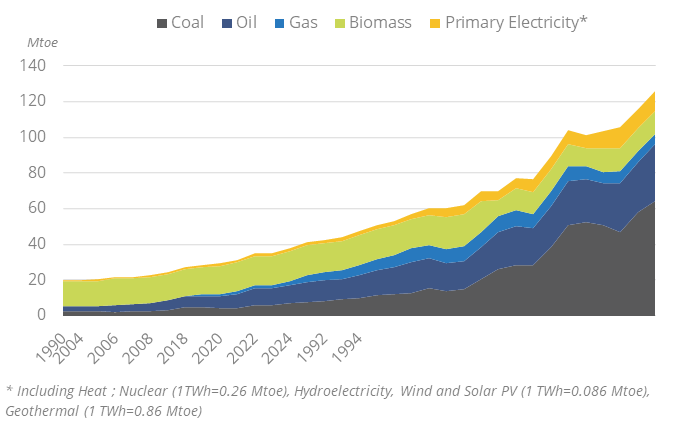
Source: Vietnam energy report
Interactive Chart Vietnam Total Energy Production & Consumption
Source: Global Energy & CO2 data
Benefit from up to 2 000 up-to-date data series for 186 countries in Global Energy & CO2 data
View the detailed fondamentals of the market at country level (graphs, tables, analysis) in the Vietnam energy report
Vietnam Oil Production & Consumption
Oil production has decreased by 2%/year since 2020, reaching 8.4 Mt in 2025. Previously, it had decreased very rapidly over 2015-2020 (-14%/year).
The Ca Tam offshore oil field (with remaining recoverable reserves of 4.3 Mt as of 2022), in southern Vietnam, came into operation in 2019. It is expected to remain in commercial production until 2032. The country started oil production in 1986 in the Bach Ho offshore field ("White Tiger"), production at which has been falling since 2001. A second important field, Dai Hung ("Big Bear"), started production in 1994.
Source: Vietnam energy report
Interactive Chart Vietnam Crude Oil Production & Consumption
Source: Global Energy & CO2 data
Interactive Chart Vietnam Refined Oil Products Production & Consumption
Source: Global Energy & CO2 data
Benefit from up to 2 000 up-to-date data series for 186 countries in Global Energy & CO2 data
Additionally, for more detailed information on refineries, you can request a sample of our Asia Refineries Dataset
Vietnam Natural Gas Production & Consumption
Gas production has been decreasing by around 5.3%/year since 2015 to 6.4 bcm in 2025. Previously, production had jumped from 1.6 bcm in 2000 to around 11.5 bcm in 2015 thanks to the commissioning of the Nam Con Son field in 2002.
Source: Vietnam energy report
Interactive Chart Vietnam Gas Production & Consumption
Source: Global Energy & CO2 data
Benefit from up to 2 000 up-to-date data series for 186 countries in Global Energy & CO2 data
Additionally, for more detailed information on the LNG trade, you can request a sample of our Asia LNG Trade Dataset
Vietnam Coal and Lignite Production & Consumption
Coal and lignite production peaked at nearly 50 Mt in 2022 before contracting by 3%/year on average to reach 44.8 Mt in 2025 (after a low of 42.9 Mt in 2024). Over 2015-2021, it ranged between 38 and 48 Mt.
Source: Vietnam energy report
Interactive Chart Vietnam Coal and Lignite Production & Consumption
Source: Global Energy & CO2 data
Benefit from up to 2 000 up-to-date data series for 186 countries in Global Energy & CO2 data
View the detailed consumption trends at country level (graphs, tables, analysis) in the Vietnam energy report
Vietnam Renewable in % Electricity Production
The Master Plan for the development of energy for 2021-2030, with a vision to 2050, was approved by MOIT in February 2026. It is aligned with Vietnam's Politburo Resolution No. 70NQ/TW (202) and aims for a share of renewables in the total primary energy between 25 and 30% by 2030 (70-89% by 2050).
Source: Vietnam energy report
Interactive Chart Vietnam Share of Renewables in Electricity Production (incl hydro)
Source: Global Energy & CO2 data
Benefit from up to 2 000 up-to-date data series for 186 countries in Global Energy & CO2 data
Vietnam GHG emissions and CO2 emissions
In its revised NDC (2022), the country increased its unconditional GHG emissions reduction target from 9% to 15.8% by 2030 relative to a BAU scenario, while the conditional target with international support was raised from 27% to 43.5%. In its revised NDC, Vietnam reiterates its intention to reach carbon neutrality by 2050, which was enshrined in the country's National Climate Change Strategy to 2050 (2022). In addition, Vietnam will reduce its methane emissions by 30% in 2030 (compared to 2020 levels), in line with the Global Methane Pledge.
Source: Vietnam energy report
Interactive Chart Vietnam CO2 emissions
Source: Global Energy & CO2 data
Benefit from up to 2 000 up-to-date data series for 186 countries in Global Energy & CO2 data
View the detailed consumption trends at country level (graphs, tables, analysis) in the Vietnam energy report