South Korea Key Figures
- Population:
- 51.8 million
- GDP growth rate:
- 2.03 %/year
- Energy independence:
- 21.4%
Data of the last year available: 2024
- Total consumption/GDP:*
- 86.8 (2015=100)
- CO2 Emissions:
- 10.2 tCO2/cap
- Rate of T&D power losses:
- 3.46%
* at purchasing power parity
View all macro and energy indicators in the South Korea energy report
South Korea Energy News
View all news, archive your new and create your own daily newsletters only on your topics/countries of interest with Key Energy Intelligence
South Korea Energy Research
- South Korea's Energy & Climate Policy Framework: South Korea has unified climate, energy, and environment policies under the Ministry of Climate, Energy and Environment (MCEE) since October 2025. The country aims to reduce greenhouse gas emissions by 53%-61% by 2035 and achieve carbon neutrality by 2050. Key initiatives include phasing out coal-fired power plants, expanding renewable energy, and promoting hydrogen and nuclear power. The energy sector is being restructured to enhance competition and sustainability, with a focus on technological self-sufficiency and clean energy development.
- South Korea's Energy Companies: KEPCO dominates Korea's electricity sector, producing 65% of power and managing transmission and distribution. Kogas leads gas supply with 91% of LNG regasification capacity. Private firms also contribute significantly to energy production.
- South Korea's Energy Supply & Demand: In 2024, South Korea's energy consumption rose by 2.3% to 293 Mtoe, with fossil fuels still dominating at 79%. Oil, coal, and gas accounted for 36%, 24%, and 19% respectively, while renewable sources made up 21%. Electricity production increased slightly, with nuclear overtaking coal. The country remains heavily reliant on imports for oil and gas, and GHG emissions have decreased but remain above 2030 targets.
- South Korea's Energy Use & Price by Sector: In 2024, final energy demand rose slightly to 181 Mtoe, with petroleum products leading consumption. Electricity and gas prices remained high, reflecting global trends. Industrial and transport sectors saw stable demand, while residential and services sectors increased electricity use. Government policies influenced energy prices across sectors.
- South Korea's Issues & Prospects: Korea plans to phase out coal power by 2050, focusing on LNG, nuclear, and renewables. Wind leads new capacity development, with significant offshore projects. Energy consumption is projected to grow modestly until 2028, then decline slightly by 2050 if NDC commitments are met. Renewable capacities are set to triple by 2038, though missing 2030 targets.
Benefit from up to 2 000 up-to-date data series for 186 countries in Global Energy & CO2 data
A data overview is available in the global energy statistics app
South Korea Total Energy Production & Consumption
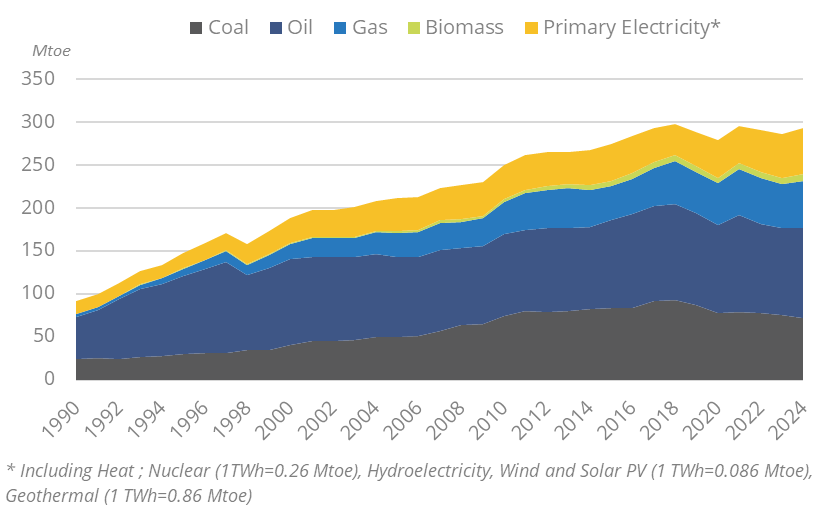
Total energy consumption increased by 2.3% in 2024 to 293 Mtoe, after two years of decrease (-1.6%/year of over 2021-2023); it remained slightly lower than its 2018 peak.
Per capita consumption was 5.7 toe/cap in 2024, which is more than three times the Asian average.
Graph: Primary Consumption Trends by Energy Source
Source: South Korea energy report
Interactive Chart South Korea Total Energy Production & Consumption
Source: Global Energy & CO2 data
Benefit from up to 2 000 up-to-date data series for 186 countries in Global Energy & CO2 data
View the detailed fondamentals of the market at country level (graphs, tables, analysis) in the South Korea energy report
South Korea Oil Production & Consumption
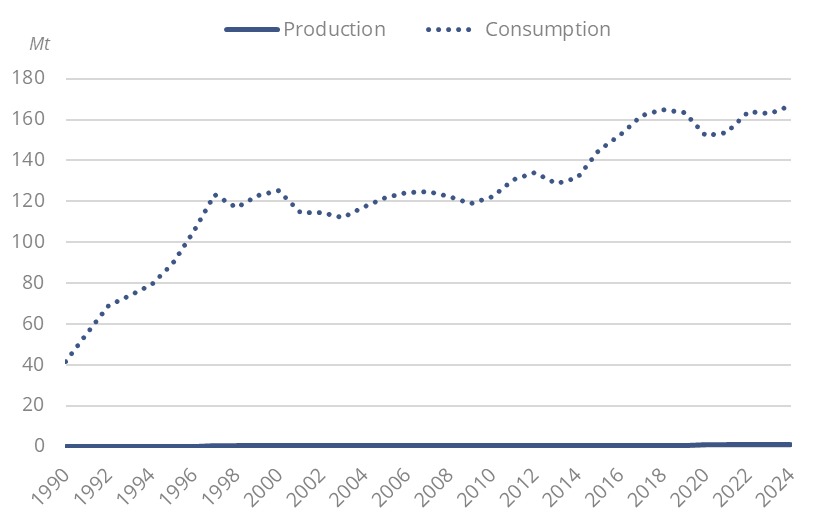
Korea depends on imports to meet its crude oil demand, mostly from the Middle East. Crude oil and NGL imports increased by 2% in 2024 to 140 Mt, close to 2019 levels after a significant drop in 2020 and 2021.
Crude oil and NGL consumption increased by 2.5% in 2024 to 167 Mt, exceeding the 2018 peak. The increase is close to the 2010-2023 average.
Graph: Crude Oil Production & Consumption
Source: South Korea energy report
Interactive Chart South Korea Crude Oil Production & Consumption
Source: Global Energy & CO2 data
Interactive Chart South Korea Refined Oil Products Production & Consumption
Source: Global Energy & CO2 data
Benefit from up to 2 000 up-to-date data series for 186 countries in Global Energy & CO2 data
Additionally, for more detailed information on refineries, you can request a sample of our Asia Refineries Dataset
South Korea Natural Gas Production & Consumption
Gas production is negligible. The offshore gas field of Dong-Hae 1 entered into servicein 2004, producing around 0.15 bcm/year, i.e. less than 1% of total gas consumption.
The country started to import LNG in 1986. The volumes of LNG imports increased by 4.5%/year between 2019 and 2022. They returned to their 2022 level in 2024 to 67 bcm, after a 5% decrease in 2023. South Korea is the world's third largest LNG importer, after China and Japan.
In 2024, the main suppliers of LNG were Australia (24%), Qatar (19%), Malaysia (14%), the United States (12%), and Oman (10%).
Source: South Korea energy report
Interactive Chart South Korea Gas Production & Consumption
Source: Global Energy & CO2 data
Benefit from up to 2 000 up-to-date data series for 186 countries in Global Energy & CO2 data
Additionally, for more detailed information on the LNG trade, you can request a sample of our Asia LNG Trade Dataset
South Korea Coal and Lignite Production & Consumption
The country imports most of its coal, as production is low and decreasing (0.6 Mt in 2024). Coal imports are generally decreasing since 2019 (-4%/year) and reached 116 Mt in 2024.
Coal consumption fell by 6.4% in 2024 to 105 Mt, close to 2008 levels. After increasing by around 2%/year over 2010-2018, it has fallen significantly by 5.6%/year since then.
Power plants accounted for 64% of coal consumption in 2024 (-7 pp vs 2018) and industry for 13%.
Graph: Coal Production & Consumption
Source: South Korea energy report
Interactive Chart South Korea Coal and Lignite Production & Consumption
Source: Global Energy & CO2 data
Benefit from up to 2 000 up-to-date data series for 186 countries in Global Energy & CO2 data
View the detailed consumption trends at country level (graphs, tables, analysis) in the South Korea energy report
South Korea Renewable in % Electricity Production
KEA, Korea Energy Agency, supports and promotes new and renewable energies.
The 11th Basic Plan for Long-Term Electricity Demand and Supply (BPLE, February 2025) set a renewables target of 22% of the power mix in 2030 and 33% in 2038, up from 9% in 2024. MCEE plans to add 40 GW of renewables by 2030, generating 134 TWh in 2030 (232 TWhin 2038).
Source: South Korea energy report
Interactive Chart South Korea Share of Renewables in Electricity Production (incl hydro)
Source: Global Energy & CO2 data
Benefit from up to 2 000 up-to-date data series for 186 countries in Global Energy & CO2 data
Learn more about renewables in the Mini grid Africa & Asia markets for village electrification
South Korea GHG emissions and CO2 emissions
In its last NDC (November 2025), the country plans to reduce its GHG emissions by 53% to 61% by 2035 relative to 2018. In the previous NDC, the objective was a 40% reduction in 2030 (excl. LULUCF). In 2020, the country also committed to achieving carbon neutrality by 2050.
Source: South Korea energy report
Interactive Chart South Korea CO2 emissions
Source: Global Energy & CO2 data
Benefit from up to 2 000 up-to-date data series for 186 countries in Global Energy & CO2 data
View the detailed consumption trends at country level (graphs, tables, analysis) in the South Korea energy report