Colombia Key Figures
- Population:
- 52.9 million
- GDP growth rate:
- 1.74 %/year
- Energy independence:
- 100%
Data of the last year available: 2024
- Total consumption/GDP:*
- 96.7 (2015=100)
- CO2 Emissions:
- 1.74 tCO2/cap
- Rate of T&D power losses:
- 7.96%
* at purchasing power parity
View all macro and energy indicators in the Colombia energy report
Colombia Energy News
View all news, archive your new and create your own daily newsletters only on your topics/countries of interest with Key Energy Intelligence
Colombia Energy Research
- Colombia's Energy & Climate Policy Framework: Colombia aims to cut GHG emissions by 51% by 2030, phase out unabated coal by 2030, and halt new oil/gas exploration. The energy sector is overseen by the Ministry of Mines and Energy, with UPME coordinating planning and CREG regulating energy markets. The country plans to invest USD 40bn in sustainable energy, including renewables, green hydrogen, and electromobility.
- Colombia's Energy Companies: In Colombia, EPM, Enel, and Isagen dominate electricity generation, while Ecopetrol leads oil, gas, and coal sectors. Drummond and Cerrejón control 75% of coal production.
- Colombia's Energy Supply & Demand: Colombia's energy mix is dominated by hydroelectricity (55-80%), with oil, gas, and coal also significant. Total energy consumption rose 3.5% annually since 2020, reaching 48 Mtoe in 2024. Oil leads consumption (42%), followed by gas (21%) and coal (15%). Electricity capacity increased 54% since 2010, with hydroelectricity accounting for 62%. Oil production decreased slightly in 2024, while coal production remained stable. The country has substantial energy resources, including large oil, gas, and coal reserves, as well as significant hydro and wind potential.
- Colombia's Energy Use & Price by Sector: Oil dominates energy use (43%), with transport as the largest consumer (38%). Prices have risen, notably for gasoline, with diesel set to follow in 2025. Final energy demand has stabilised post-COVID.
- Colombia's Issues & Prospects: Colombia's National Energy Plan targets 19 GW of renewable capacity by 2050, with significant investments in solar, wind, and gas projects. Electricity demand is projected to rise, driven by renewables, while CO2 emissions are expected to fall by 46-83%. Key initiatives include expanding transmission infrastructure and developing offshore wind and LNG terminals. Ecopetrol focuses on gas exploration and energy transition, with notable discoveries in the Caribbean Sea. Coal production is set to decline, and green hydrogen projects are under development.
Benefit from up to 2 000 up-to-date data series for 186 countries in Global Energy & CO2 data
A data overview is available in the global energy statistics app
Colombia Total Energy Production & Consumption
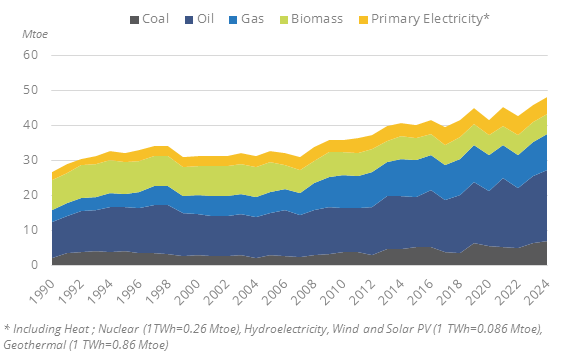
Total energy consumption has increased by around 3.5%/year since 2020, reaching 48 Mtoe in 2024. Previously, it had fluctuated around 39-44 Mtoe between 2015 and 2019 and dropped by 8% in 2020. Per capita consumption is around 0.9 toe and 1 600 kWh in 2024.
Graph: Primary Consumption Trends by Energy Source
Source: Colombia energy report
Interactive Chart Colombia Total Energy Production & Consumption
Source: Global Energy & CO2 data
Benefit from up to 2 000 up-to-date data series for 186 countries in Global Energy & CO2 data
View the detailed fondamentals of the market at country level (graphs, tables, analysis) in the Colombia energy report
Colombia Oil Production & Consumption
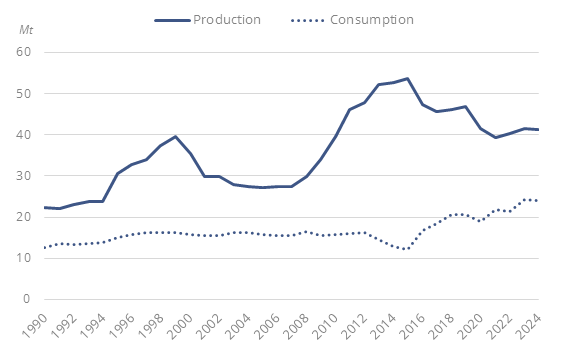
Oil production decreased slightly to 41 Mt in 2024, after 3%/year growth from 2021 to 2023. Previously, it peaked at 54 Mt in 2015 and decreased by 27% until 2021. Its 2024 level is 24% below its peak.
Graph: Crude Oil Production & Consumption
Source: Colombia energy report
Interactive Chart Colombia Crude Oil Production & Consumption
Source: Global Energy & CO2 data
Interactive Chart Colombia Refined Oil Products Production & Consumption
Source: Global Energy & CO2 data
Benefit from up to 2 000 up-to-date data series for 186 countries in Global Energy & CO2 data
Additionally, for more detailed information on refineries, you can request a sample of our America Refineries Dataset
Colombia Natural Gas Production & Consumption
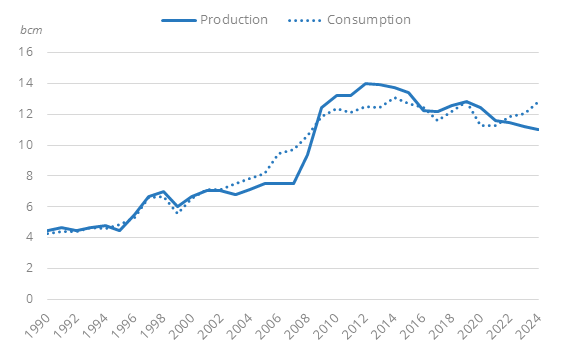
Natural gas production has been decreasing by 3%/year since 2019, resching 11 bcm in 2024; it reached a peak in 2012 at 14 bcm. Since 2022, production does not meet demand and LNG imports are increasing rapidly.
Graph: Gas Production & Consumption
Source: Colombia energy report
Interactive Chart Colombia Gas Production & Consumption
Source: Global Energy & CO2 data
Benefit from up to 2 000 up-to-date data series for 186 countries in Global Energy & CO2 data
Additionally, for more detailed information on the LNG trade, you can request a sample of our America LNG Trade Dataset
Colombia Coal and Lignite Production & Consumption
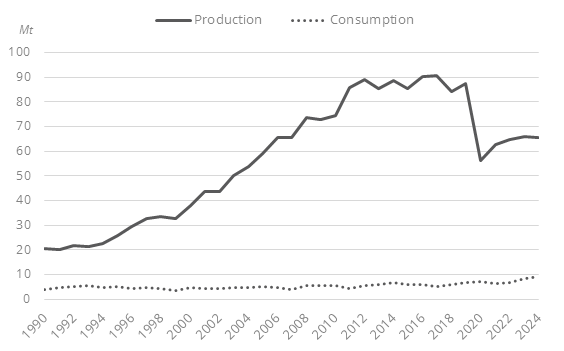
In 2024, coal production remained stable (66 Mt), after a light post-COVID upward trend. Coal production peaked in 2017 (91 Mt) and collapsed in 2020 (-41%). Production is mainly exported (around 95% since 2021).
Graph: Coal Production & Consumption
Source: Colombia energy report
Interactive Chart Colombia Coal and Lignite Production & Consumption
Source: Global Energy & CO2 data
Benefit from up to 2 000 up-to-date data series for 186 countries in Global Energy & CO2 data
View the detailed consumption trends at country level (graphs, tables, analysis) in the Colombia energy report
Colombia Renewable in % Electricity Production
In 2014, Colombia passed a law aimed at encouraging the penetration of non-conventional renewable energy sources, referred to as FNCER (Fuentes No Convencionales de Energía Renovable). FNCER include biomass, small hydro, wind, solar, and tidal energy, as well as green and blue hydrogen since 2022.
The objective of the National Development Plan 2022-2026 for 2 300 MW of FNCER in 2026 is on track, since close to 80% of the target was met at the end of 2024.
Source: Colombia energy report
Interactive Chart Colombia Share of Renewables in Electricity Production (incl hydro)
Source: Global Energy & CO2 data
Benefit from up to 2 000 up-to-date data series for 186 countries in Global Energy & CO2 data
Colombia GHG emissions and CO2 emissions
According to its first NDC update (2020), Colombia has pledged to cut GHG emissions by at least 51% in 2030 compared to a BAU scenario (equivalent to 170 MtCO2eq of emissions). It is also committed to reducing black carbon by 40% compared to 2014 levels. In 2021, the government launched the Carbon Neutral Colombia strategy with the aim of reaching carbon neutrality by 2050, which corresponds to a 90% emissions reduction compared to 2015.
Source: Colombia energy report
Interactive Chart Colombia CO2 emissions
Source: Global Energy & CO2 data
Benefit from up to 2 000 up-to-date data series for 186 countries in Global Energy & CO2 data
View the detailed consumption trends at country level (graphs, tables, analysis) in the Colombia energy report