The Ministry of Coal of India has withdrawn the Bander coal mine from a list of 41 coal blocks to be sold in an auction for commercial mining launched in June 2020. The Bander coal mine is estimated to hold over 126 Mt of coal reserves, enough to produce 2 Mt/year at peak capacity, but it is located near a tiger reserve in the Chandrapur district of Maharashtra, in central India, prompting the government to withdraw it from the auction.
In June 2020, India launched the auction process of 41 coal blocks for commercial mining. The mines will require an investment of around INR330bn (US$4.4bn) over the next five to seven years and should reach peak production of 225 Mt, accounting for 15% of the country's total coal output in 2025-2026. Four projects have been identified and could gasify around 100 Mt of coal by 2030 at a cost of INR200bn (US$2.6bn).
Meanwhile, the Union Home Ministry has announced plans to raise the domestic coal production to 1 Gt/year by 2023-2024, in an attempt to reduce coal imports to zero. India currently imports around 235 Mt/year of coal, with around half of this amount tied to power plants or user plants and non-substitutable. The government aims at stopping most of substitutable coal imports and bets on the higher domestic production. In January 2020, it promulgated the Mineral Laws (Amendment) Ordinance 2020 that aims at attracting investors in the coal mining sector by removing restrictions on end-use and prior experience in coal auctions. India's coal production is expected to reach 700 Mt in the current fiscal year (April 2020-March 2021), corresponding to a 16% annual increase.
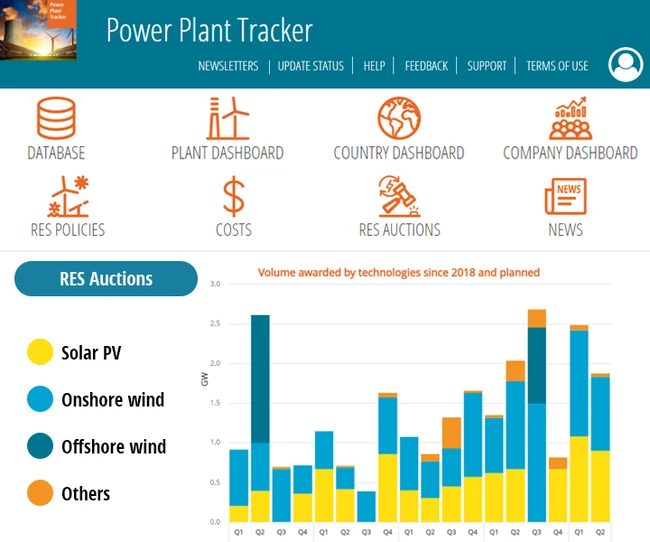
Do you want to become an expert on renewable energies auctions?
Discover our very detailed and regularly updated RES auctions database with worldwide coverage and a technical focus backed by academic research.
With our renewable energies auctions service you will be able to monitor auctions at a global level. Its (expanding) scope notably includes all major G20 countries and offers an especially fine tracking on Europe and South America.