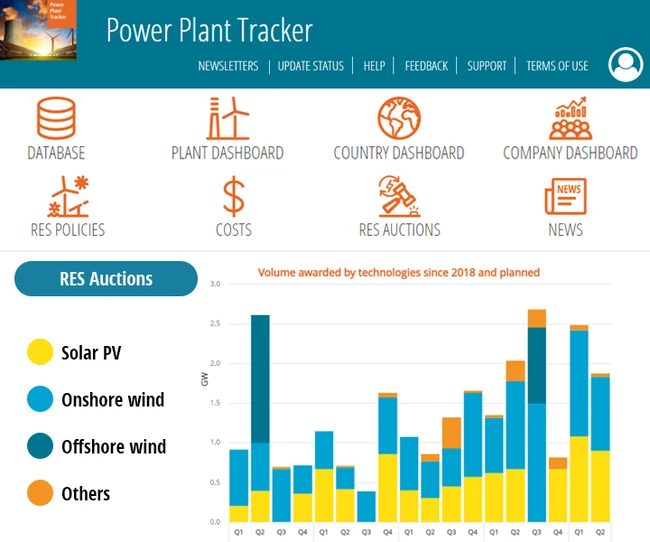
The German Federal network regulator (Bundesnetzagentur or BNetzA) published the results of the October 2017 solar PV auction round. In total, the BNetzA received 110 bids with a total volume of 754 MW and the average bid size was 6.9 MW. Only 20 bids won the round and a total capacity of 222 MW has been awarded. The maximum bidding price during this tender was previously set at €8.84c/kWh. The average bidding rate dropped further by €75c/kWh compared with the previous round and reached €4.91c/kWh (€49.1/MWh). The highest bid achieved €5.06c/kWh and the lowest one €4.29c/kWh. Three out of the 20 successful bids obtained a volume higher than 20 MW.
The last tenders took place in January 2017 and June 2017 while the awarded capacities amounted respectively 200 MW and 201 MW. The German solar market is becoming increasingly competitive and showed strong cost reduction. In June 2017, bidding rates dropped to an average of €5.66c/kWh (from €6.58c/kWh in January 2017), while the highest aggregate value of the tender reached only €5.9c/kWh (€6.00c/kWh in January).
Since the beginning of 2017, solar and wind power projects bigger than 750 kW have to compete in tenders in order to secure power purchase deals, as feed-in tariff (FiT) contracts are no longer available.
-
-
Energy and Climate Databases- The most comprehensive and up-to-date annual energy database.
- Monitoring of technology providers in H2 supply chain.
- Monthly energy data on key energy markets.
- Monitoring of Hydrogen and Derivatives Projects
- The most reliable and up-to-date power generation database.
- The essentials of LNG trade at your fingertips.
- Global monitoring of new and existing refineries.
- Analyse energy consumption and efficiency trends at world level. Benchmark countries.
- Have your database developed by a recognised expert of both energy and IT.
-
Energy - Climate Forecasts- Future carbon costs with reliable price forecasts
- Instant access to energy and emissions forecasts.
- Annual projections of wholesale prices up to 2050, based on a 360° approach of the energy markets, enabled by the globally recognised POLES model.
- Wedges module showing a breakdown of the levers enabling to reduce emissions between two scenarios.
- Unique, independent projections of consumption by end-use.
- GHG Marginal Abatement Cost Curves.
- Benefit from proven models to draw your own energy scenarios and anticipate tomorrow’s challenges.
-
Market Intelligence- 110 Energy and climate country reports.
- Tracking trends, EPCs, and national subsidy schemes for residential buildings.
- Daily brief covering the entirety of the turbine industry.
- A newsletter to receive the latest updates on evolving technologies and policies.
- Global energy news and analyses curated daily.
- Enerdata’s experts bring you the essentials about your market and competitors.
-
-
-
Market Analysis- Understanding key consumption trends and drivers across sectors.
- Granular and exclusive insight to address the most pressing business and strategic issues.
- Expertise in strategic and business intelligence, with fine-tuning to the market’s specificities.
-
Energy - Climate Scenarios- Providing the outlook of an energy commodity in mid to long term time horizons.
- Sector and driver specific energy demand forecasting.
- Assess the evolution of energy prices on the international and regional markets, as well as end-users prices.
- Enerdata guides you through pathways to reach climate targets.
- Supporting local authorities in their decarbonisation strategies.
-
Climate Strategy and Policy Evaluation- Cutting-edge quantitative tools and relevant indicators to monitor and evaluate evolutions on worldwide energy markets.
- Analysis of the most cost-effective options to reduce emissions.
- Quantified simulation and analysis of pledges for climate change negotiations.
- Breakdown of carbon markets and evaluation of the climate change impacts on the carbon price.
- Enerdata guides you on the most beneficial policy or investment options.
- Turning climate objectives into concrete action plans.
-
Training- Understand different policy targets and measures on energy efficiency.
- How to measure energy savings?
- Energy Forecasting is a 2 days training to learn to design and interpret energy forecasts.
- Energy statistics training allowing to create energy balance with supply, transformation and consumption and understanding the international energy statistics regulations.
- Initiation to EnerMED level 1is the training to approach on the most powerful energy demand forecasting model.
-
-
Resource Centre