Uruguay Key Figures
- Population:
- 3.39 million
- GDP growth rate:
- 3.11 %/year
- Energy independence:
- 67.5%
Data of the last year available: 2024
- Total consumption/GDP:*
- 116 (2015=100)
- CO2 Emissions:
- 1.99 tCO2/cap
- Rate of T&D power losses:
- 9.91%
* at purchasing power parity
View all macro and energy indicators in the Uruguay energy report
Uruguay Energy News
View all news, archive your new and create your own daily newsletters only on your topics/countries of interest with Key Energy Intelligence
Uruguay Energy Research
- Uruguay's Energy & Climate Policy Framework: Uruguay's energy policy aims to diversify its mix, reduce oil and hydro reliance, and boost efficiency. It has achieved 53% renewables in primary consumption and targets green hydrogen production. Nuclear is banned, and energy efficiency measures are in place. The country aims for carbon neutrality by 2050.
- Uruguay's Energy Companies: UTE dominates Uruguay's electricity market, supplying 63% of the country's power, including hydro and wind. ANCAP leads oil and gas, managing exploration, refining, and distribution. Both entities control transmission and distribution networks.
- Uruguay's Energy Supply & Demand: In 2024, Uruguay's energy mix was dominated by renewables (99%), with biomass leading at 53%. Total energy consumption rose to 6.7 Mtoe, driven by increased biomass and primary electricity. Hydropower and wind were key electricity sources, while oil's share declined. Uruguay exports electricity and imports crude oil, with GHG emissions stable around 40 MtCO2eq.
- Uruguay's Energy Use & Price by Sector: Since 2023, final energy consumption has surged by 11% annually, driven by industry (50% of demand), with biomass as the primary source. Energy prices remain high in South America, with regulated costs for electricity and gas. Transport and residential sectors show moderate growth, with oil and electricity as dominant fuels.
- Uruguay's Issues & Prospects: Uruguay is advancing its energy sector with green hydrogen projects, offshore hydrocarbon exploration, and hydropower modernisation. The country plans to expand wind, solar, and gas power capacity while exploring domestic gas reserves to reduce import dependence. A USD 10M pilot project aims to decarbonise heavy transport, and a USD 6B green hydrogen plant is under development.
Benefit from up to 2 000 up-to-date data series for 186 countries in Global Energy & CO2 data
A data overview is available in the global energy statistics app
Uruguay Total Energy Production & Consumption
Total energy consumption rose to 6.7 Mtoe in 2024 (+7%), after an 11% jump in 2023 and stability in 2022; it rose by 2.7%/year on average from 2010 to 2021. The average consumption per capita stood at 2 toe in 2024, up from 1.5 toe in 2015 (+29%).
Source: Uruguay energy report
Interactive Chart Uruguay Total Energy Production & Consumption
Source: Global Energy & CO2 data
Benefit from up to 2 000 up-to-date data series for 186 countries in Global Energy & CO2 data
View the detailed fondamentals of the market at country level (graphs, tables, analysis) in the Uruguay energy report
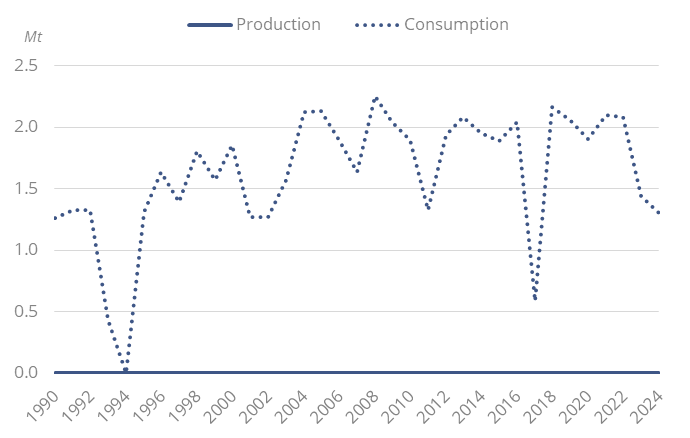
Uruguay Oil Production & Consumption
Uruguay doesn't produce any crude oil, although some exploration rounds have been launched off the country's coasts since 2009.
The country imports crude oil to produce petroleum products from its only refinery in Teja, which has a distillation capacity of 50 kb/d. Uruguay imports crude oil mainly from Nigeria and Argentina, also from Azerbaijan, Kazakhstan, and the United States.
Graph: Crude Oil Production & Consumption
Source: Uruguay energy report
Interactive Chart Uruguay Crude Oil Production & Consumption
Source: Global Energy & CO2 data
Interactive Chart Uruguay Refined Oil Products Production & Consumption
Source: Global Energy & CO2 data
Benefit from up to 2 000 up-to-date data series for 186 countries in Global Energy & CO2 data
Additionally, for more detailed information on refineries, you can request a sample of our America Refineries Dataset
Uruguay Natural Gas Production & Consumption
In 2008, an important offshore gas reserve was discovered approximately 100 km off Punta del Este. Exploration started in 2010, but gas has not yet been produced.
The country imports small quantities of gas from Argentina (between 50 mcm and 100 mcm depending on the year), through two gas pipes: the first one entered into service in 1998 (northern gas pipeline, capacity of 700 000 m³/d and length of 20 km) and the second onein 2002, Gasoducto Cruz del Sur (capacity of 6 mcm/d).
Graph: Gas Production & Consumption
Source: Uruguay energy report
Interactive Chart Uruguay Gas Production & Consumption
Source: Global Energy & CO2 data
Benefit from up to 2 000 up-to-date data series for 186 countries in Global Energy & CO2 data
Additionally, for more detailed information on the LNG trade, you can request a sample of our America LNG Trade Dataset
Uruguay Renewable in % Electricity Production
The target set in the National Energy Policy 2005-2030 to reach a 50% share of renewables in total primary consumption in 2015 (compared with 35% in 2005) was achieved in 2014 with renewables accounting for 53% of the primary consumption; the additional goal of 1.2 GW of wind capacity was reached in 2016.
Foreign investments in renewables are made through the Investment, Export, and Country Brand Agency.
Source: Uruguay energy report
Interactive Chart Uruguay Share of Renewables in Electricity Production (incl hydro)
Source: Global Energy & CO2 data
Benefit from up to 2 000 up-to-date data series for 186 countries in Global Energy & CO2 data
Uruguay GHG emissions and CO2 emissions
In its third NDC (NDC3, December 2024), the country has postponed its unconditional cap on energy-related emissions of 9.3 MtCO2 to 2035, from 2030 in the second NDC (2022), and an additional effort of 0.96 MtCO2 conditional on aid. It also extends to 2035 the 2030 cap on CH4 emissions (at 818 Mt) and N2O emissions (32 Mt).
In its first NDC (2017), Uruguay targeted a 24% reduction in CO2 energy-related emissions by 2025 compared to 1990 levels (29% with international aid). The NDC also included targets for other GHG.
Source: Uruguay energy report
Interactive Chart Uruguay CO2 emissions
Source: Global Energy & CO2 data
Benefit from up to 2 000 up-to-date data series for 186 countries in Global Energy & CO2 data
View the detailed consumption trends at country level (graphs, tables, analysis) in the Uruguay energy report