Serbia Key Figures
- Population:
- 6.62 million
- GDP growth rate:
- 3.85 %/year
- Energy independence:
- 60.4%
Data of the last year available: 2023
- Total consumption/GDP:*
- 81.1 (2015=100)
- CO2 Emissions:
- 6.71 tCO2/cap
- Rate of T&D power losses:
- 12.1%
* at purchasing power parity
View all macro and energy indicators in the Serbia energy report
Serbia Energy News
View all news, archive your new and create your own daily newsletters only on your topics/countries of interest with Key Energy Intelligence
Serbia Energy Research
- Serbia's Energy & Climate Policy Framework: Serbia is aligning its energy and climate policies with EU standards, adopting its NECP in 2024 and amending its Energy Law to permit nuclear energy. The Ministry of Mining and Energy oversees policy through six departments, while AERS regulates the energy sector. Serbia, an EU candidate, is part of the Energy Community Treaty, requiring adoption of EU legislation. Recent updates to the Energy Law focus on harmonisation, independent oversight, and carbon neutrality. The NECP sets CO2, energy efficiency, and renewable targets for 2030, with strategies to phase out coal and lignite. The energy market is liberalised, with ongoing efforts to integrate with the EU market. Renewable energy targets aim for 33.6% of final energy consumption by 2030, supported by auctions and feed-in tariffs. Serbia also plans to develop green hydrogen and nuclear energy, while enhancing energy efficiency and climate change mitigation efforts.
- Serbia's Energy Companies: In Serbia, EPS dominates electricity (90% market share) and plans to invest EUR 4.8bn in renewables. Srbijagas leads gas (80% sales), while NIS, majority-owned by Gazprom, is the primary oil supplier. The government aims to reduce reliance on Russian energy.
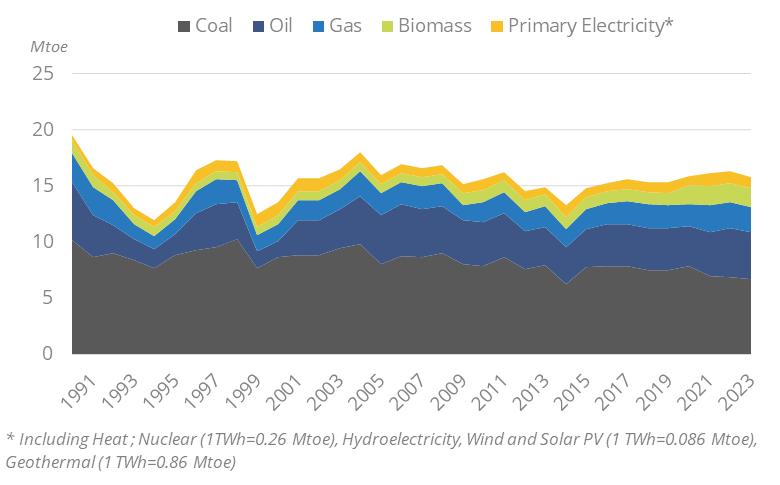
- Serbia's Energy Supply & Demand: Serbia's energy mix relies heavily on lignite, with hydropower playing a significant role. Total energy consumption has fluctuated, with a recent decline in 2023. Coal and lignite dominate primary energy use, followed by gas, oil, biomass, and hydropower. The country has limited oil and gas reserves but substantial lignite reserves. Electricity generation is influenced by hydrological conditions, with lignite and hydropower being the primary sources. Serbia is interconnected with nine countries for electricity transmission and has diversified its energy imports, including oil and gas, to reduce dependency on Russia.
- Serbia's Energy Use & Price by Sector: In 2023, Serbia's final energy consumption decreased by 2.6% to 9.9 Mtoe, with oil dominating usage. Electricity and gas prices surged but remained below EU averages. Industrial and residential sectors saw significant price hikes, while transport fuel prices hit record highs.
- Serbia's Issues & Prospects: Serbia is expanding its energy sector with significant wind and solar projects, while modernising power plants and enhancing transmission networks. The country aims for 50% renewables in final energy consumption by 2040 and climate neutrality by 2050, replacing coal with up to 22 GW of renewable capacity. Gas and hydropower projects are also under development, alongside plans for modular nuclear power plants.
Benefit from up to 2 000 up-to-date data series for 186 countries in Global Energy & CO2 data
A data overview is available in the global energy statistics app
Serbia Total Energy Production & Consumption
Energy consumption per capita amounts to 2.4 toe (14% below the EU average in 2023).
Total energy consumption has hovered around 16 Mtoe since 2005, with a 2.6%/year increase between 2014 (energy supply problems due to massive floods) and 2022 and a 3.3% drop in 2023 to 15.8 Mtoe.
Graph: Primary Consumption Trends by Energy Source
Source: Serbia energy report
Interactive Chart Serbia Total Energy Production & Consumption
Source: Global Energy & CO2 data
Benefit from up to 2 000 up-to-date data series for 186 countries in Global Energy & CO2 data
View the detailed fondamentals of the market at country level (graphs, tables, analysis) in the Serbia energy report
Serbia Oil Production & Consumption
Oil fields are located in Vojvodine, in the north of the country. Crude oil production, which had been declining by 3.8%/year between 2013 and 2022 (-30%), remained stable in 2023 at 877 Mt and dipped by 1.5% in 2024, according to preliminary estimates. It nearly doubled between 2008 and 2013, following the acquisition of NIS by Gazprom. Production covered 21% of domestic oil supply in 2023 and around 22% in 2024.
Source: Serbia energy report
Interactive Chart Serbia Crude Oil Production & Consumption
Source: Global Energy & CO2 data
Interactive Chart Serbia Refined Oil Products Production & Consumption
Source: Global Energy & CO2 data
Benefit from up to 2 000 up-to-date data series for 186 countries in Global Energy & CO2 data
Additionally, for more detailed information on refineries, you can request a sample of our EMEA Refineries Dataset
Serbia Natural Gas Production & Consumption
Gas production has been decreasing rapidly since 2015 (-7.2%/year) to 315 mcm in 2023(-4% in 2023), i.e., 11% of the consumption; according to preliminary estimates, it declined again in 2024 (-11%). Gas production more than doubled between 2007 and 2015.
Source: Serbia energy report
Interactive Chart Serbia Gas Production & Consumption
Source: Global Energy & CO2 data
Benefit from up to 2 000 up-to-date data series for 186 countries in Global Energy & CO2 data
Additionally, for more detailed information on the LNG trade, you can request a sample of our EMEA LNG Trade Dataset
Serbia Coal and Lignite Production & Consumption
Lignite production, which had recovered significantly between 2014 (when it fell by 26% to 30 Mt due to floods) and 2020 (40 Mt), has been declining since then to 32 Mt in 2023. It is carried out in two open sky mines: Kolubara (more than ¾ of production) and Kostolac. According to preliminary estimates, lignite production remained stable in 2024.
Source: Serbia energy report
Interactive Chart Serbia Coal and Lignite Production & Consumption
Source: Global Energy & CO2 data
Benefit from up to 2 000 up-to-date data series for 186 countries in Global Energy & CO2 data
View the detailed consumption trends at country level (graphs, tables, analysis) in the Serbia energy report
Serbia Renewable in % Electricity Production
The final NECP (2024) sets a target of 33.6% of renewables in final energy consumption in 2030 (45% for electricity, 41% for heating and cooling, and 7% for transport), which is below the target set by the Energy Community (40.7%). In 2023, this share averaged 25% (31.7% for electricity, 35.9% for heating, and 0.6% for transport). The NECP aims to add around 3.5 GW of new solar and wind power capacity by 2030.
Source: Serbia energy report
Interactive Chart Serbia Share of Renewables in Electricity Production (incl hydro)
Source: Global Energy & CO2 data
Benefit from up to 2 000 up-to-date data series for 186 countries in Global Energy & CO2 data
Learn more about renewables in the European Battery Market Analysis
Serbia GHG emissions and CO2 emissions
In its updated NDC (2022), Serbia raised its GHG emissions reduction target to 33.3% by 2030 compared with 1990 levels or 13% compared to 2010.
In its NECP (2024), Serbia raised its GHG emission reduction target by 2030 to 40.3% (compared to 1990 levels). The Low Carbon Development Strategy for 2023-2030, with Projections until 2050 (2023), indicated a reduction target of 55-69% by 2050 compared to 2010.
Source: Serbia energy report
Interactive Chart Serbia CO2 emissions
Source: Global Energy & CO2 data
Benefit from up to 2 000 up-to-date data series for 186 countries in Global Energy & CO2 data
View the detailed consumption trends at country level (graphs, tables, analysis) in the Serbia energy report