Bosnia And Herzegovina Key Figures
- Population:
- 3.16 million
- GDP growth rate:
- 2.48 %/year
- Energy independence:
- 75.0%
Data of the last year available: 2024
- Total consumption/GDP:*
- 92.4 (2015=100)
- CO2 Emissions:
- 5.45 tCO2/cap
- Rate of T&D power losses:
- 10.1%
* at purchasing power parity
View all macro and energy indicators in the Bosnia and Herzegovina energy report
Bosnia And Herzegovina Energy News
View all news, archive your new and create your own daily newsletters only on your topics/countries of interest with Key Energy Intelligence
Bosnia And Herzegovina Energy Research
- Bosnia-Herzegovina's Energy & Climate Policy Framework: Bosnia and Herzegovina's fragmented administrative structure and lack of political will hinder national energy policy implementation. Despite EU commitments, progress on transposing energy laws remains slow, with the country lagging in adopting the EU’s third energy package. Recent efforts include draft energy and climate plans, regulatory updates, and renewable energy targets, but challenges persist in achieving energy efficiency and emissions reduction goals.
- Bosnia-Herzegovina's Energy Companies: Bosnia's power sector comprises three state-owned monopolies with regional dominance, delayed unbundling, and limited competition. Oil exploration is active, while gas and coal sectors are state-controlled with notable inefficiencies.
- Bosnia-Herzegovina's Energy Supply & Demand: Bosnia and Herzegovina relies heavily on lignite (60-70% of power mix) and hydro for energy, with declining consumption since 2018. It exports electricity, primarily to Croatia, Montenegro, and Serbia. Energy intensity remains high, and emissions have decreased since 2018.
- Bosnia-Herzegovina's Energy Use & Price by Sector: Energy demand in Bosnia and Herzegovina has shifted, with households and services now the largest consumers, while industry and transport have declined. Electricity and oil products have decreased, with biomass rising significantly. Energy prices for households remain regulated and lower than EU averages, while industrial prices are deregulated but still below EU levels.
- Bosnia-Herzegovina's Issues & Prospects: Bosnia and Herzegovina plans to expand electricity and gas interconnections with neighbours, with significant renewable energy projects and transmission upgrades underway. Electricity demand is projected to grow modestly, while coal plants face closures. Key solar and wind projects are in development, alongside hydropower and gas pipeline initiatives. Transmission capacity is set to increase, enhancing regional energy integration.
Benefit from up to 2 000 up-to-date data series for 186 countries in Global Energy & CO2 data
A data overview is available in the global energy statistics app
Bosnia And Herzegovina Total Energy Production & Consumption
The country's total consumption has been declining since 2018 (-2%/year), reaching 6.6 Mtoe in 2024 (-4.8% in 2024 alone, third decrease in a row). It had surged very rapidly between 1995 and 2018 (+7%/year), despite a sharp drop in 2012-2013 (-5%/year). The country's overall consumption per capita is 2.1 toe (19% below the EU average in 2024). The energy intensity is twice as high as the EU average (at purchasing power parity) and declining at a slower pace (-1.5%/year over 2010-2024 compared to -2.9%/year in the EU).
Graph: Primary Consumption Trends by Energy Source
Source: Bosnia and Herzegovina energy report
Interactive Chart Bosnia And Herzegovina Total Energy Production & Consumption
Source: Global Energy & CO2 data
Benefit from up to 2 000 up-to-date data series for 186 countries in Global Energy & CO2 data
View the detailed fondamentals of the market at country level (graphs, tables, analysis) in the Bosnia and Herzegovina energy report
Bosnia And Herzegovina Oil Production & Consumption
The 4.2 Mt/year Bosanski Brod refinery (Republic of Srpska) has been idle since an emergency shutdown in 2018 and production has not restarted yet. Oil product imports have increased by 44% since 2018 to 1.6 Mt on average (1.6 Mt in 2024).
Oil product consumption tripled between 1995 and 2011 (1.7 Mt) and has averaged 1.6 Mt since 2016.
Graph: Crude Oil Production & Consumption
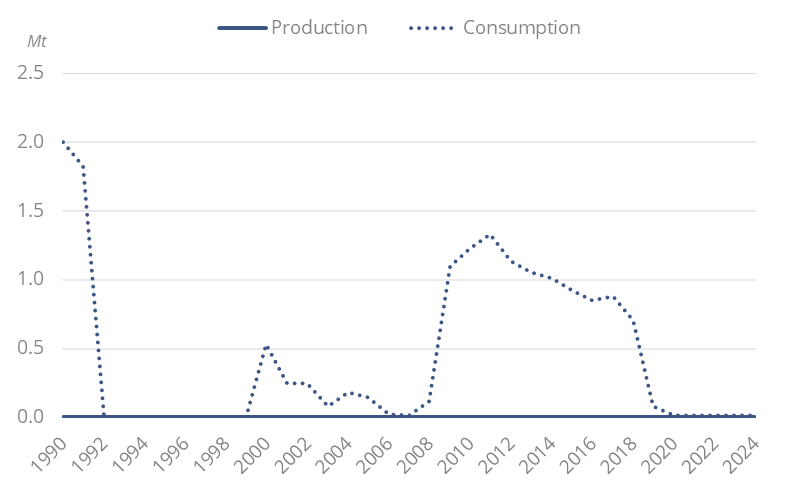
Graph: Petroleum Products Production & Consumption
Source: Bosnia and Herzegovina energy report
Interactive Chart Bosnia And Herzegovina Crude Oil Production & Consumption
Source: Global Energy & CO2 data
Interactive Chart Bosnia And Herzegovina Refined Oil Products Production & Consumption
Source: Global Energy & CO2 data
Benefit from up to 2 000 up-to-date data series for 186 countries in Global Energy & CO2 data
Additionally, for more detailed information on refineries, you can request a sample of our EMEA Refineries Dataset
Bosnia And Herzegovina Natural Gas Production & Consumption
All the gas is imported by BH Gas from Russia through Hungary and Serbia. Gas imports have been averaging 250 mcm/year since 2000. Gas imports dipped by 10% to 223 mcm in 2023 and remained stable in 2024.
In 2015, Gazprom signed a contract with GAS RES, to supply 106 mcm of gas directly to the RS. In 2021, Gazprom started gas deliveries to Serbia and Bosnia and Herzegovina through the TurkStream gas pipeline that supplies 15.75 bcm/year to Bulgaria, Serbia, and Hungary. A 6 km long, 5.6 bcm/year gas pipeline between Bosanski Brod and Slobodnica in Croatia was completed in 2021.
Source: Bosnia and Herzegovina energy report
Interactive Chart Bosnia And Herzegovina Gas Production & Consumption
Source: Global Energy & CO2 data
Benefit from up to 2 000 up-to-date data series for 186 countries in Global Energy & CO2 data
Additionally, for more detailed information on the LNG trade, you can request a sample of our EMEA LNG Trade Dataset
Bosnia And Herzegovina Coal and Lignite Production & Consumption
Lignite production tends to follow the power sector demand. It nearly doubled between 2000 and 2018 (+3.8%/year) to 14.5 Mt, before declining by 2.5%/year until 2024 to 12.5 Mt. Production covers domestic consumption. Coal imports surged from less than 0.6 Mt in 2005 to 1.7 Mt in 2019 but have been declining since then (1 Mt in 2024).
After a ninefold increase between 1995 and 2018 (up to 15 Mt), coal and lignite consumption has been declining (-4.9%/year since 2020, including -5.9% in 2024 to 12 Mt).
Graph: Coal Production & Consumption
Source: Bosnia and Herzegovina energy report
Interactive Chart Bosnia And Herzegovina Coal and Lignite Production & Consumption
Source: Global Energy & CO2 data
Benefit from up to 2 000 up-to-date data series for 186 countries in Global Energy & CO2 data
View the detailed consumption trends at country level (graphs, tables, analysis) in the Bosnia and Herzegovina energy report
Bosnia And Herzegovina Renewable in % Electricity Production
Under its draft NECP (2023), Bosnia and Herzegovina aims to reach a share of 43.6% of renewables in final energy consumption by 2030 (up from 40% in 2023), including 70% for electricity, 61% for heating and cooling, and 8.4% for transport (52%, 60%, and 0.3%, respectively, in 2023). The 2020 target of the National Renewable Energy Action Plan (NREAP, 2016) of 40% of renewables in final energy consumption was reached.
Source: Bosnia and Herzegovina energy report
Interactive Chart Bosnia And Herzegovina Share of Renewables in Electricity Production (incl hydro)
Source: Global Energy & CO2 data
Benefit from up to 2 000 up-to-date data series for 186 countries in Global Energy & CO2 data
Learn more about renewables in the European Battery Market Analysis
Bosnia And Herzegovina GHG emissions and CO2 emissions
Under its draft NECP (2023), Bosnia and Herzegovina aims to cut its GHG emissions (including carbon sinks) by over 41% from the 1990 level to 15.65 MtCO2 in 2030; this draft target is not included in national legislation to date. In the long term, net emissions could be cut to 6.7 MtCO2 in 2040 and reach 0 in 2050, but the long-term strategy submitted to the UNFCCC only sets a reduction target of 80% by 2050 compared to 1990. It also plans to introduce the EU ETS model in the country by 2026 to avoid paying the EU's CBAM tax.
Source: Bosnia and Herzegovina energy report
Interactive Chart Bosnia And Herzegovina CO2 emissions
Source: Global Energy & CO2 data
Benefit from up to 2 000 up-to-date data series for 186 countries in Global Energy & CO2 data
View the detailed consumption trends at country level (graphs, tables, analysis) in the Bosnia and Herzegovina energy report