Albania Key Figures
- Population:
- 2.71 million
- GDP growth rate:
- 3.96 %/year
- Energy independence:
- 74.1%
Data of the last year available: 2024
- Total consumption/GDP:*
- 72.0 (2015=100)
- CO2 Emissions:
- 1.22 tCO2/cap
- Rate of T&D power losses:
- 13.2%
* at purchasing power parity
View all macro and energy indicators in the Albania energy report
Albania Energy News
View all news, archive your new and create your own daily newsletters only on your topics/countries of interest with Key Energy Intelligence
Albania Energy Research
- Albania's Energy & Climate Policy Framework: Albania is transposing EU energy acquis, liberalising its electricity market, and boosting renewables to become a regional energy leader by 2030.
- Albania's Energy Companies: **Summary:** Albania’s energy sector is dominated by state-run KESh (electricity) and Bankers Petroleum (oil/gas). Privatisation efforts face challenges.
- Albania's Energy Supply & Demand: Albania’s energy supply relies heavily on hydropower, with fluctuating output, while oil production declines. Total energy consumption has fallen since 2017, with per capita use significantly below the EU average. Electricity generation is dominated by hydropower (90%), supplemented by solar.
- Albania's Energy Use & Price by Sector: **Summary:** Final energy consumption stable at 2 Mtoe since 2010. Oil dominates (46%), followed by electricity (30%). Industry, transport, and households account for 25%, 32%, and 43% respectively. Prices liberalised, converging with EU levels.
- Albania's Issues & Prospects: Albania advances hydropower, solar, wind, and gas projects to meet rising energy demand and diversify its energy mix.
Benefit from up to 2 000 up-to-date data series for 186 countries in Global Energy & CO2 data
A data overview is available in the global energy statistics app
Albania Total Energy Production & Consumption
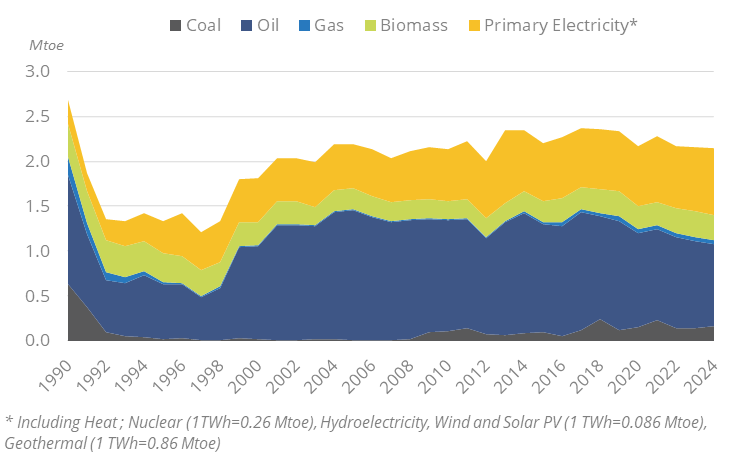
Total energy consumption has been declining overall by an average of 1.4%/year since 2017 to 2.1 Mtoe in 2024. It had increased at a slower pace before (+0.6%/year between 2005 and 2017). Consumption per capita is much lower than the EU average, at approximately 0.8 toe (72% below the EU average) in 2024.
Graph: Primary Consumption Trends by Energy Source
Source: Albania energy report
Interactive Chart Albania Total Energy Production & Consumption
Source: Global Energy & CO2 data
Benefit from up to 2 000 up-to-date data series for 186 countries in Global Energy & CO2 data
View the detailed fondamentals of the market at country level (graphs, tables, analysis) in the Albania energy report
Albania Oil Production & Consumption
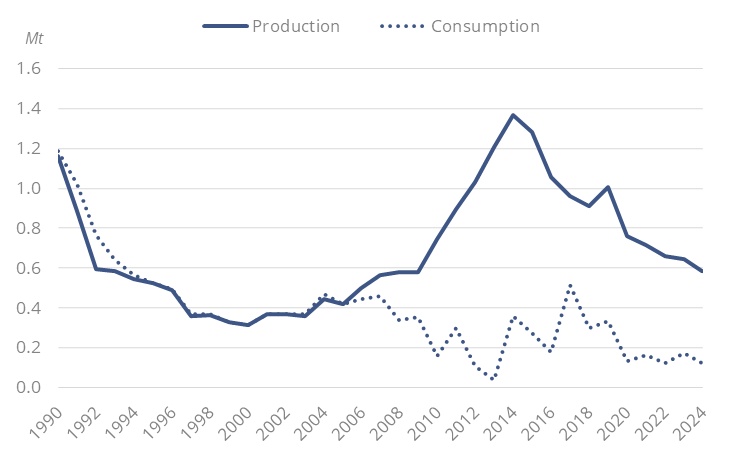
Oil production has halved since 2014, from 1.4 Mt to less than 0.6 Mt in 2024, due to low investment in the sector and most of this production is exported. Production had previously tripled between 2004 and 2014.
With its two refineries stopped, Albania relies on crude oil product imports (1.1 Mt in 2024, +9% in 2024). The country has a biodiesel refinery (100 kt/year) at Porto Romano, that started in 2011.
Graph: Crude Oil Production & Consumption
Source: Albania energy report
Interactive Chart Albania Crude Oil Production & Consumption
Source: Global Energy & CO2 data
Interactive Chart Albania Refined Oil Products Production & Consumption
Source: Global Energy & CO2 data
Benefit from up to 2 000 up-to-date data series for 186 countries in Global Energy & CO2 data
Additionally, for more detailed information on refineries, you can request a sample of our EMEA Refineries Dataset
Albania Natural Gas Production & Consumption
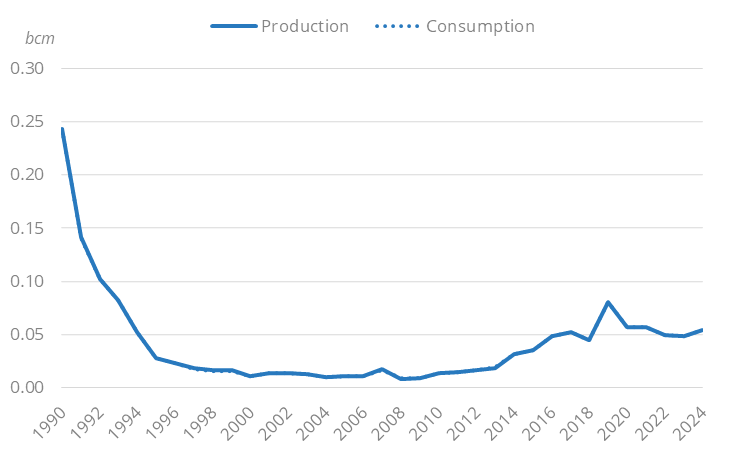
Natural gas production is marginal (55 mcm in 2024). There are no imports. Gas is only used in industry.
Graph: Gas Production & Consumption
Source: Albania energy report
Interactive Chart Albania Gas Production & Consumption
Source: Global Energy & CO2 data
Benefit from up to 2 000 up-to-date data series for 186 countries in Global Energy & CO2 data
Additionally, for more detailed information on the LNG trade, you can request a sample of our EMEA LNG Trade Dataset
Albania Coal and Lignite Production & Consumption
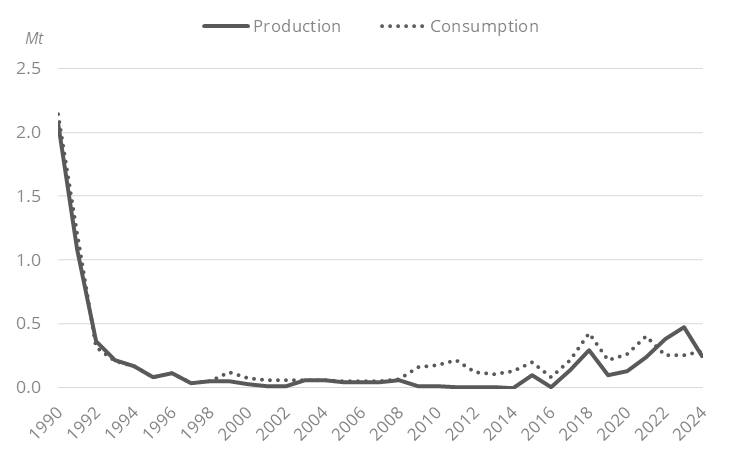
Coal production is marginal (below 250 kt in 2024, -48% in 2024). It is produced from 8 mines. Albania only imports small amounts of coal (211 kt in 2024) to supply its industry, which accounts for 97% of coal demand (2024).
Graph: Coal Production & Consumption
Source: Albania energy report
Interactive Chart Albania Coal and Lignite Production & Consumption
Source: Global Energy & CO2 data
Benefit from up to 2 000 up-to-date data series for 186 countries in Global Energy & CO2 data
View the detailed consumption trends at country level (graphs, tables, analysis) in the Albania energy report
Albania Renewable in % Electricity Production
The target of 38% of renewables in final energy consumption in 2020 from the National Renewable Energy Action Plan was exceeded by 7 points, as this share reached 45%.
The draft revised NECP (2024) targets a share of 59.4% of renewables in final consumption in 2030 (up from the 54.4% target set in the 2021 NECP, including 178% in electricity, 16.6% in heating and cooling, and 34.6% in transport). In 2024, renewables covered 46.9% of final energy consumption (105% for electricity, 23% for heating and cooling, and 0.2% for transport).
Source: Albania energy report
Interactive Chart Albania Share of Renewables in Electricity Production (incl hydro)
Source: Global Energy & CO2 data
Benefit from up to 2 000 up-to-date data series for 186 countries in Global Energy & CO2 data
Learn more about renewables in the European Battery Market Analysis
Albania GHG emissions and CO2 emissions
The draft revised NECP (2024) aims to limit net GHG emissions to 10.2 MtCO2eq in 2030, which will require additional measures (with existing measures, emissions could exceed 11.7 MtCO2eq). This is in line with the first NECP but more ambitious than the updated NDC (2021), which aimed to reduce GHG emissions to 12 MtCO2eq by 2030 (-20.9% compared to a BAU scenario). In 2020, Albania committed to reaching carbon neutrality by 2050, without adopting a long-term strategy.
Source: Albania energy report
Interactive Chart Albania CO2 emissions
Source: Global Energy & CO2 data
Benefit from up to 2 000 up-to-date data series for 186 countries in Global Energy & CO2 data
View the detailed consumption trends at country level (graphs, tables, analysis) in the Albania energy report