Spain Key Figures
- Population:
- 49.4 million
- GDP growth rate:
- 2.77 %/year
- Energy independence:
- 32.9%
Data of the last year available: 2025
- Total consumption/GDP:*
- 79.1 (2015=100)
- CO2 Emissions:
- 4.06 tCO2/cap
- Rate of T&D power losses:
- 9.21%
* at purchasing power parity
View all macro and energy indicators in the Spain energy report
Spain Energy News
View all news, archive your new and create your own daily newsletters only on your topics/countries of interest with Key Energy Intelligence
Spain Energy Research
- Spain's Energy & Climate Policy Framework: Spain targets 48% renewables by 2030, phasing out coal by 2026, aiming for carbon neutrality by 2050.
- Spain's Energy Companies: Iberdrola, Endesa, and Naturgy dominate Spain’s energy sector, controlling 50% of power generation and 43% of gas supply. Naturgy leads gas, while Repsol and Moeve share oil.
- Spain's Energy Supply & Demand: Spain’s energy mix shifted to 73% CO₂-free power in 2025, with solar and wind rising significantly. Oil remains the top primary energy source, though its share declined.
- Spain's Energy Use & Price by Sector: Spain’s final energy consumption stable at 83 Mtoe since 2021; prices remain above pre-crisis levels.
- Spain's Issues & Prospects: Spain targets 160 GW renewable capacity by 2030, with 81% of electricity from renewables, alongside significant green hydrogen and storage expansion.
Benefit from up to 2 000 up-to-date data series for 186 countries in Global Energy & CO2 data
A data overview is available in the global energy statistics app
Spain Total Energy Production & Consumption
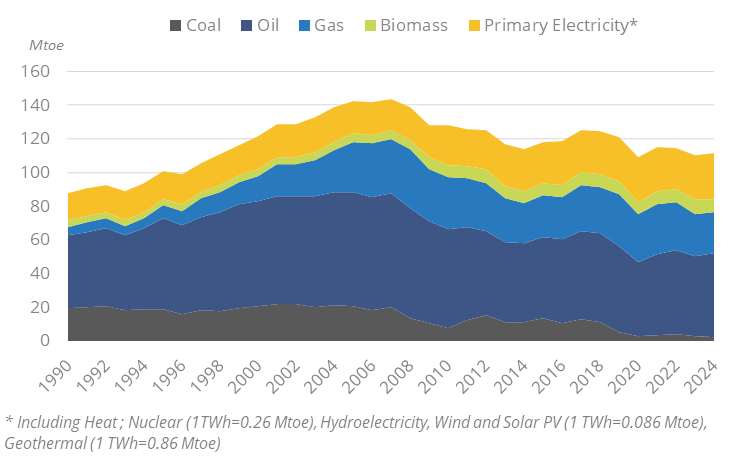
Spain's total primary consumption fell by 1% on average per year between 2010 and 2025, reaching about 114 Mtoe in 2025 (+1% in 2025, as in 2024). In 2025, oil covered 44% of primary consumption (-2 pp since 2010), followed by primary electricity (mainly nuclear, solar and wind) at 24% (+5 pp thanks to solar and wind), gas (23%, -2 pp), biomass (7%, +2 pp), and coal (2%, -4 pp).
Graph: Primary Consumption Trends by Energy Source
Source: Spain energy report
Interactive Chart Spain Total Energy Production & Consumption
Source: Global Energy & CO2 data
Benefit from up to 2 000 up-to-date data series for 186 countries in Global Energy & CO2 data
View the detailed fondamentals of the market at country level (graphs, tables, analysis) in the Spain energy report
Spain Oil Production & Consumption
Spain's crude oil production is very limited (around 1 kt in 2025) and most of its crude oil consumption, which dipped by 3.7% to 63 Mt in 2025, comes from imports. Previously, crude oil consumption had been increasing regularly (+2%/year over 2010-2019, before a 15% fall in 2020 and a 2%/year rebound since then). Imports have followed the same trend (+2%/year since 2020, despite a 3% drop in 2025), reaching 65 Mt in 2025. The main suppliers of crude in 2025 were the United States (15%), Brazil (14%), Mexico (12%), and Nigeria (10%).
Graph: Crude Oil Production & Consumption
Source: Spain energy report
Interactive Chart Spain Crude Oil Production & Consumption
Source: Global Energy & CO2 data
Interactive Chart Spain Refined Oil Products Production & Consumption
Source: Global Energy & CO2 data
Benefit from up to 2 000 up-to-date data series for 186 countries in Global Energy & CO2 data
Additionally, for more detailed information on refineries, you can request a sample of our EMEA Refineries Dataset
Spain Natural Gas Production & Consumption
The country's gas production is very limited (around 80 mcm in 2025).
The country's gas network is growing steadily and, in 2025, reached 96 141 km (compared to 37 000 km in 2000). The number of clients has increased from 4.2 m in 2000 to 8 m in 2025 with over 1 800 cities connected to the gas network.
Gas imports increased by 10% in 2025 to 33 bcm, 67% of which as LNG (+21%); they mainly came from Algeria (35%), the United States (30%), Russia (11%), and Nigeria (7%).
Source: Spain energy report
Interactive Chart Spain Gas Production & Consumption
Source: Global Energy & CO2 data
Benefit from up to 2 000 up-to-date data series for 186 countries in Global Energy & CO2 data
Additionally, for more detailed information on the LNG trade, you can request a sample of our EMEA LNG Trade Dataset
Spain Coal and Lignite Production & Consumption
Spain stopped producing bituminous and brown coal in 2019. After a peak of 40 Mt between 1982 and 1985, production fell by about -12%/year between 2000 and 2018 to around 2 Mt.
Coal imports decreased by 17% in 2025 to less than 4 Mt (-8%/year over 2010-25), while consumption has also seen a steady decrease since 2010 (-10%/year), reaching 3 Mt in 2025. The power sector represents the largest coal and lignite user, with 23% in 2025 (-54 pp since 2010), followed by industry (17%) and the residential and services sector (1%).
Graph: Coal Production & Consumption
Source: Spain energy report
Interactive Chart Spain Coal and Lignite Production & Consumption
Source: Global Energy & CO2 data
Benefit from up to 2 000 up-to-date data series for 186 countries in Global Energy & CO2 data
View the detailed consumption trends at country level (graphs, tables, analysis) in the Spain energy report
Spain Renewable in % Electricity Production
Under the NECP 2023-2030, Spain will increase the share of renewables to 48% of final energy consumption, of which 81% is for power (up from 74%) and 28% for transport (up from 25%). In 2024, renewables covered 25.4% of the final consumption (59.7% for electricity, 21.6% for heating and cooling, and 11.3% in transport).
Source: Spain energy report
Interactive Chart Spain Share of Renewables in Electricity Production (incl hydro)
Source: Global Energy & CO2 data
Benefit from up to 2 000 up-to-date data series for 186 countries in Global Energy & CO2 data
Learn more about renewables in the European Battery Market Analysis
Spain GHG emissions and CO2 emissions
According to the NECP 2023-2030, Spain aims to reduce its GHG gas emissions by 32% in 2030 compared to 1990 levels (70% emission reduction in ETS sectors and 43% in other sectors); in 2023, they were 13% below 1990 levels and 44% below 2005.
In 2021, the Parliament approved the Law on Climate Change and Energy Transition, which aims for carbon neutrality by 2050.
Source: Spain energy report
Interactive Chart Spain CO2 emissions
Source: Global Energy & CO2 data
Benefit from up to 2 000 up-to-date data series for 186 countries in Global Energy & CO2 data
View the detailed consumption trends at country level (graphs, tables, analysis) in the Spain energy report