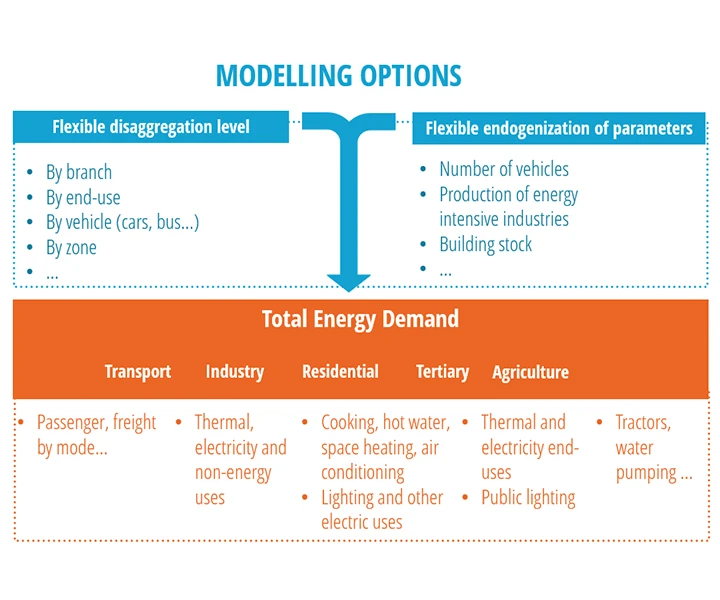
EnerMED is a bottom-up demand forecasting model enabling users to assess the impact of energy efficiency policies at country level, and to drill down to branches and end-uses.
EnerMED is a turnkey model, easy to use by any user, be it with your database or with other ones.
MEDEE models have been and are being used in more than 60 countries worldwide, both by public authorities and governments, and by industries.
Key Benefits
Disaggregation level:
- Transport: 4 main modes (road, rail, air, waterway); distinction passengers/goods; as many as 7 types of vehicles with 9 possibilities of energies/motors.
- Industry: as many as 10 sub-sectors + 10 energy-intensive products with 3 processes each
- Residential: as many as 10 x 10 energy label and building categories, 6 end-uses, 10 appliances
- Services: as many as 10 sub-sectors, 6 end-uses, 10 appliances
- Agriculture
EnerMED includes the following functionalities:
- Simulation of energy demand by type and end-use according to various energy efficiency scenarios
- Calculation of future energy demand and related CO2 and GHG emissions
- Calculation of energy indicators (sectoral energy intensities, unit consumption, etc.)
The main assets of EnerMED are:
- Flexible structure and disaggregation level, selected by users to best fit study objectives
- Adapted modelling to each category or end-use, consistent with relevant drivers
- Supported by a highly efficient and user-friendly software
- GHG emissions are delivered in a format close to the UNFCCC format
Delivery:
- Our experts can perform custom studies or scenarios adapted to your requirements, relying on EnerMED.
- We can deliver the full turnkey model, together with training for your team for optimal use of EnerMED.
MEDEE models have been used to produce reference demand forecasts showing the impact on energy demand of current energy and GHG policies and evaluate the change induced by energy efficiency and GHG measures.
EnerMED is a bottom-up model for long-term energy demand, and GHG forecasts at national and regional level. It analyses energy demand at a detailed level, by subsector and end-use / appliances / types of vehicles.
The user can configure the energy consumption structure to adapt its equations to the available data and to the national context.
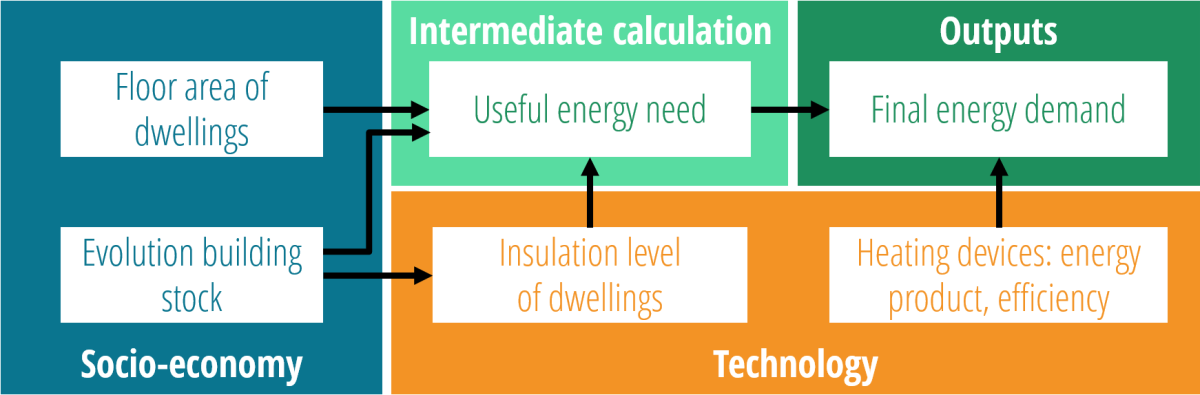
Then EnerMED simulates the energy demand in detail. For each end-use, a useful energy demand is calculated. The market share and efficiency of each technology are modelled to obtain the final energy consumption and GHG emissions.
It enables to evaluate the effect of several drivers on energy demand for each end-use:
- Efficiency and sufficiency policies
- Technological development
- Shifting of fuel or technology
Example: energy demand calculation for space heating
Accurate model: output drilling down to end uses
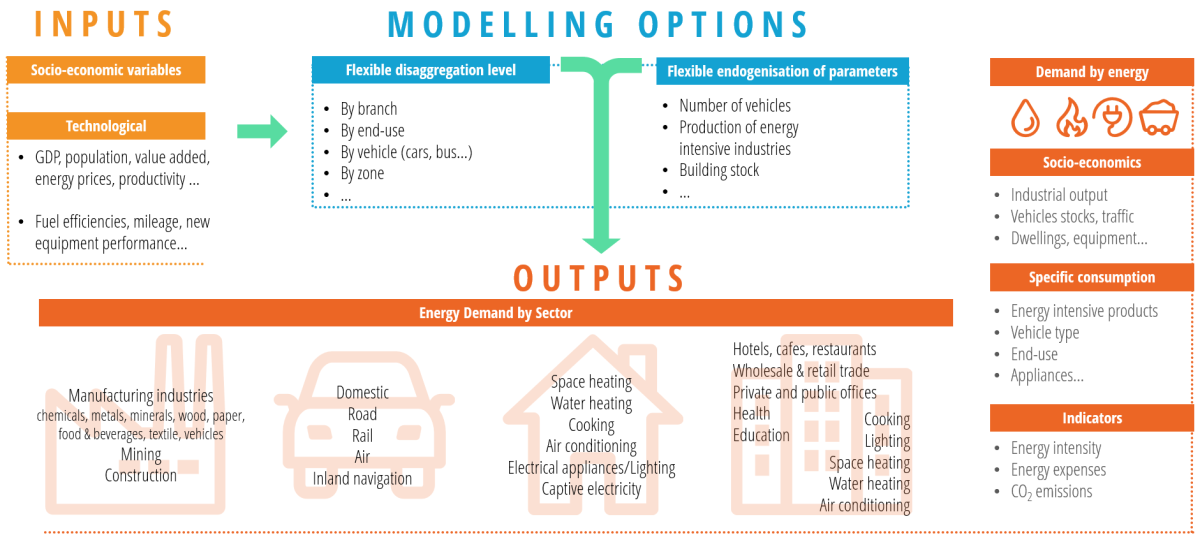
Energy demand
- Passenger/freight
- By mode
- By type of vehicles
- By type of energy/motor for road vehicles
- By branch: chemicals, food, non-metallic minerals and much more
- By Energy-Intensive Product -EIP
- Choice of up to 3 processes per EIP
- 3 types of uses: thermal uses, captive electricity, non-energy uses
- By type of building
- By energy label of building, for each type of building
- By end-use
- Electrical appliances
- Lighting technologies
- Several technologies per energy vector
- By branch: offices, hospitals and much more
- By end-use
- Electrical appliances
- Lighting technologies
- Several technologies per energy vector
- Several energies
- Self-consumption of biogas produced locally
References
- Tunisian National Agency for Energy Management (ANME), United Nations Development Programme (UNDP): Study based on analysis, forecasts, and modelling to develop a new trajectory for greenhouse gas (GHG) emissions in the energy sector for Tunisia by 2030 and 2050. The study also includes a section on capacity building for Tunisian actors on methodological aspects related to energy and GHG modelling: Simulation of GHG emissions in the energy sector in Tunisia by 2050
- EnerMED is replacing MedPro as the latest version of the MEDEE models used under different versions since the mid-70’s.
- The Canadian Department for Natural Resources (NRCan) wanted to explore their policy and program strategies and assess long-term impacts on the energy system. In this context, NRCan has commissioned Enerdata to study the potential of energy efficiency to impact various sectors of the Canadian economy.
- Enerdata supported the Directorate General for Energy and Climate (DGEC) in the development of energy transition scenarios and their consistency checks, as well as modelling the industrial sector.
- Enerdata supports the Tunisian National Agency for Energy Conservation (ANME) with the assistance of the United Nations Development Programme (UNDP) in the implementation of a net-zero emissions scenario by 2050. EnerMED model was used to simulate long-term sectoral energy demand, energy balances, and GHG balances.
EnerMED-Territory Model
The EnerMED-Territory is a model designed to empower local authorities and organisations in defining their energy and emissions strategies. Our experts can leverage this model to adapt the national policies on energy and climate transition, at the scale of local authorities to:
- Develop and update official strategic documents to define a reference low carbon scenario: the model enables to create local scenarios, compliant with the national policy, and taking into account the specific characteristics of the territory, to provide credible foundations to establish a specific policy – examples of realisation with: Brittany’s Energy-Climate Scenarios or Monaco's Low Carbon Strategy.
- Enable informed decision-making thanks to exploratory scenarios adapted to the territory: the model enables to generate exploratory scenarios to explores the impacts of a specific policy implementation or general policy directions – examples of realisation with: Grenoble’s decarbonisation strategy and Burgundi’s prospective exercice.
Key Benefits
- Flexibility: can be easily tailored to the territories’ specificities
- Detailed customisation: inputs can be added to fit with local contexts and policies
- Robust sectoral projections: detailed energy consumption and CO2 emissions by 2030, 2040, and 2050