Request the full publication (FREE)
Here is an overview of the comprehensive insights available in our study. To get a deeper understanding of the key takeaways, uncertainties on prices, and the role of new technologies like hydrogen electrolysis and electric vehicles, download the full analysis.
Despite ambitious official electrification targets, Europe's recent electricity consumption has seen a period of stagnation, leading to uncertainty for short-to-medium term forecasts. Our experts in Energy-Climate scenario modelling analysed the key drivers behind these recent trends in European electricity consumption, with a particular focus on the industrial sector.
1. Electrification of Energy Demand
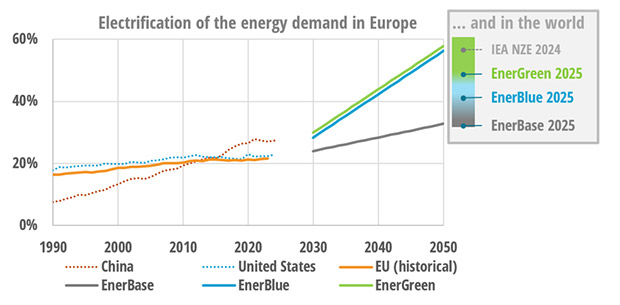
The share of electricity in Europe's total energy demand has been increasing steadily, with projections showing a significant acceleration. This trend, driven by policies and scenarios aimed at strong electrification, is considered a crucial vector for decarbonization and efficiency.
EU electrification of the energy demand
Source: Enerdata, EnerFuture
2. Sectoral Electricity Demand
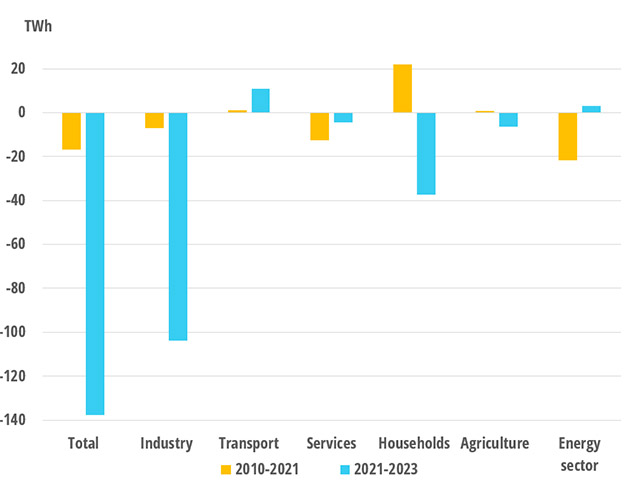
European households have seen a relatively stable electrification rate since 2010 (increase of +22 TWh until 2021 followed by a decrease of -37 TWh between 2021 and 2023). By contrast, the industry electricity demand has dropped in the period, in particular in the 2021-2023 period (-104 TWh).
This is in stark contrast with the electrification objectives contained in the decarbonisation strategies.
Electricity consumption variation by sector (EU)
Source: Enerdata, ODYSSEE
3. Industry Focus
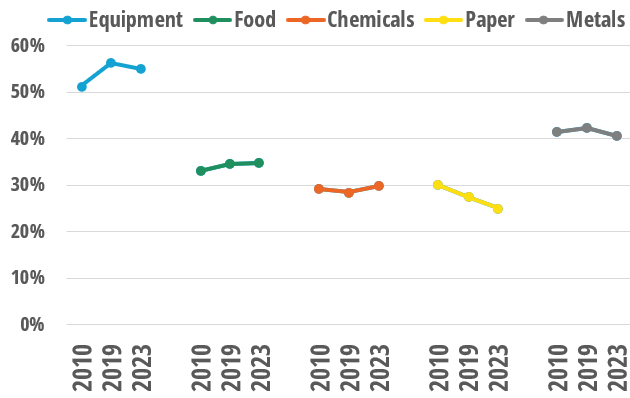
The industry is making efforts to migrate to electrification, but important barriers remain, limiting the efforts: the investment costs and the relative energy prices.
Moreover, some fossil fuels can be replaced by electricity. The main electrification development can be done on heat thanks to clean technologies like hydrogen or power-to-gas combined to the waste heat reuse.
Electrification per industrial branch in EU
Source: Enerdata, ODYSSEE
4. The Rise of Data Centres
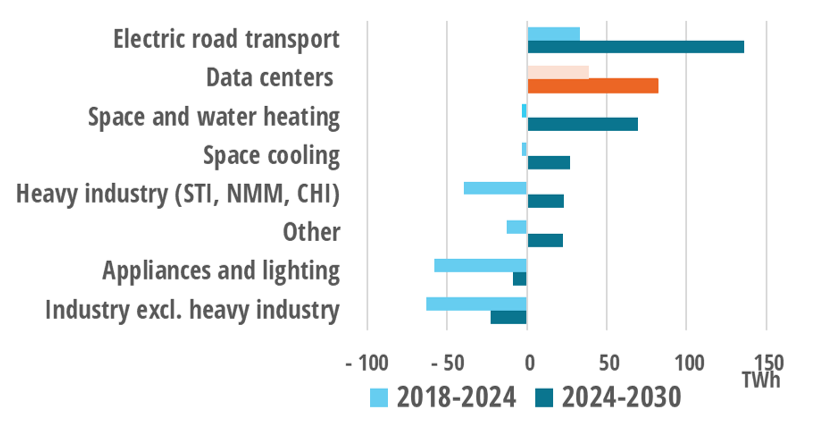
Since 2017, the electricity demand from data centres has grown exponentially, fuelled by video streaming, social networks, remote work, 5G, and generative AI. Projections indicate that by 2030, electricity demand for data centres will double globally, with Europe seeing a significant increase of around 82 TWh.
Increase in electricity demand by sector in Europe in EnerBlue
Source: Enerdata, EnerFuture