Request the full report (FREE)
A decade on from the COP21 in Paris, which yielded the historic international agreement, the world finds itself at a pivotal moment. The Paris Agreement’s central goal—to limit global temperature increase to "well below 2°C" compared to pre-industrial levels—remains the guiding principle for global climate policy. Yet, after decades of rapid increases, global CO2 emissions (excluding AFOLU) stood at 36 GtCO2 in 2015, having grown at an average of 2.5% per year since the turn of the millennium.
This publication provides an assessment of the last decade, analysing the progress made since 2015 and offering a robust look ahead to 2050, powered by our globally recognised POLES-Enerdata model.
Our experts have analysed the outcome of our energy-climate scenarios in 2015, which initially revealed the scale of the challenge defined in the agreement to address the following questions:
- Looking back over the last decade, is the world on track to meet the Paris Agreement goals?
- Where has real, tangible progress been achieved across different sectors and regions since the Paris Agreement?
- What decisive actions must be taken now to impact the current trajectory and align with long-term climate targets?
- The impact of the Paris Agreement for global climate ambition.
The publication’s first section details the concerning fact that global CO2 emissions have continued to rise despite the Paris Agreement. Emissions reached 39 GtCO2 in 2024, marking an average increase of nearly 1% per year since 2015. Critically, this figure is 4.5 GtCO2 higher than the reduction target set by a Paris-compatible scenario from 2016 (EnerGreen).
Global CO2 Emissions Trajectories (2000-2050): Pre- vs. Post-Paris Ambition
|
Before COP21, scenarios accounting for existing country policies showed global emissions climbing steadily, projecting a level of 50 GtCO2 by the year 2050. TOTAL CO2 EMISSIONS* - WORLD
Source: EnerFuture, Enerdata |
Following the agreement, our first post-COP21 EnerGreen scenario envisioned a target of only 14 GtCO2 in 2050 to align with the "well below 2°C" objective. TOTAL CO2 EMISSIONS* - WORLD
Source: EnerFuture, Enerdata |
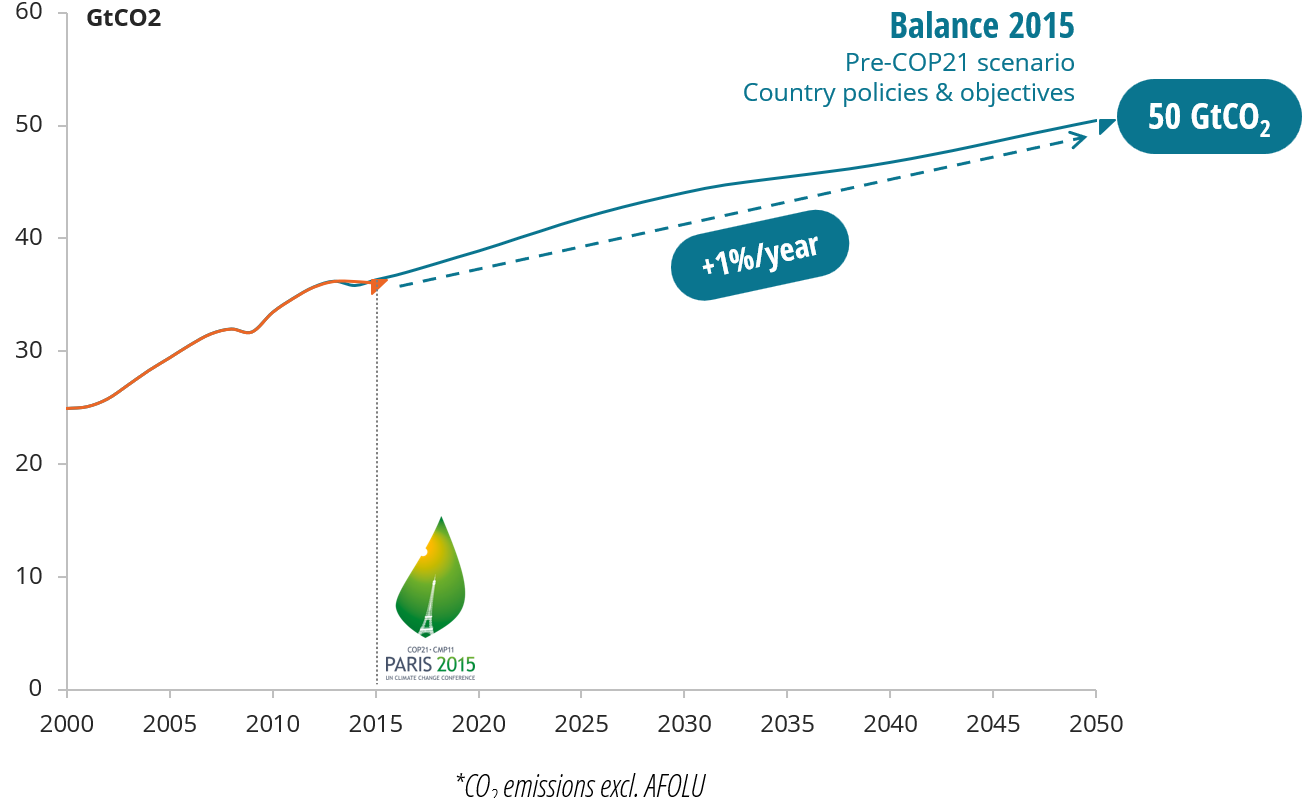
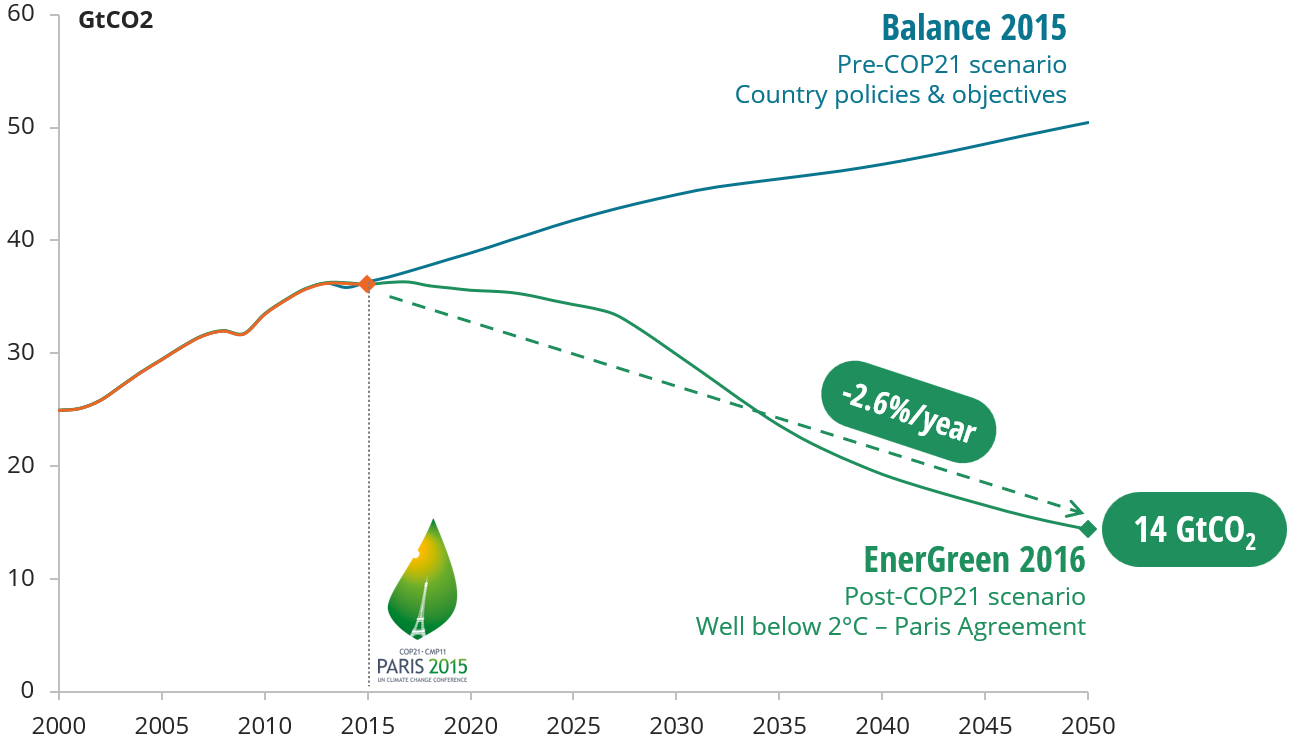
This contrast highlights the necessary, unprecedented reversal in trends requested by the treaty, moving away from a business-as-usual outlook toward radical decarbonisation levers.
Looking back from today, even if the emission peak has not been reached, the required rate of decarbonisation has drastically steepened. The current "EnerGreen 2025" scenario now demands a massive annual reduction of 4.5% until 2050 to maintain the climate objective.
- Yet, real progress was still made
The publication’s second section compares the projections to 2050 made before the Paris Agreements, after (2016), and nowadays (2025).
It finds that global CO2 emissions in 2024 (39 GtCO2) were significantly lower than the projections from all pre-COP21 scenarios. This divergence proves that efforts towards climate change mitigation are making a tangible difference, which should be an encouraging signal to continue and even accelerate—even in a troubled global context.
- Looking forward: what now?
The final section addresses the next step. We are currently operating within an unfavourable geopolitical and economic context, which risks leading to increased fragmentation and a decline in climate commitments.
However, meeting the Paris Agreement goal requires an immediate, radical acceleration of effort, particularly in the next five years. This will involve implementing deep, structural changes across the regions and key sectors like power generation, heavy industry, and transport to finally close the emissions gap.
|
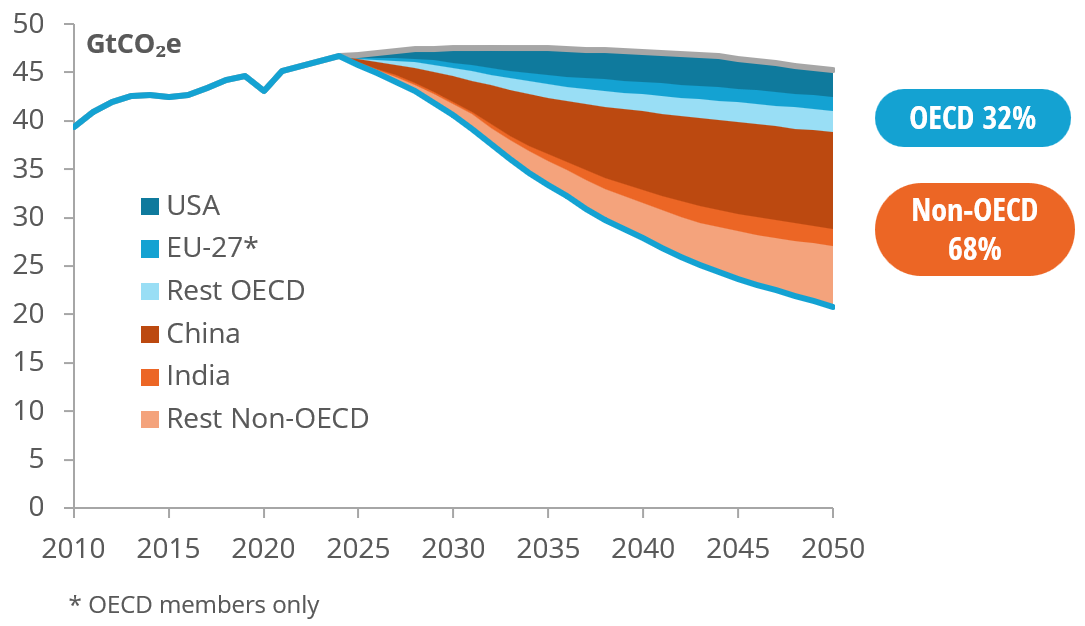
GHG EMISSION REDUCTIONS BY REGION - EnerBlue
Source: EnerFuture, Enerdata |
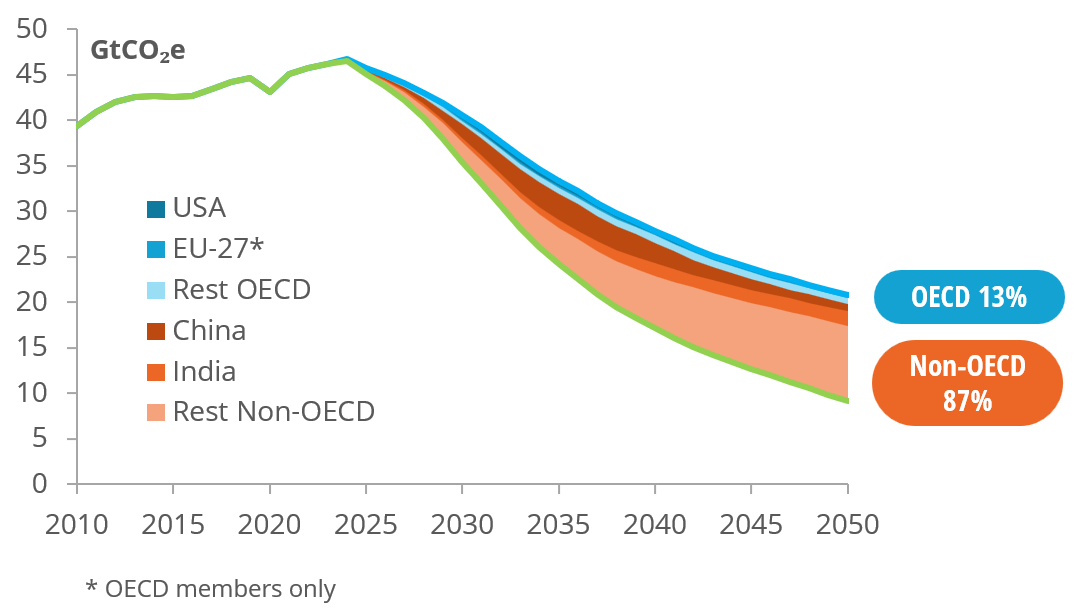
GHG EMISSION REDUCTIONS BY REGION - EnerGreen
Source: EnerFuture, Enerdata |