The German energy group Uniper reported an adjusted EBIT of €1.1bn in 2017, primarily thanks to the performance of its power generation businesses in Europe and Russia. The company's net income significantly improved and posted a net loss of €538m, much better than the €3.2bn loss in 2016. This is mostly attributable to the disposal of its gas stake in the Yuzhno-Russkoye gas field in Siberia. The company started to implement its debt-reduction programme in 2017 and its net debt of €2.4bn (at year-end 2017) was 40% lower than in 2016 (€4.2bn).
In 2017, Uniper's attributable power generation capacity declined by 4.3% to 35,318 MW, including 29,273 MW of thermal capacity (-4% due to disposal of the Vilvoorde power plant in Belgium and decommissioning of the Maasvlakte 1 and 2 power plants in the Netherlands), 3,696 MW of hydropower (-0.7%) and 2,255 MW of nuclear power capacity. The group generated 121 TWh in 2017 (-13% on 2016) but raised its power purchases by 9.3% to 595 TWh. Uniper's power sales grew by 5% to 726 TWh (of which 649 TWh sold on wholesale markets and 77 TWh sold to business customers and resellers), while its gas sales rose by nearly 13% to 1,945 TWh in 2017 (1,729 TWh on the wholesale market and 216 TWh to business customers and resellers).
In February 2018, the Finnish state-held power group Fortum became the majority shareholder of Uniper with a 47.12% stake. The transaction is still subject to regulatory and competition approvals and is expected to be finalized by mid-2018. Fortum could later buy additional shares on the open market and reach the 50% threshold at some point in the future.
-
-
Energy and Climate Databases- The most comprehensive and up-to-date annual energy database.
- Monitoring of technology providers in H2 supply chain.
- Monthly energy data on key energy markets.
- Monitoring of Hydrogen and Derivatives Projects
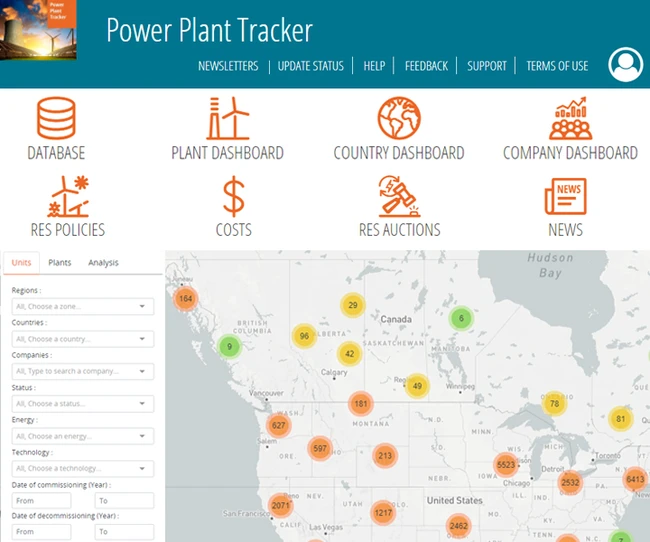
- The most reliable and up-to-date power generation database.
- The essentials of LNG trade at your fingertips.
- Global monitoring of new and existing refineries.
- Analyse energy consumption and efficiency trends at world level. Benchmark countries.
- Have your database developed by a recognised expert of both energy and IT.
-
Energy - Climate Forecasts- Future carbon costs with reliable price forecasts
- Instant access to energy and emissions forecasts.
- Annual projections of wholesale prices up to 2050, based on a 360° approach of the energy markets, enabled by the globally recognised POLES model.
- Wedges module showing a breakdown of the levers enabling to reduce emissions between two scenarios.
- Unique, independent projections of consumption by end-use.
- GHG Marginal Abatement Cost Curves.
- Benefit from proven models to draw your own energy scenarios and anticipate tomorrow’s challenges.
-
Market Intelligence- 110 Energy and climate country reports.
- Tracking trends, EPCs, and national subsidy schemes for residential buildings.
- Daily brief covering the entirety of the turbine industry.
- A newsletter to receive the latest updates on evolving technologies and policies.
- Global energy news and analyses curated daily.
- Enerdata’s experts bring you the essentials about your market and competitors.
-
-
-
Market Analysis- Understanding key consumption trends and drivers across sectors.
- Granular and exclusive insight to address the most pressing business and strategic issues.
- Expertise in strategic and business intelligence, with fine-tuning to the market’s specificities.
-
Energy - Climate Scenarios- Providing the outlook of an energy commodity in mid to long term time horizons.
- Sector and driver specific energy demand forecasting.
- Assess the evolution of energy prices on the international and regional markets, as well as end-users prices.
- Enerdata guides you through pathways to reach climate targets.
- Supporting local authorities in their decarbonisation strategies.
-
Climate Strategy and Policy Evaluation- Cutting-edge quantitative tools and relevant indicators to monitor and evaluate evolutions on worldwide energy markets.
- Analysis of the most cost-effective options to reduce emissions.
- Quantified simulation and analysis of pledges for climate change negotiations.
- Breakdown of carbon markets and evaluation of the climate change impacts on the carbon price.
- Enerdata guides you on the most beneficial policy or investment options.
- Turning climate objectives into concrete action plans.
-
Training- Understand different policy targets and measures on energy efficiency.
- How to measure energy savings?
- Energy Forecasting is a 2 days training to learn to design and interpret energy forecasts.
- Energy statistics training allowing to create energy balance with supply, transformation and consumption and understanding the international energy statistics regulations.
- Initiation to EnerMED level 1is the training to approach on the most powerful energy demand forecasting model.
-
-
Resource Centre