The Indian Ministry of New and Renewable Energy (MNRE) has outlined three models for the development of offshore wind energy projects along the southern and western coastlines of the country.
The Model A (VGF Model) involves designated offshore wind zones, such as portions of Zones B3 off the coasts of Gujarat and Tamil Nadu. It includes capacity of 500 MW each. The government will solicit bids for offshore wind power capacity and provide financial assistance (Viability Gap Funding) to achieve predetermined power tariffs. Successful bidders will have lease arrangements with annual fees and will need to obtain necessary clearances for project stages. About 1 GW are expected to be tendered under this model in 2023-24 and 2024-25.
The Model B (Non-VGF Model with Exclusivity Over Seabed) approach applies to sites identified by NIWE, where project development will be undertaken by potential developers without central financial assistance. The electricity produced will be used for internal consumption, sold through PPAs, or made available via power exchanges. Around 14 GW are said to be awarded under this model, including 4 GW in 2023-24, 3 GW/year between 2024-25 and 2026-27, and 1 GW in 2027-28.
Finally, under the Model C (Non-VGF Model without Exclusivity Over Seabed), developers can identify offshore wind sites within Exclusive Economic Zones (EEZs) excluding those designated under Model A and B. These developers will undertake examinations and surveys and can submit proposals for project development and offshore wind site allocation without central financial assistance. More than 22 GW will be tendered under this model starting in 2025-2026, with 4 GW/year between 2025-26 and 2027-28 and 5 GW/year in 2028-29 and 2029-30.
In total, around 37 GW of offshore wind capacity should be auctioned between 2023-24 and 2029-30. The country has currently no operational offshore wind capacity. The National Institute of Wind Energy (NIWE) is the central agency responsible for these projects. The grid connection responsibility will be up to the offshore interconnection point, and infrastructure beyond will be established by the Central Transmission Utility (CTU). Projects commissioned until 31 December 2032 will enjoy a waiver for interstate transmission system charges.
In addition, the MNRE in India has introduced the green hydrogen standard, setting the emission limits for hydrogen production to be classified as “green” at 2 CO2eq/kg. This encompasses all stages from production to the gate, including processes like water treatment, electrolysis, gas purification, drying, and compression. The definition applies to both electrolysis-based and biomass-based production methods. The Bureau of Energy Efficiency under the Ministry of Power will oversee accreditation for monitoring and verification of green hydrogen production projects. This move aligns with the National Green Hydrogen Mission launched to produce 5 Mt/year of green hydrogen annually and achieve 125 GW of renewable energy capacity by 2030.
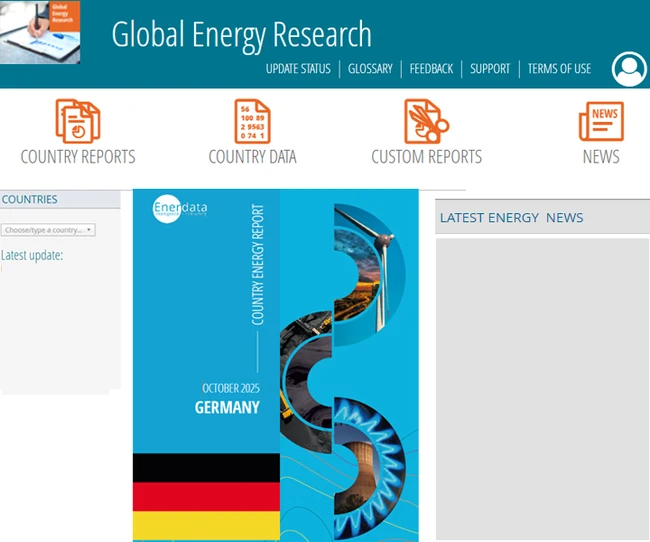
Interested in Global Energy Research?
Enerdata's premium online information service provides up-to-date market reports on 110+ countries. The reports include valuable market data and analysis as well as a daily newsfeed, curated by our energy analysts, on the oil, gas, coal and power markets.
This user-friendly tool gives you the essentials about the domestic markets of your concern, including market structure, organisation, actors, projects and business perspectives.