Germany’s Federal Network Agency (Bundesnetzagentur) has opened the first auction under the country’s new Electricity Supply Security and Capacity Act (StromVKG), seeking to secure long-term power supply capacity. The initial auction with a bidding deadline of 8 September 2026 covers 4.5 GW of capacity. “The generation plants must meet certain requirements for their location and their technical characteristics, for example the provision of the so-called instantaneous reserve for grid stability, even in times when there is no power operation », said the agency. Winning participants will receive capacity payments in return for maintaining the availability of their facilities over a period of 15 years.
To facilitate grid expansion, the auction introduces a regional allocation mechanism. At least one-third of the total auction volume will first be allocated to projects located in the “grid-technical north.” Projects in the “grid-technical south” will subsequently be assessed, with their bids evaluated after applying a deduction of EUR16,000/MW from the bid price. The auction sets a maximum bid price of EUR244,000/MW of reduced capacity per year. Reduced capacity is determined using statutory reduction factors that differ depending on the eligible technology.
Battery energy storage systems qualify only if they are capable of discharging continuously for a minimum of 10 hours. A reduction factor of 0.58 applies to 10-hour systems, increasing to 0.85 for 20-hour systems, which is the same factor assigned to combined-cycle gas turbine (CCGT) plants. The framework also requires battery energy storage systems to provide 100% technical availability, compared with 85% for CCGT plants. Furthermore, battery systems must demonstrate a round-trip efficiency of at least 92%, a requirement that may be challenging for certain long-duration storage technologies, including flow batteries.
The auction further introduces local-content requirements, under which key components, including battery cells and inverters, must be sourced from the European Union or from countries that have a free trade agreement with the EU.
A second tender for long-term capacity is scheduled to take place before the end of 2026.
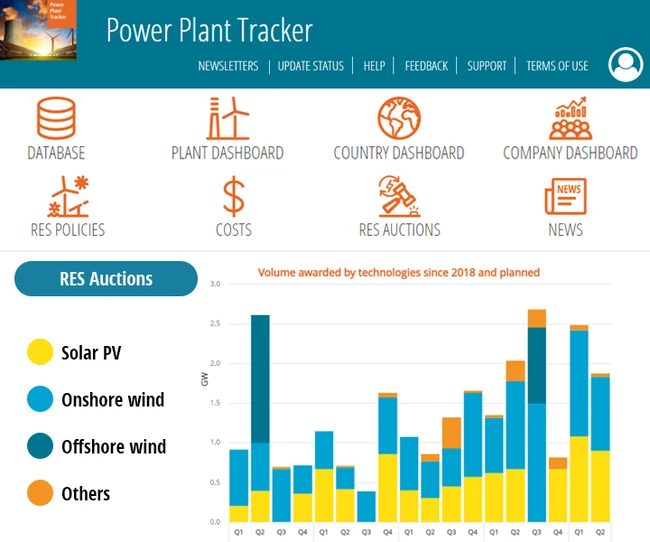
Do you want to become an expert on renewable energies auctions?
Discover our very detailed and regularly updated RES auctions database with worldwide coverage and a technical focus backed by academic research.
With our renewable energies auctions service you will be able to monitor auctions at a global level. Its (expanding) scope notably includes all major G20 countries and offers an especially fine tracking on Europe and South America.