The German coalition government has approved changes to a new energy law to ensure a significant increase in the country’s renewable power production. The new law, which is expected to be enacted by 1 January 2021, will give local communities financial incentives to build onshore wind projects, promote biomass and geothermal energy and encourage more large-scale solar plants. In addition, the text will cut red tape on production from solar and wind plants over their first 20 years of operation, allowing old renewable installations, whose 20-year support period runs out, to participate in auctions for renewed support as of 2022.
In September 2020, the government has approved an amendment to the Renewable Energy Sources Act (EEG 2021) targeting a 65% share of renewables in gross electricity consumption by 2030 (up from 43% in 2019). In addition, the amendment introduced a legally binding goal of greenhouse gas (GHG) neutrality before 2050 for the electricity generated and consumed in Germany. The text also comprised annual quotas for solar, biomass, and onshore and offshore wind, which are to be regularly checked in each of Germany’s 16 federal states. The draft EEG 2021, which is expected to be adopted by the end of 2020, foresees at least 67 GW of new renewable capacity to be auctioned between 2021 and 2028.
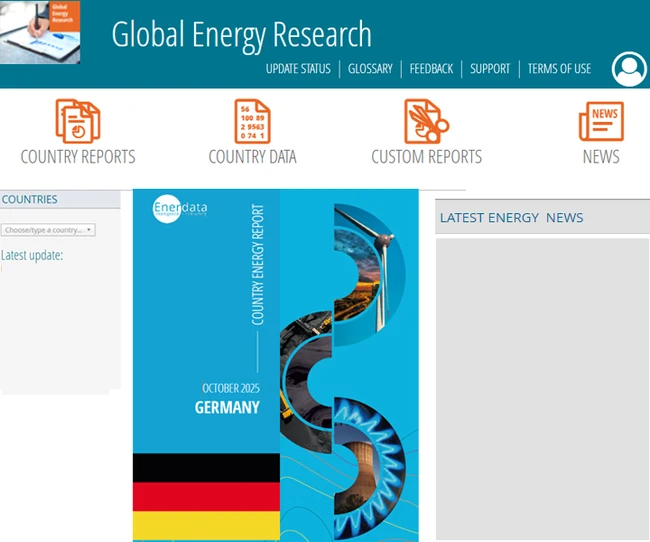
Interested in Global Energy Research?
Enerdata's premium online information service provides up-to-date market reports on 110+ countries. The reports include valuable market data and analysis as well as a daily newsfeed, curated by our energy analysts, on the oil, gas, coal and power markets.
This user-friendly tool gives you the essentials about the domestic markets of your concern, including market structure, organisation, actors, projects and business perspectives.