According to preliminary statistics released by the British Department for Business, Energy & Industrial Strategy (BEIS), total greenhouse gas (GHG) emissions in the United Kingdom declined by 2.5% in 2018, reaching 449 MtCO2eq, i.e. 44% below their 1990 level.
CO2 emissions contracted by 2.4% to 364 Mt (39% of their 1990 level), thanks to a 7.2% decrease in emissions from the energy sector (including power plants), as the fuel mix for power generation changed, away from coal and towards renewables and gas. CO2 emissions from the energy sector have more than halved (-59%) since 1990. Emissions from the power plants fell by 9.9% to 65.2 Mt, i.e. 68% below their 1990 level: coal accounted for only 7% of the fuel used for power generation -from 65% in 1990- while nuclear and renewables accounted for 47% of the power mix in 2018 (from 22% in 1990).
CO2 emissions from the transport sector also contracted by 2.6% in 2018, as a result of traffic volumes or improvements in fuel efficiency. These improvements were partially offset by higher CO2 emissions from the residential sector (+2.8%) and from the public sector (+4.5%), as the colder weather in the first quarter of 2018 raised heating demand. Emissions from the business sector remained stable (-0.3%). Overall, in 2018, 1/3 of CO2 emissions came from the transport sector, 27% from the energy sector, 18% from businesses and 18% from households.
Interested in Power Plants?
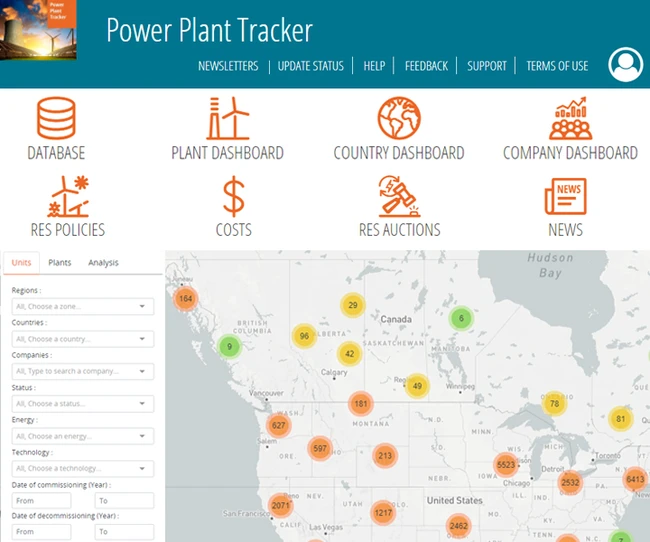
Enerdata has developed a market research service to screen, monitor and analyse the development of power generation assets.
Power Plant Tracker offers an interactive database and a powerful search engine covering power plants worldwide – including both installed and planned capacities for renewables and fossil fuels.