Philippines Key Figures
- Population:
- 116 million
- GDP growth rate:
- 5.69 %/year
- Energy independence:
- 44.0%
Data of the last year available: 2024
- Total consumption/GDP:*
- 90.3 (2015=100)
- CO2 Emissions:
- 1.43 tCO2/cap
- Rate of T&D power losses:
- 10.9%
* at purchasing power parity
View all macro and energy indicators in the Philippines energy report
Philippines Energy News
View all news, archive your new and create your own daily newsletters only on your topics/countries of interest with Key Energy Intelligence
Philippines Energy Research
- Philippines's Energy & Climate Policy Framework: The Philippines aims for 35% renewables in its power mix by 2030 and a 75% reduction in GHG emissions. The Department of Energy oversees the energy sector, with plans to accelerate renewable development, decommission coal plants, and introduce nuclear energy by 2032. The Energy Plan 2023-2050 outlines strategies for a sustainable energy transition.
- Philippines's Energy Companies: "In the Philippines, over 90% of electricity is generated by IPPs, with key players including Aboitiz, San Miguel, and First Gen. EDC leads in geothermal energy. Prime Infra acquired the Malampaya gas field in 2022. The transmission network is operated by NGCP, while Meralco dominates distribution. Petron is the sole refiner, and Prime Infra now controls the Malampaya gas field."
- Philippines's Energy Supply & Demand: The Philippines' energy supply is dominated by coal (62%), with rising imports and declining gas production. Total energy consumption has increased by 4.8% annually since 2020, reaching 70 Mtoe in 2024. Coal and oil now account for 36% and 31% of total consumption, respectively. The country has moderate conventional energy resources and significant geothermal potential. Electricity capacity has grown to 29 GW, with coal accounting for 44% of installed capacity. Power generation has increased by 5.7% annually since 2020, with coal-fired generation dominating the mix. The Philippines is the world's third-largest producer of geothermal energy. Oil and gas production are declining, with imports covering most demand. GHG emissions have risen significantly, with fuel combustion being the primary source.
- Philippines's Energy Use & Price by Sector: The Philippines' final energy consumption has risen sharply since 2020, driven by transport, with oil and electricity being the primary sources. Electricity prices, though high, slightly decreased in 2024. Households and services account for the largest share of consumption, followed by transport and industry.
- Philippines's Issues & Prospects: The Philippines anticipates rapid energy demand growth, requiring USD 80bn in investment by 2028. Electricity demand is projected to rise by 5.5% annually, with significant renewable energy targets set for 2030 and 2040. Despite a coal moratorium, existing plants will operate for decades, while new gas, solar, and wind projects are planned to enhance energy resilience and sustainability.
Benefit from up to 2 000 up-to-date data series for 186 countries in Global Energy & CO2 data
A data overview is available in the global energy statistics app
Philippines Total Energy Production & Consumption
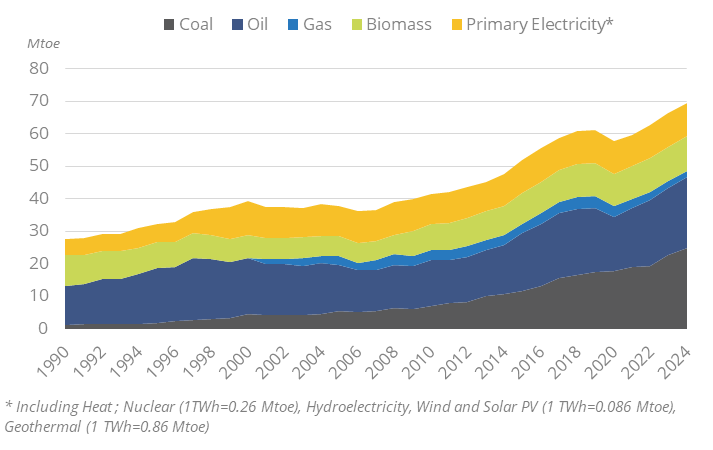
Total energy consumption has been increasing by 4.8%/year since 2020, reaching 70 Mtoein 2024, after a 5.6% drop in 2020. Previously, it had been increasing by 4.4%/year since 2009, reaching 61 Mtoe in 2019. Per capita consumption is 0.6 toe (2024), which is much lower than the Asian average (-65%).
Graph: Primary Consumption Trends by Energy Source
Source: Philippines energy report
Interactive Chart Philippines Total Energy Production & Consumption
Source: Global Energy & CO2 data
Benefit from up to 2 000 up-to-date data series for 186 countries in Global Energy & CO2 data
View the detailed fondamentals of the market at country level (graphs, tables, analysis) in the Philippines energy report
Philippines Oil Production & Consumption
Oil production is low and decreasing (0.2 Mt in 2024) and only covers 4% of oil demand. Most of the crude oil supply is covered by imports (5.85 Mt in 2024). Saudi Arabia is the largest crude oil supplier (nearly 49% in June 2024), followed by the United Arab Emirates (28%), Iraq (19%), and Colombia (4%).
Source: Philippines energy report
Interactive Chart Philippines Crude Oil Production & Consumption
Source: Global Energy & CO2 data
Interactive Chart Philippines Refined Oil Products Production & Consumption
Source: Global Energy & CO2 data
Benefit from up to 2 000 up-to-date data series for 186 countries in Global Energy & CO2 data
Additionally, for more detailed information on refineries, you can request a sample of our Asia Refineries Dataset
Philippines Natural Gas Production & Consumption
The production of gas has halved since 2020, reaching 2 bcm in 2024; it started in 2002 with the commissioning of the Malampaya field. It was stable between 2011 and 2019 at around 4 bcm. The gas field is estimated to run dry by 2027 (remaining reserves estimated by DOE at 4 bcm). It supplies five power plants in Luzon: Ilijan, Sta. Rita, San Lorenzo, Avion, and San Gabriel.
Source: Philippines energy report
Interactive Chart Philippines Gas Production & Consumption
Source: Global Energy & CO2 data
Benefit from up to 2 000 up-to-date data series for 186 countries in Global Energy & CO2 data
Additionally, for more detailed information on the LNG trade, you can request a sample of our Asia LNG Trade Dataset
Philippines Coal and Lignite Production & Consumption
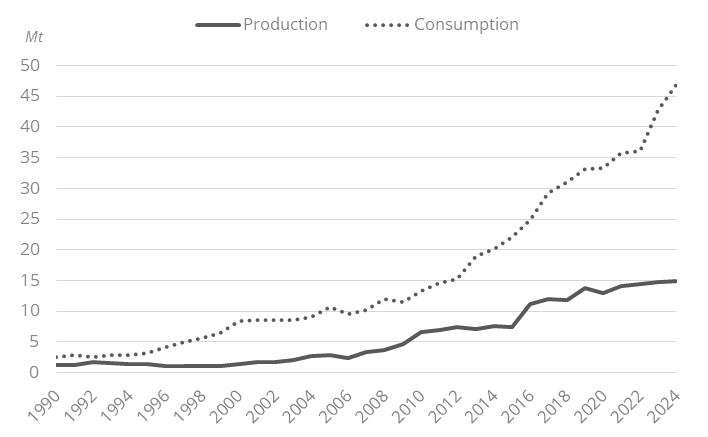
Lignite production has more than doubled since 2010 and reached 15 Mt in 2024 (+1.7%in 2024), though covering only 1/3 of domestic coal and lignite consumption. Coal imports have more than tripled since 2010, from 11 Mt to around 41 Mt in 2024 (10%/year). Most of the coal is used in power plants, with the remainder in industry.
Graph: Coal Production & Consumption
Source: Philippines energy report
Interactive Chart Philippines Coal and Lignite Production & Consumption
Source: Global Energy & CO2 data
Benefit from up to 2 000 up-to-date data series for 186 countries in Global Energy & CO2 data
View the detailed consumption trends at country level (graphs, tables, analysis) in the Philippines energy report
Philippines Renewable in % Electricity Production
The Renewable Energy Roadmap 2020-2040 aims to reach 35% of renewables in the power mix by 2030, and 50% by 2040 under a Clean Energy Scenario (CES) (35% in a Reference Scenario (REF)). These objectives were renewed in PEP 2023-2050. This share was 27% in 2023. To achieve this target, the country will need PHP 25.3bn (US$490m) of green investments for pre-developments under the CES scenario and PHP 17.9bn (US$347m) under the REF scenario.
Source: Philippines energy report
Interactive Chart Philippines Share of Renewables in Electricity Production (incl hydro)
Source: Global Energy & CO2 data
Benefit from up to 2 000 up-to-date data series for 186 countries in Global Energy & CO2 data
Philippines GHG emissions and CO2 emissions
In its updated NDC (2021), the country aims to reduce emissions by around 75% in 2030, relative to a BAU scenario (of which 2.7% unconditional and 72.3% conditional). The mitigation contribution is conditioned by the extent of financial resources, including technology development and transfer, and capacity building, that will be made available to the country. In its first NDC (2015), the objective was slightly lower (70% reduction).
Source: Philippines energy report
Interactive Chart Philippines CO2 emissions
Source: Global Energy & CO2 data
Benefit from up to 2 000 up-to-date data series for 186 countries in Global Energy & CO2 data
View the detailed consumption trends at country level (graphs, tables, analysis) in the Philippines energy report