Lao Key Figures
- Population:
- 7.66 million
- GDP growth rate:
- 3.75 %/year
- Energy independence:
- 100%
Data of the last year available: 2023
- Total consumption/GDP:*
- 128 (2015=100)
- CO2 Emissions:
- 2.56 tCO2/cap
- Rate of T&D power losses:
- 17.8%
* at purchasing power parity
View all macro and energy indicators in the Lao energy report
Lao Energy News
View all news, archive your new and create your own daily newsletters only on your topics/countries of interest with Key Energy Intelligence
Lao Energy Research
- Lao PDR's Energy & Climate Policy Framework: Lao PDR aims to reduce GHG emissions by 60% by 2030, with key policies led by the Ministry of Energy and Mines. The country targets 100% electrification by 2030 and a 10% reduction in final energy consumption. Renewable energy and energy efficiency initiatives are central to these goals, supported by international cooperation.
- Lao PDR's Energy Companies: In Laos, EDL oversees electricity generation (14% capacity), transmission, and distribution. IPPs dominate power production, with key players including Hongsa Lignite, CH. Karnchang, and NTPC. EDL-T, a joint venture with China Southern Power Grid, manages the high-voltage grid. In oil, Medco Energi leads upstream exploration, while Laopec operates a refinery with expansion plans. Lao State Fuel Company leads downstream distribution.
- Lao PDR's Energy Supply & Demand: Laos' energy mix is dominated by hydro (76%) and lignite (24%), with rising consumption and significant electricity exports. The country has substantial hydro and wind potential but faces deforestation challenges. Lignite use has surged, impacting emissions.
- Lao PDR's Energy Use & Price by Sector: "Residential and services sectors account for 43% of the country's final energy consumption, with biomass and electricity being the primary sources. Energy demand has risen, with industry and transport sectors also showing significant consumption. Electricity prices have decreased, enhancing access to clean cooking options, though biomass remains dominant in households." (149 characters)
- Lao PDR's Issues & Prospects: Laos, known as Southeast Asia's "Battery," is expanding its power capacity with hydropower leading, but faces challenges in meeting export targets due to infrastructure limitations. Plans include coal, solar, and wind projects, with significant hydropower developments under construction. Transmission projects aim to enhance regional energy trade, though delays and capacity constraints persist.
Benefit from up to 2 000 up-to-date data series for 186 countries in Global Energy & CO2 data
A data overview is available in the global energy statistics app
Lao Total Energy Production & Consumption
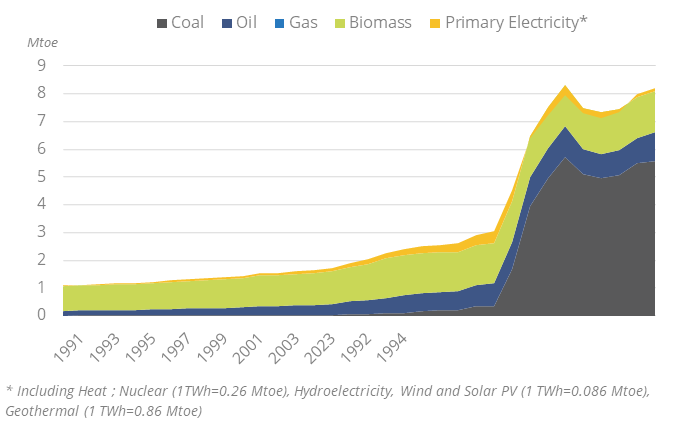
Total energy consumption has been increasing since 2020 (5%/year), reaching 8.2 Mtoein 2023. Consumption per capita is low, at 1.1 toe in 2023, slightly under the Asian average (1.7 toe). It surged between 2014 and 2018 (+27%/year), with the start of production at the lignite power plants.
Graph: Primary Consumption Trends by Energy Source
Source: Lao energy report
Interactive Chart Lao Total Energy Production & Consumption
Source: Global Energy & CO2 data
Benefit from up to 2 000 up-to-date data series for 186 countries in Global Energy & CO2 data
View the detailed fondamentals of the market at country level (graphs, tables, analysis) in the Lao energy report
Lao Oil Production & Consumption
In 2007, the Government granted an exploration permit for the Savannakhet area, which is the main zone of interest in the country. Three permits had been granted in the past, but no drillings were carried out and the companies withdrew. Drilling has not started in the Champasak and Saravan PSC.
A small refinery of 20 kb/d was commissioned in 2020. Oil demand is entirely supplied by imports from China, Thailand, and Vietnam.
Source: Lao energy report
Interactive Chart Lao Crude Oil Production & Consumption
Source: Global Energy & CO2 data
Interactive Chart Lao Refined Oil Products Production & Consumption
Source: Global Energy & CO2 data
Benefit from up to 2 000 up-to-date data series for 186 countries in Global Energy & CO2 data
Additionally, for more detailed information on refineries, you can request a sample of our Asia Refineries Dataset
Lao Coal and Lignite Production & Consumption
Lignite production increased four-fold in 2015 and tripled in 2016 with the commissioning of the Hongsa power plant. It reached its highest level in 2018 (16 Mt) and then subsequently decreased until jumping by 16% in 2022 back to its 2018 level (16.3 Mt), remaining at this level in 2023.
In parallel, coal and lignite consumption evolved similarly as power generation accounts for 95% of solid fuel consumption. The rest is used in industry (mostly for cement).
The country does not import coal but exports a small part of its production (1.2 Mt, i.e. 7% of production in 2023).
Source: Lao energy report
Interactive Chart Lao Coal and Lignite Production & Consumption
Source: Global Energy & CO2 data
Benefit from up to 2 000 up-to-date data series for 186 countries in Global Energy & CO2 data
View the detailed consumption trends at country level (graphs, tables, analysis) in the Lao energy report
Lao Renewable in % Electricity Production
The Renewable Energy Development Strategy (2011) focused on small scale renewables (biofuels, biogas, solar energy, wind, small hydropower). The government aimed to increase their share to 30% of the total energy consumption by 2025 (ambition confirmed in the new PDP 2020-2030). This goal will not be attained as renewables reached 18% of total consumption in 2024 (all met by biomass).
Source: Lao energy report
Interactive Chart Lao Share of Renewables in Electricity Production (incl hydro)
Source: Global Energy & CO2 data
Benefit from up to 2 000 up-to-date data series for 186 countries in Global Energy & CO2 data
Learn more about renewables in the Mini grid Africa & Asia markets for village electrification
Lao GHG emissions and CO2 emissions
In its updated NDC (2021), the country pledged to unconditionally reduce its GHG emissions by 60% in 2030 compared to a BAU scenario. To achieve this goal, Lao PDR aims to reduce LULUCF emissions by 1.1 MtCO2eq/year by reducing deforestation, to instal 7.5 GW of hydropower capacity (to reach 13 GW), and to introduce 50 000 energy-efficient cooking stoves. With international support, the country could increase the forest cover to 70% of total land area (against 40% in 2024) and develop 1 GW of wind and solar and 300 MW of biomass.
Source: Lao energy report
Interactive Chart Lao CO2 emissions
Source: Global Energy & CO2 data
Benefit from up to 2 000 up-to-date data series for 186 countries in Global Energy & CO2 data
View the detailed consumption trends at country level (graphs, tables, analysis) in the Lao energy report