Kuwait Key Figures
- Population:
- 4.97 million
- GDP growth rate:
- -2.6 %/year
- Energy independence:
- 100%
Data of the last year available: 2024
- Total consumption/GDP:*
- 122 (2015=100)
- CO2 Emissions:
- 19.5 tCO2/cap
- Rate of T&D power losses:
- 10.0%
* at purchasing power parity
View all macro and energy indicators in the Kuwait energy report
Kuwait Energy News
View all news, archive your new and create your own daily newsletters only on your topics/countries of interest with Key Energy Intelligence
Kuwait Energy Research
- Kuwait's Energy & Climate Policy Framework: Kuwait targets 15% renewable electricity by 2030 while maintaining oil dominance, with MEW overseeing energy policy and efficiency measures.
- Kuwait's Energy Companies: MEW oversees Kuwait’s electricity transmission, distribution, and most generation via IPPs. KPC is the sole hydrocarbon operator, managing oil, gas, and refining through subsidiaries like KOC, KNPC, and Q8.
- Kuwait's Energy Supply & Demand: **Kuwait’s energy mix is dominated by gas (57%) and oil (43%), with rising gas share. Oil production fell 7% in 2024; gas rose 5%.**
- Kuwait's Energy Use & Price by Sector: Industry leads energy use, with gas dominating; transport relies solely on oil. Prices stable since 2018.
- Kuwait's Issues & Prospects: **Kuwait advancing energy projects: 25GW in development (63% gas, 37% solar), aiming for 15% renewables by 2030.**
Benefit from up to 2 000 up-to-date data series for 186 countries in Global Energy & CO2 data
A data overview is available in the global energy statistics app
Kuwait Total Energy Production & Consumption
Total primary consumption increased by 6%/year since 2021, reaching 43 Mtoe in 2024. It remained roughly stable from 2016 to 2019 and dropped by 9% in 2020 due to the COVID.
Graph: Primary Consumption Trends by Energy Source
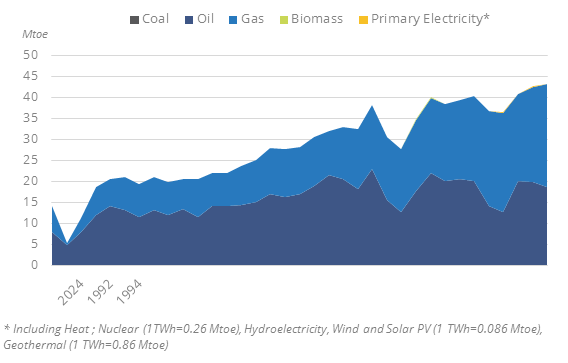
Source: Kuwait energy report
Interactive Chart Kuwait Total Energy Production & Consumption
Source: Global Energy & CO2 data
Benefit from up to 2 000 up-to-date data series for 186 countries in Global Energy & CO2 data
View the detailed fondamentals of the market at country level (graphs, tables, analysis) in the Kuwait energy report
Kuwait Oil Production & Consumption
Crude oil production fell by 7% in 2024 to 132 Mt, back to its 2020 level. The fall is due to the voluntary production cuts in OPEC countries (as occurred previously in 2018-2019). After remaining on an upward increase trend until 2016 (+4.5%/year since 2010), oil production reached its highest level at 158 Mt before falling to its lowest level due to the COVID at 129 Mt in 2021 (-3%/year over the period). Its production represents just less than 10% of total OPEC output (5th country behind Iran).
Source: Kuwait energy report
Interactive Chart Kuwait Crude Oil Production & Consumption
Source: Global Energy & CO2 data
Interactive Chart Kuwait Refined Oil Products Production & Consumption
Source: Global Energy & CO2 data
Benefit from up to 2 000 up-to-date data series for 186 countries in Global Energy & CO2 data
Additionally, for more detailed information on refineries, you can request a sample of our EMEA Refineries Dataset
Kuwait Natural Gas Production & Consumption
Gas production increased in 2023 and 2024 (+12% and +5% respectively) after a drop by 21% in 2022. It increased rapidly between 2010 and 2021, by around 5%/year.
Production represents two third of the country's gas consumption (67% in 2024), a stable share since 2022. The country imports LNG through two regasification terminals: Mina Al-Ahmadi FSRU (capacity of 7.8 bcm/year, commissioned in 2009) and Al-Zour (14.85 bcm/year, commissioned in 2022). Natural gas imports and increased at a steady pace of 10%/ year since 2010, reaching around 10 bcm in 2024.
Source: Kuwait energy report
Interactive Chart Kuwait Gas Production & Consumption
Source: Global Energy & CO2 data
Benefit from up to 2 000 up-to-date data series for 186 countries in Global Energy & CO2 data
Additionally, for more detailed information on the LNG trade, you can request a sample of our EMEA LNG Trade Dataset
Kuwait Renewable in % Electricity Production
The country set an ambitious goal to generate 15% of its electricity from renewables by 2030, as part of the goals set in its New Vision 2035. Several photovoltaic projects are ongoing; however, no flagship policy has yet been implemented to speed-up the development of renewables.
Source: Kuwait energy report
Interactive Chart Kuwait Share of Renewables in Electricity Production (incl hydro)
Source: Global Energy & CO2 data
Benefit from up to 2 000 up-to-date data series for 186 countries in Global Energy & CO2 data
Kuwait GHG emissions and CO2 emissions
In its updated NDC (2021), Kuwait pledged to cut GHG emissions by 7.4% by 2035, compared to a BAU projection. This would reduce GHG emissions by nearly 11 MtCO2eq to 132 MtCO2eq, corresponding to emissions 54% higher than in 2016 (reference year). Most of the reduction would come from an oil-to-gas substitution in energy production, new CCGT power plants, energy efficiency measures, and renewable projects; the country would also promote carbon capture and storage and mangrove cultivation.
Source: Kuwait energy report
Interactive Chart Kuwait CO2 emissions
Source: Global Energy & CO2 data
Benefit from up to 2 000 up-to-date data series for 186 countries in Global Energy & CO2 data
View the detailed consumption trends at country level (graphs, tables, analysis) in the Kuwait energy report