- Update
-
- Format
- 3 files (PDF report, 2 Excel files)
- Pages
-
45 (Report only)
- Delivery
- Immediate by e-mail
- GENERAL OVERVIEW
- ENERGY AND CLIMATE POLICY FRAMEWORK
- ENERGY COMPANIES
- ENERGY SUPPLY AND DEMAND
- ENERGY USE AND PRICE BY SECTOR
- ISSUES AND PROSPECTS
- STATISTICS
- ABBREVIATIONS
- GLOSSARY
Buy Kuwait energy report
Price without VAT. Depending on your status and location, VAT might be applicable. Get in touch with us for more information.
After validation, you will immediately receive 3 files by email (one pdf report and 2 excel files containing the datasets).
Overview
Kuwait’s energy strategy balances its reliance on oil and gas—central to its economy—with gradual diversification into renewables, targeting increased solar capacity. State-led entities oversee production, while private partnerships expand electricity infrastructure. Climate goals focus on emissions reduction through efficiency, gas substitution, and emerging low-carbon technologies.
Get more details on the table of contents and data files, as well as the list of graphs and tables by browsing the tabs below.
Highlights
- Kuwait aims to meet at least 15% of its electricity needs from renewables by 2030.
- MEW controls electricity transmission, distribution, and most of generation through one large IPP.
- KPC is the only operator in the hydrocarbon sector.
- Crude oil production fell by 7% in 2024 due to voluntary production cuts.
- Natural gas production increased by 5% in 2024.
- Final energy consumption in industry has doubled since 2010.
- Oil product prices have remained stable since 2018, despite the surge in international prices.
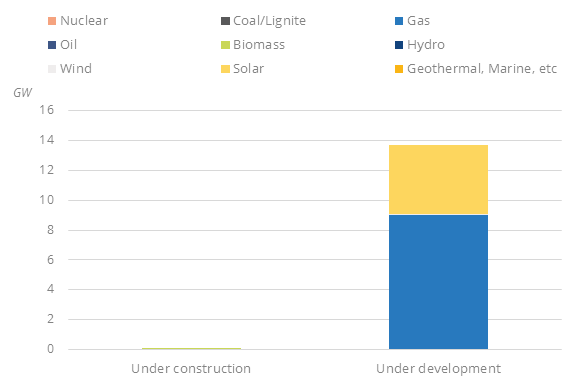
- About 25 GW are under development, mostly gas (63%) and solar (37%).
Energy & Climate Policy Framework
The Ministry of Oil is responsible for overseeing activities related to oil and gas (upstream and downstream).
The Ministry of Electricity & Water and Renewable Energy (MEW) is responsible for the electricity sector. It is in charge of tenders in the power sector, as well as development of new energy sources.
Energy Companies
Gas:
KPC, via its subsidiaries, is also in charge of the entire gas sector.
Energy Supply & Demand
Oil:
Crude oil production fell by 7% in 2024 to 132 Mt, back to its 2020 level. The fall is due to the voluntary production cuts in OPEC countries (as occurred previously in 2018-2019). After remaining on an upward trend until 2016 (+4.5%/year since 2010), oil production reached its highest level at 158 Mt before falling to its lowest level due to COVID at 129 Mt in 2021(-3%/year over the period).
Energy Use and Price by Sector
Energy Prices in Transport:
Prices for road fuel are among the lowest in the world (ranking in the top 10) as they are heavily subsidized. In 2015, the government started to remove part of these subsidies.
Issues & Prospects
Electricity:
The public-private partnership programme is expected to cover about 7.5 GW of the 14 GW capacity increase over the next 20 years. About 25 GW are under development, mostly gas (63%) and solar (37%).
Graph: Upcoming New Capacity by Energy Source
- Graph 1: Primary Consumption Trends by Energy Source
- Graph 2: Total Consumption Market Share by Energy (2024)
- Graph 3: Installed Electric Capacity by Source
- Graph 4: Installed Electric Capacity by Source (2024)
- Graph 5: Gross Power Production by Source & Consumption
- Graph 6: Power Generation by Source (2024)
- Graph 7: Crude Oil Production & Consumption
- Graph 8: Petroleum Products Production & Consumption
- Graph 9: Gas Production & Consumption
- Graph 10: Emissions of GHG and CO2 from Fuel Combustion
- Graph 11: Final Demand Trends by Energy Source
- Graph 12: Final Consumption by Sector
- Graph 13: Final Consumption Market Share by Sector (2024)
- Graph 14: Final Consumption in Industry by Energy Source
- Graph 15: Final Consumption in Transport by Energy Source
- Graph 16: Energy Prices in Transport (Taxes Included)
- Graph 17: Final Consumption in Residential, Services, Agriculture by Energy Source
- Graph 18: Upcoming New Capacity by Energy Source
- Economic Indicators: Annual historical data including population, GDP growth, imports and exports, inflation rate, energy security and efficiency indicators, CO2 emissions.
- Supply Indicators: Historical data including oil and gas reserves, electric and refining capacity, energy production, power production and external trade. All are detailed by energy source.
- Demand Indicators: Historical data including consumption per inhabitant, consumption trends, total consumption by energy source, final consumption by energy source and sector, and electricity consumption by sector.
- Energy Balances: Single table displaying the overall energy industry balance per annum, also graphically displayed by energy sub-segment.
The Kuwait energy market data since 1990 and up to
is included in the Excel file accompanying the Kuwait country report.
It showcases the historical evolution, allowing users to easily work with the data.
Key Data included in the excelsheet:
- Economic indicators: Annual historical economic indicators, energy security, energy efficiency and CO2 emissions.
- Supply indicators: Annual historical reserves, capacity, production and external trade (imports(+) exports(-) balance).
- Demand indicators: Annual historical consumption per capita, consumption trends, total consumption, final consumption (per energy and per sector) and electricity consumption total and per sector.
- Energy Balance: total and per energy.
- Kuwait Energy Prices: In addition to the analysis provided on the report we also provided a data set which includes historical details on the Kuwait energy prices for the follow items: price of premium gasoline (taxes incl.), price of diesel (taxes incl.), price of electricity in industry (taxes incl.), price of electricity for households (taxes incl.), price of natural gas in industry (taxes incl.), prices of natural gas for households (taxes incl.), spot price of Brent and CO2 emissions (from fuel combustion).