Cambodia Key Figures
- Population:
- 17.6 million
- GDP growth rate:
- 6.02 %/year
- Energy independence:
- 25.8%
Data of the last year available: 2024
- Total consumption/GDP:*
- 126 (2015=100)
- CO2 Emissions:
- 1.24 tCO2/cap
- Rate of T&D power losses:
- 11.0%
* at purchasing power parity
View all macro and energy indicators in the Cambodia energy report
Cambodia Energy News
View all news, archive your new and create your own daily newsletters only on your topics/countries of interest with Key Energy Intelligence
Cambodia Energy Research
- Cambodia's Energy & Climate Policy Framework: Cambodia aims for 100% electrification and 70% renewable energy by 2030, with policies overseen by the Ministry of Mines and Energy and the National Council for Sustainable Development. The Electricity Authority of Cambodia regulates the sector, while new laws support renewable energy growth, including solar and wind projects. Energy efficiency and climate change mitigation are key priorities, with targets for reducing GHG emissions and achieving carbon neutrality by 2050.
- Cambodia's Energy Companies: China Huadian dominates Cambodia's energy sector, controlling 40% of power generation. IPPs account for 86% of capacity and 98% of generation, with major players including Huadian Sihanoukville and CIIDG Erdo Hongjun. EDC, the national power company, holds 14% of capacity. Kampuchea Tela leads oil distribution.
- Cambodia's Energy Supply & Demand: Cambodia's energy supply has surged, with coal-fired generation driving a 14-fold increase in electricity production since 2010. The country's energy mix now relies heavily on coal (28%), while biomass and oil shares have declined. Energy consumption has doubled, though per capita remains below ASEAN averages. Electricity generation has tripled since 2015, with coal accounting for 59% of production. The nation faces growing energy dependence, importing significant amounts of oil, coal, and electricity, and its greenhouse gas emissions have risen sharply.
- Cambodia's Energy Use & Price by Sector: Final energy consumption in Cambodia grew rapidly (8%/year) from 2010 to 2024, with electricity's share rising to 23%. Oil dominated (50%), while biomass fell and coal surged. Industry's demand quadrupled, driven by coal and electricity. Transport and residential sectors also saw significant growth, with oil and electricity as primary sources. Energy prices varied, with industrial electricity among the highest in ASEAN.
- Cambodia's Issues & Prospects: Cambodia plans to invest USD 1.8bn in electricity transmission, shifting from coal to gas and expanding hydro, solar, and wind projects by 2040.
Benefit from up to 2 000 up-to-date data series for 186 countries in Global Energy & CO2 data
A data overview is available in the global energy statistics app
Cambodia Total Energy Production & Consumption
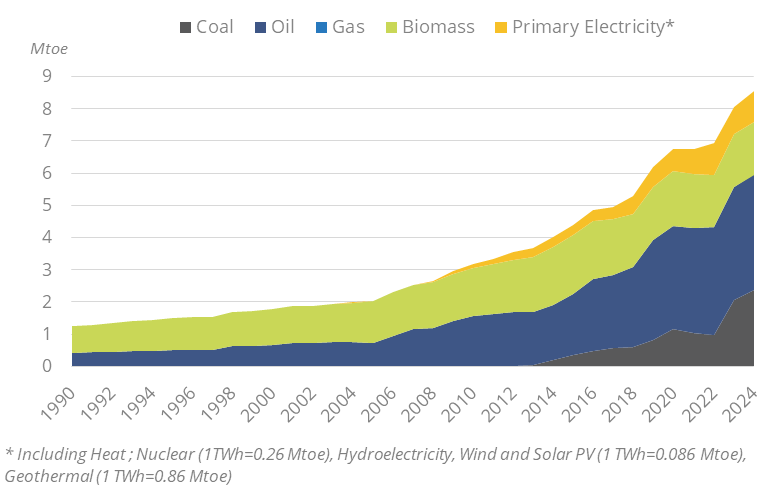
Total energy consumption was multiplied by 2.7 between 2010 and 2024 (+7%/year) to 8.5 Mtoe, with 42% of oil, 28% of coal, 19% of biomass, and 11% of primary electricity (9% of hydro and 2% of solar). Per capita energy consumption has doubled since 2010 (+6%/year), reaching 0.5 toe in 2024, which is less than half of the average for ASEAN (1.2 toe/cap.).
Graph: Primary Consumption Trends by Energy Source
Source: Cambodia energy report
Interactive Chart Cambodia Total Energy Production & Consumption
Source: Global Energy & CO2 data
Benefit from up to 2 000 up-to-date data series for 186 countries in Global Energy & CO2 data
View the detailed fondamentals of the market at country level (graphs, tables, analysis) in the Cambodia energy report
Cambodia Oil Production & Consumption
The country possesses six offshore oil blocks (A, B, C, D, E, and F) and an OCA block (overlapping concession area with Thailand), as well as four onshore blocks in the area surrounding Tonle Sap Lake (XI, XII, XV, XVII). None of those blocks are currently under production, but several firms are conducing exploration activities.
Block A is the priority for redevelopment, with estimated reserves of 728 mbl. Cambodia produced crude oil from block A for a few months in 2021, before the operating company was forced into liquidation.
Source: Cambodia energy report
Interactive Chart Cambodia Crude Oil Production & Consumption
Source: Global Energy & CO2 data
Interactive Chart Cambodia Refined Oil Products Production & Consumption
Source: Global Energy & CO2 data
Benefit from up to 2 000 up-to-date data series for 186 countries in Global Energy & CO2 data
Additionally, for more detailed information on refineries, you can request a sample of our Asia Refineries Dataset
Cambodia Coal and Lignite Production & Consumption
Cambodia produces only a limited volume of coal (less than 0.1 Mt in 2024) and almost all the coal consumed is imported.
From 2013 onwards, the country started to import significant quantities of coal following the commissioning of its first coal-fired power plant. Driven by the rise in coal-fired capacity, imports were multiplied by 7 between 2015 and 2024, reaching 7 Mt. In 2023, most of the coal (89%) was imported from Indonesia.
Source: Cambodia energy report
Interactive Chart Cambodia Coal and Lignite Production & Consumption
Source: Global Energy & CO2 data
Benefit from up to 2 000 up-to-date data series for 186 countries in Global Energy & CO2 data
View the detailed consumption trends at country level (graphs, tables, analysis) in the Cambodia energy report
Cambodia Renewable in % Electricity Production
In November 2024, the Government announced plans to raise the share of renewables in power generation to 70% by 2030 (39% in 2024). To achieve this goal, 13 renewable projects totalling 1 275 MW are already under construction and another 23 power projects totalling 5.95 GW were approved for 2024-2029, including 12 solar projects, 6 wind projects (900 MW), 1 biomass, 1 solar project, 1 hydropower project, and 2 energy storage projects. In its NDC 3.0, the country targets 72% of renewables in the capacity mix by 2035.
Source: Cambodia energy report
Interactive Chart Cambodia Share of Renewables in Electricity Production (incl hydro)
Source: Global Energy & CO2 data
Benefit from up to 2 000 up-to-date data series for 186 countries in Global Energy & CO2 data
Learn more about renewables in the Mini grid Africa & Asia markets for village electrification
Cambodia GHG emissions and CO2 emissions
In its NDC 3.0, the country aims to reduce its GHG emissions by 16% compared to a BAU scenario (-21.7 MtCO2eq) and by 55% with international support (-73.7 MtCO2eq). The conditional target aims to halve emissions from the energy sector (-23.3 MtCO2eq) and make the FOLU sector a carbon sink (-13 MtCO2eq in 2035, -27 MtCO2eq compared to BAU).
Source: Cambodia energy report
Interactive Chart Cambodia CO2 emissions
Source: Global Energy & CO2 data
Benefit from up to 2 000 up-to-date data series for 186 countries in Global Energy & CO2 data
View the detailed consumption trends at country level (graphs, tables, analysis) in the Cambodia energy report