Request this Executive Brief in pdf format (FREE)
A two-level approach to residential building’s decarbonisation
Clear EU targets…
The decarbonisation of the residential building stock in Europe relies on a two-level approach. At the EU level, targets are clearly expressed in the Energy Performance of Buildings Directive (EU/2024/1275, EPBD): reducing the average primary energy consumption of residential buildings by 16% by 2030 and 20% by 2035, with efforts primarily focused on the least energy-efficient buildings, which are expected to deliver at least 55% of the savings. The EPBD entered into force on 28 May 2024 and must be transposed into national laws by 29 May 2026.
…and the role of Member States
Recent reductions in energy consumption appear to be driven largely by rising energy prices, according to Enerdata, rather than by structural energy efficiency policies. Therefore, the key objective is to understand how Member States mobilise structural levers — such as building renovation policies and bans on fossil fuel heating systems — to progress towards carbon neutrality, rather than relying primarily on cyclical factors like energy prices.
The implementation of building decarbonisation policies is managed by individual Member States, which set their own priorities and measures. National targets are often expressed through annual renovation rates, heating system upgrades, or improvements in Energy Performance Certificates (EPCs). Under Article 3 of the EPBD, Member States are required to establish National Buildings Renovation plans (NBRPs). While the process was initiated with draft submissions in late 2025, final national strategies are due by December 31, 2026, following review and recommendations from the European Commission. To date, however, only a limited number of draft NBRPs have been made available.
Ultimately, while the EU sets the collective ambition, Member States define the specific pathways to achieve it.
Challenges in monitoring renovation progress across Europe
Tracking and harmonising indicators
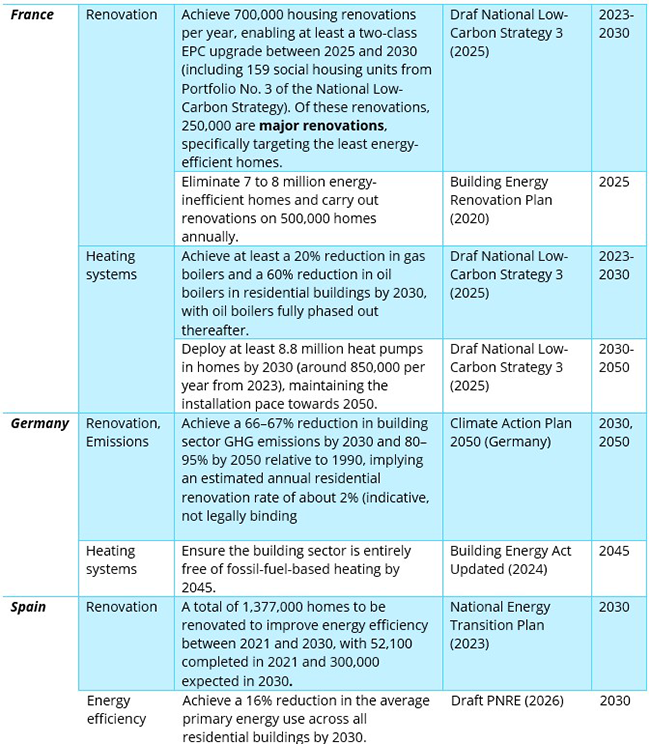
Despite clearly defined national targets (Table 1), tracking progress remains complex.
There is a lack of robust and consistent indicators specifically capturing thermal renovation across Member States, compounded by difficulties in measuring the depth and scope of renovations. Existing statistics often record the number of dwellings undergoing any type of work, without distinguishing between minor interventions and comprehensive energy renovations. For example, in Spain, renovation targets are expressed in terms of the number of dwellings renovated for energy purposes, whereas official data include all renovation permits, including non-energy-related works such as aesthetic improvements. This misalignment between policy targets and statistical data is not unique to Spain but observed in several Member States.
Table 1: Overview of national targets for renovation, heating systems and EPCs by country (example of France, Germany and Spain)
Source: Enerdata
An additional difficulty stems from the coexistence of multiple EPC reference frameworks, either within the same country, as in Belgium, or across Member States. Although the EPBD recast requires Member States to align EPC systems on a common A-to-G scale by May 2026, harmonisation remains partial. Differences in methodologies and nationally defined thresholds (e.g. class G corresponding to the worst 15% of the stock) persist, and implementation is likely to be gradual and uneven. As a result, cross-country comparisons of renovation policies remain challenging.
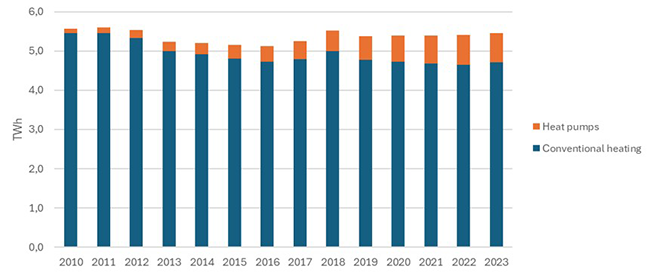
Finally, national energy statistics often report total electricity consumption for heating without distinguishing between heat pumps and conventional electric heating, although in some countries this split can be estimated from public data (Figure 1). Knowing the electricity use of each heating type is crucial, as heat pumps provide an efficient means to reduce energy consumption and decarbonize buildings.
Figure 1: Electricity consumption by heating system type, Spain
Source: Enerdata’s own calculations based on EUROSTAT and EHPA
Contrasting national renovation policy systems: some examples
In France, renovation relies on direct subsidies, notably MaPrimeRénov’—a grant supporting energy renovations based on income and expected savings—and Energy Savings Certificates (CEEs), which obligate energy suppliers to promote efficiency actions. CEEs finance around €5 billion per year, almost matching the National Housing Agency budget (€4.39 billion in 2025). Regulatory measures also ban the rental of the least efficient dwellings. Monitoring focuses on renovation numbers and energy consumption.
In Germany, financial support comes from KfW and the Federal Office for Economic Affairs and Export Control (BAFA), via grants and low-interest loans for individual measures or comprehensive “Effizienzhaus” renovations. The Gebäudeenergiegesetz (GEG, 2020) sets minimum energy standards and regulates the phase-out of fossil fuel heating. Monitoring tracks compliance and uptake of supported measures.
In Belgium, renovation is managed regionally. Grants and tax reductions support energy improvements (e.g., insulation, heating, renewables), such as Flanders’ Renovatiepremie. Regulatory rules prevent leasing inefficient rental properties. Monitoring covers renovation counts and energy performance, though reporting varies by region.
These three examples illustrate distinct approaches—direct subsidies, structured financing, and regionalised implementation—while highlighting the need for reliable indicators to monitor the progress and effectiveness of each type of measure in each country. This situation raises an important question: are countries tracking the right indicators to accurately assess the success of their policies, and are current trends in renovation and heating systems replacement sufficient to meet short-term targets? Answering this question requires robust data, modelling tools, and scenario analyses for the residential sector.
Drivers and barriers to renovation by 2030: some examples
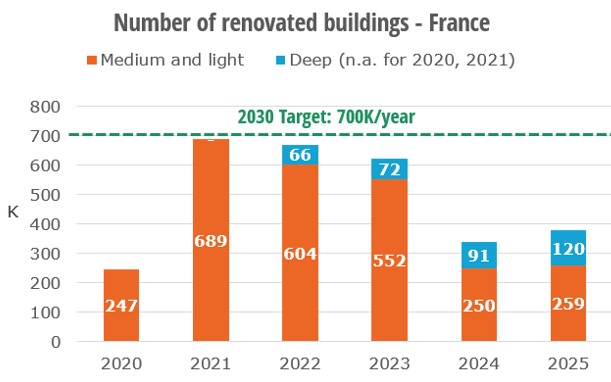
Monitoring current trends can reveal a gap between policy ambitions and actual outcomes, as for France renovation trends (Figure 2). To better understand these dynamics and why they fall short of ambitions, it is essential to examine the underlying factors shaping the renovation market.
In France, several factors are likely to shape renovation activity by 2030. Shortages of skilled labour—marked by the loss of around 60,000 jobs lost between 2023 and 2024—combined with ongoing recruitment challenges and limited incentives for wage increases or training, could constrain the sector’s renovation capacity. Material costs remain high and are expected to keep rising. While regulations such as RE2020 and the phase-out of oil-fired boilers provide clear direction, some targets—particularly the ban on renting the least efficient dwellings—may be hard to achieve due to frequent policy changes, including the temporary suspension of MaPrimeRénov’ in 2025, which weakened stakeholder confidence. Despite financial support schemes, high upfront costs and administrative complexity continue to hinder progress, and the limited rollout of technical innovation is likely to keep its impact modest by 2030.
Figure 2: Number of renovated dwellings and 2030 national target, France
Source: Enerdata, based on Anah and Draft National Low-Carbon Strategy (SNBC-3)
In Germany, the Unified Building Energy Act (GEG, 2020) sets a clear direction by requiring energy renovations upon change of ownership. Renovation is supported by centralized financial and regulatory schemes, with subsidies generally not mean-tested (except for heating system replacements). The Federal Funding for Efficient Buildings (BEG), delivered via KfW and BAFA, provides grants to support these efforts. Strong local networks also help build trust and facilitate projects. However, high renovation and borrowing costs, administrative complexity, limited financial support, and labour shortages—combined with rising housing demand—continue to constrain the pace of renovation.
In Belgium, the energy renovation market could experience significant acceleration if several structural levers identified in regional strategies are activated. These include translating phase-out timelines for energy-inefficient buildings into legislation and harmonizing the EPC systems across the three regions (Flanders, Brussels, and Wallonia). However, the Belgian Central Economic Council has identified several persistent obstacles: administrative barriers (excessive delays in obtaining permits and legal constraints on external insulation for certain buildings), financial barriers (high renovation costs and public subsidies that are either poorly known or inadequately calibrated), and informational barriers (a lack of detailed statistics on the number of renovated dwellings).
Overall, for these countries, while financing schemes and tax incentives support renovation activity, high costs for households and administrative complexity continue to slow progress. In addition, limited deployment of technical innovations means their impact is likely to remain modest by 2030, leaving a significant risk of missing official targets.
Assessing the feasibility of national targets
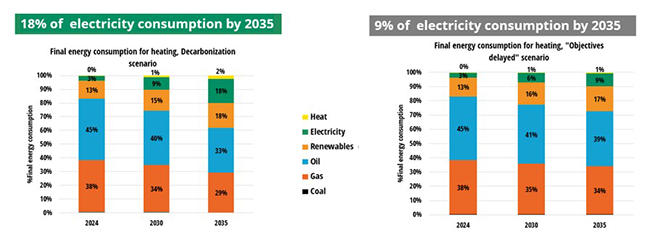
To assess the feasibility of national targets, Enerdata analyses trends in renovation indicators, heating systems, and EPCs, combined with macroeconomic, regulatory, and technological perspectives. Two scenarios are developed:
- An ambitious decarbonisation scenario, aligned with official national assumptions.
- A scenario where targets are reached with delay, based on historical trends and existing policies.
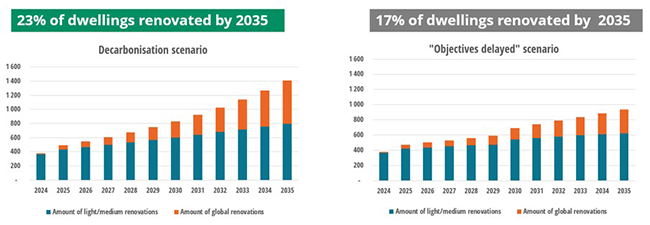
Our technico-economic modelling highlights a substantial gap between targets and feasibility. In Germany, while 23% of dwellings would need to be renovated in the short term under a decarbonisation scenario, only 17% are expected to be renovated under a less ambitious scenario (Figure 3). This reflects lower renovation rates and a larger building stock, where new construction often takes priority over renovation.
Figure 3: Number of dwellings renovated by 2035 (Germany)
Source: Enerdata, Building Renovation Outlook Reports
In Belgium, the situation is more complex, with three distinct regional trajectories. Wallonia and the Brussels-Capital Region plan a full ban on boilers from 2025, whereas Flanders implement a partial ban, limited to gas-heated areas. At the national level, combining the three regional trajectories, electricity consumption for heating is projected to grow by 18% by 2035 based on official targets; however, under the less ambitious scenario, it is expected to be roughly halved (Figure 4).
Figure 4: Final energy demand for heating in 2 scenarios, Belgium
Source: Enerdata, Building Renovation Outlook Reports
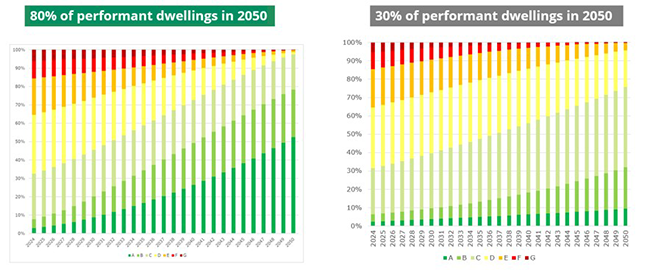
Looking at the 2050 targets, achieving 80% of performant dwellings in France, in line with official objectives, would require - according to our model - that nearly all renovations from 2025 onward be deep renovations (Figure 5). Given current trends, such a shift appears highly unrealistic.
Figure 5: EPC’s distribution in 2 scenarios, France
Conclusion: Bridging the gap between ambition and reality
While the decarbonisation targets for Europe’s residential building stock are ambitious and clearly defined, their implementation faces significant structural, technical, and economic obstacles. Understanding these challenges, modelling realistic trajectories, and addressing both policy constraints and supply-side factors is essential to narrow the gap between ambition and reality.
In this context, having an observatory of reliable and comparable indicators at the national level is indispensable. Such a tool allows for tracking renovation and heating systems replacement progress, identifying barriers, adjusting policies in real time, and anticipating delays, thereby strengthening the European strategy to achieve carbon neutrality in the residential sector.
KEY TAKEAWAYS
- While a European regulatory framework is gradually being established, tracking residential renovation remains challenging due to fragmented goals, indicators, and EPC frameworks, alongside diverse national and regional policy approaches.
- Despite the lack of dedicated indicators in national statistical frameworks, heat pump electricity demand and induced energy savings can be derived for certain Member States using available proxy data.
- Current renovation trends reveal a gap between policy ambitions and actual outcomes.
- Robust data, modelling tools, and scenario analyses are essential to refine trajectories and inform decision-making.