Finnish power company Fortum has preliminary results for 2018 and unveiled its objectives for the next year. Approximately €600m - €650m will be set aside for capital expenditures throughout 2019, including maintenance and excluding potential acquisitions. The company expects electricity demand in the Nordic countries (i.e. Norway, Sweden, Denmark and Finland) to grow by 0.5% on average. At the end of 2018, it had approximately 2.4 million electricity customers in the region.
Fortum's 2018 global power generation figures reached 43.5 TWh in the Nordics, 29.5 TWh in Russia, 0.7 TWh in the Baltic countries (i.e. Estonia, Latvia and Lithuania) and 0.6 TWh in Poland. Its global power generation consisted mostly of gas-fired power plants (38%), nuclear power (30%) and hydropower (26%). In Europe, the company produced 44.7 TWh, most of which was nuclear (50%) and hydropower (43%).
In 2018, the group operated around 13.7 GW of power capacity and 15 GW of heat production capacity. Its European generation capacity (8,811 MW) is located mostly in Sweden (4,542 MW), Finland (3,860 MW), Poland (186 MW) and Norway (102 MW). Most of these assets are hydropower facilities (4,672 MW) and nuclear plants (2,819 MW).
However, the company's growth targets are Russia and India, where it is developing wind and solar power plant projects. In Russia, Fortum owns stakes in 85 MW of operational wind capacity (70 MW Fortum share) and in 1,753 MW wind parks under construction or in development (887 MW share). It also has 35 MW of solar capacity and a further 110 MW under development in Russia. In India, 185 MW of solar power are operational (85 MW Fortum share) and 250 MW are currently under development.
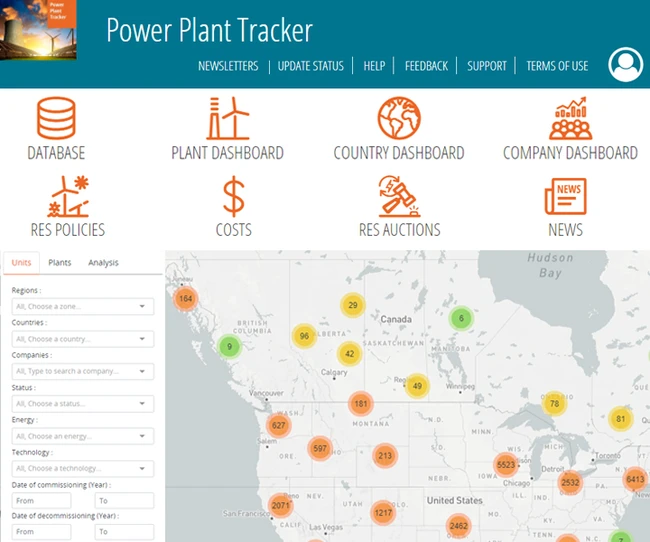
Interested in Power Plants?
Enerdata has developed a market research service to screen, monitor and analyse the development of power generation assets.
Power Plant Tracker offers an interactive database and a powerful search engine covering power plants worldwide – including both installed and planned capacities for renewables and fossil fuels.