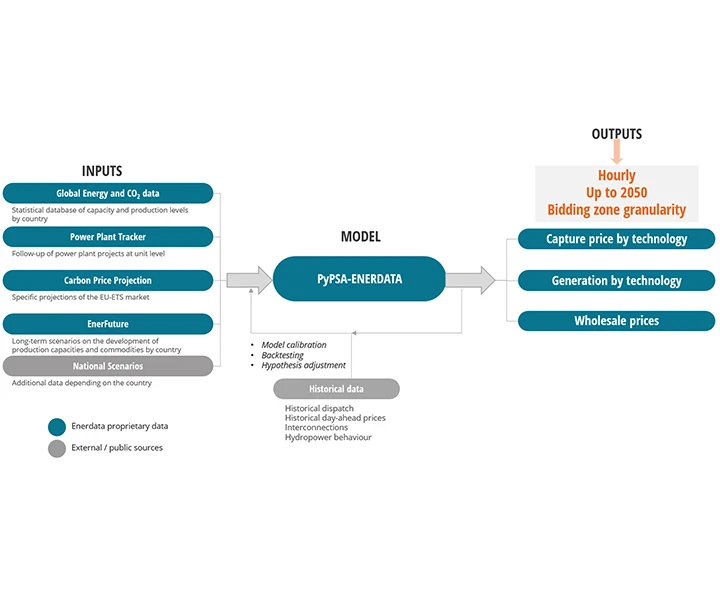
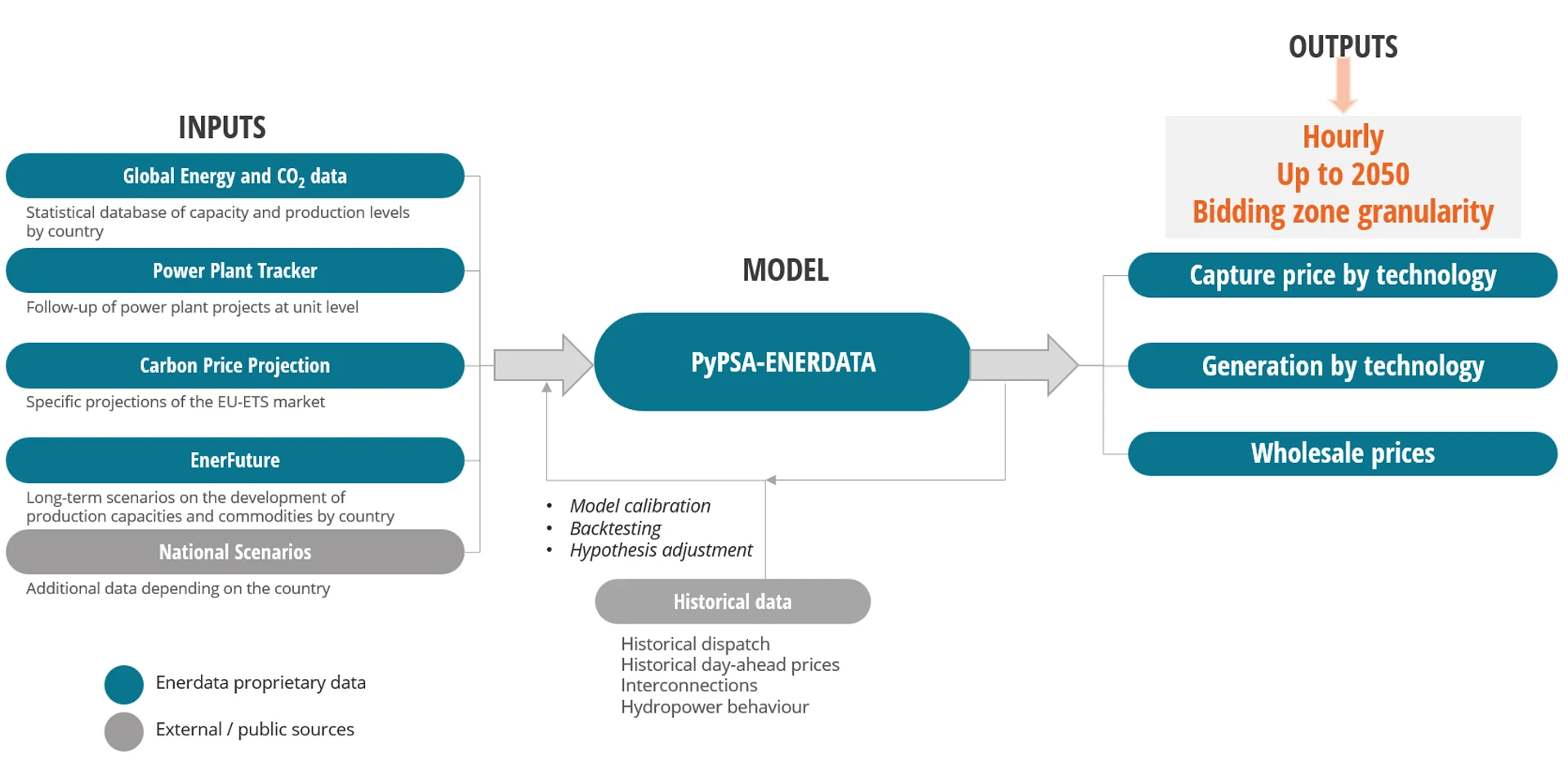
The PyPSA-ENERDATA model was developed to simulate the hourly dispatch of electricity markets and to analyse how long-term developments in capacities and demand influence wholesale electricity prices.
It builds on Enerdata’s wider energy-climate modelling system, using outputs from POLES-Enerdata model and inputs from EnerFuture, Global Energy and CO2 Data, Carbon Price Forecasts, and Power Plant Tracker to provide a detailed electricity-market perspective. By translating long-term energy scenarios into hourly dispatch and power price modelling at bidding-zone level, the model helps to analyse how evolving capacity and demand developments influence electricity-market dynamics.
Key benefits
What makes our model unique
- Most electricity forecasting models estimate future installed capacities by optimising the total system cost over a long-term horizon. This leads to an « ideal » capacity building.
- In real life, capacity development depends on several other factors (national subsidies, geopolitical factor, electrification of end-uses, other fuels demand and costs…).
- Instead of choosing an « electrically optimised » path for the development of installed capacities, Enerdata leverages the POLES-Enerdata model for the estimation of future capacities.
- This model encompasses the global energy system including ongoing projects, national objectives, macro-economic equilibriums...
- Enerdata Electricity Price Scenario model capitalises on POLES results to detail the influence of its capacity scenarios into hourly-level wholesale prices.
Why PyPSA
- PyPSA is an open-source python library developed and maintained by the Technical University of Berlin (TU Berlin)
- It is a multi-energy library that can be used both to model short term dispatch and long-term capacity building scenarios.
- It converts the optimisation problem of hourly dispatch into linear equations. It can additionally include non-linear constraints (e.g., start-up minimum levels, ramping conditions) using a Mixed Integer Linear Programming approach.
Outcomes:
- Evolution projections up to 2050:
- Installed capacities, detailed by technologies
- Production costs
- Demand
- Interconnection capacities and exchanges
- Power generation by technology
- Power price projections up to 2050:
- Average yearly prices
- Hourly day-ahead prices
- Monthly and daily renewables capture prices
Coverage:
- Extended view of the European power market including 34 bidding zones
- Unit-level breakdown of installed capacities for thermal-gas sector by bidding zone, based on Power Plant Tracker database.
- Possible extension (on request) to countries with a zonal market, with custom modelling of dispatch behaviours.
Specificities:
- Reproduction of negative prices
- Plant level granularity integrating announced projects
- Bidding zone granularity
- Precise decomposition of power demand using our Granular Energy Demand Forecast module (European countries only)
- Integration of multiple BESS technologies (2.5- and 4-hours durations)
- Integration of Demand Response
PyPSA-Enerdata model is based on the open-source library PyPSA and on Enerdata’s pre-existing energy-climate scenarios. It has been developed by our multi-skilled team of experts (modellers, analysts, economists) and our extensive data collection on the relevant topics such as electricity demand and power plant level details.
References
Long term regional power price projections in Southeast Asia for the purchase strategy of a large consumer (confidential)