Request the full Energy Demand Scenarios presentation (FREE)
Our modelling experts have recently released a comprehensive deep dive into Europe's energy demand. By examining the Transport, Buildings & Agriculture, and Industry sectors at a highly granular end-use level, this new analysis unpacks the fundamental drivers shaping the future of European energy consumption.
Here is a closer look at how EU energy demand is projected to evolve across key sectors
 Transport
Mobility, Modal shift and Electrification of the fleet
How could mobility habits evolve across the scenarios? What does it take to decarbonise transport?
While EnerBase sees a continued predominance of private vehicles, the EnerBlue and EnerGreen scenarios reveal a reduction in mobility demand after 2030. This is driven by modal shifts towards public transport, more robust public transport policies, and spatial planning geared towards proximity. In EnerBlue, total car fuel consumption in the EU sees a 5-fold decrease by 2050.
What will it take to decarbonise transport in France?
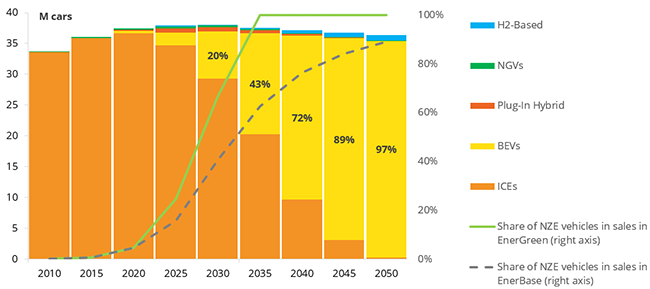
As the car remains the primary mode of transport, electrifying the vehicle fleet is a key driver for decarbonising road transport. In the EnerGreen scenario, the transition to battery electric vehicles (BEVs) is rapid and almost complete, aiming to replace internal combustion engines. From representing just 3% of the car fleet in 2025, electric cars scale to 98% (36 million cars) by 2050—a radical transformation driven by zero-emission targets.
CAR FLEET EVOLUTION IN FRANCE – EnerGreen Scenario
Source: Enerdata, Granular Energy Demand Forecast
 Buildings & Agriculture
Space heating energy mix, Renovation, and Electrification
What are the key trends in the sector and what main drivers affect them?
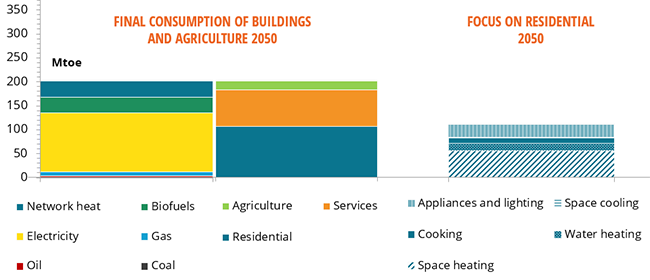
By dividing buildings and agriculture energy demand into sub-sectors, it appears that buildings energy consumption is halved by 2050 in the EnerBlue scenario.
Focusing on space heating—the most energy-intensive use in the residential sector—shows a rapid decrease in energy consumption across all three scenarios, along with a significant shift in the energy mix. Fossil fuels almost entirely disappear by 2050.
ENERGY CONSUMPTION IN EUROPE – EnerBlue-Scenario
Source: Enerdata, Granular Energy Demand Forecast
 Industry
Consumption, Electrification, and CO₂ Emissions
How will the electrification of energy use help decarbonise the EU’s industry by 2050?
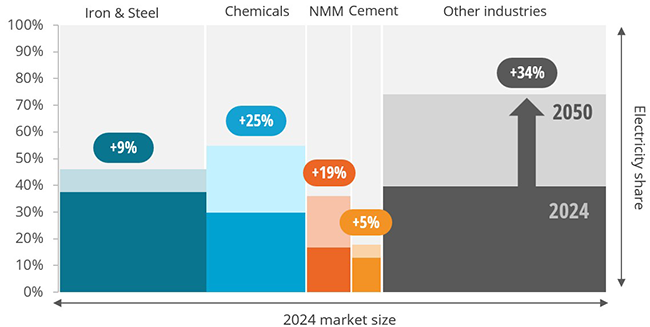
Industry energy consumption in EnerBlue is halved by 2050. The electrification rate will significantly increase across all industrial sectors in the EnerGreen scenario, driven by the switch of heating technology towards electricity.
Notably, despite the large-scale electrification of industrial processes, electricity consumption does not rise significantly, as efficiency gains offset most of the additional demand.This transformation has a profound impact on emissions: total CO₂ from fuel combustion decreases drastically, and by 2050, the industrial sector is completely decarbonised in both the EnerBlue and EnerGreen scenarios, aided by circularity and the development of carbon capture.
SHARE OF ELECTRICITY IN EACH INDUSTRY SECTOR IN ENERGREEN
Source: Enerdata, Granular Energy Demand Forecast
Granular Energy Demand Forecast
Download the full Energy Demand Scenarios presentation to get more insights on sectoral demand and drivers.
This new analysis has been conducted thanks to the release of the Granular Energy Demand Forecast module from EnerFuture, which delves deep into future energy demand trends and its drivers at the end-use level.
This module is built on Enerdata’s EnerFuture scenarios—three distinct energy-climate projections extending to 2050 that explore potential pathways for the global energy system (EnerBase, EnerBlue, and EnerGreen).

For each EnerFuture scenario, the Granular Energy Demand Forecast offers enhanced detail across demand sectors, featuring:
- Over 300 data series.
- Extensive sectoral and end-use breakdowns, providing deeper insight beyond traditional sector-level data.
- Dedicated coverage across eight European countries plus the EU aggregate.