Our modelling experts just released the 2026 edition of our 2050 Global Energy & Climate scenarios.
Below, we share a brief snapshot of some key highlights from this comprehensive study. Want the full story? Download the complete 55-page publication for free to explore all the data, detailed charts, and in-depth analysis.
|
The new analysis has been conducted thanks to the update of our EnerFuture database and its most recent developments:
|
ACCESS ENERFUTURE - FREE TRIAL |
EnerFuture relies on the recognised POLES-Enerdata model, an energy-economy-environment model of the global energy system, covering 66 countries up to 2050.
The Global Energy Scenarios publication details the three contrasted energy-climate scenarios up to 2050

Powering 2050: Balancing Surging Demand with Slower Generation
|
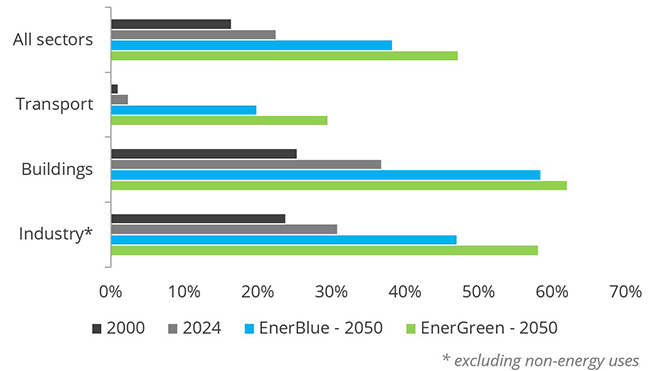
Share of electricity by sector (World)
|
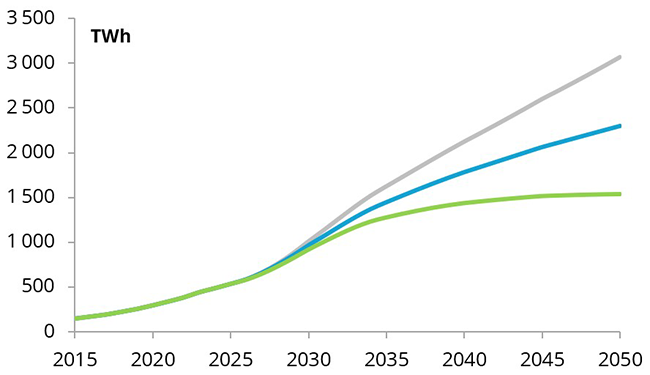
Data centres’ electricity demand (world)
|
Source: EnerFuture - Global Energy Scenarios 2026
Electrification is a core challenge across all three scenarios, relying heavily on the widespread deployment of clean technologies such as heat pumps and electric vehicles. This transition is further accelerated by booming data centres, whose electricity demand is projected to quadruple between 2024 and 2050 (EnerBlue Scenario). Crucially, however, power generation is forecast to grow at a slower rate than the historical average, highlighting a potential supply-demand gap.
Key Outcomes of the 2026 Analysis
- EnerBase (Continuation of existing trends): Leading to a temperature increase around 3°C, global energy demand continues to grow (+44% over 2024-2050). Fossil fuels remain highly dominant, and CO₂ emissions peak around 2045 before slightly decreasing.
- EnerBlue (Achievement of new NDCs): Leading to a temperature increase between 2°C and 2.5°C, energy demand remains stable. Electrification is heavily pushed, representing 38% of the mix in 2050. CO₂ emissions halve to around 23 GtCO₂ by 2050 thanks to energy sufficiency, efficiency, and renewable development.
- EnerGreen (Paris Agreement alignment): Leading to a temperature increase well below 2°C. Global demand decreases by 12% between 2024 and 2050, with almost half of the energy mix met by electricity. CO₂ emissions drop to around 10 GtCO₂ in 2050, reaching net-zero by 2065.