See also
Webinar - EU ETS Reform 2026: what does it mean for your business?
Understanding the future of carbon pricing and industrial competitiveness.
The European Commission's July 2026 proposal marks the most significant overhaul of the EU Emissions Trading System (EU ETS) since the Fit-for-55 package.
Expert insights into its implications for the EU carbon market and industry.
Request this Executive Brief in PDF format (FREE)
The European Commission's July 2026 proposal marks the most significant overhaul of the EU Emissions Trading System since the Fit-for-55 package. While the reform is formally designed to align the ETS with the EU's new 2040 climate target, its broader ambition is to reconcile three increasingly difficult objectives: maintaining climate ambition, preserving industrial competitiveness, and limiting the risk of excessive carbon market tightening.
Rather than pursuing a simple tightening of emissions caps, the proposal introduces a new balance between emissions reductions and economic competitiveness. It combines a slower cap decline with the reintroduction of international credits, the integration of carbon removals, a redesign of the Market Stability Reserve (MSR), and an unprecedented expansion of industrial support mechanisms.
Taken together, these measures would fundamentally reshape the ETS architecture during the 2030s. The carbon market would no longer operate solely as a scarcity-driven pricing mechanism, but increasingly as a strategic tool supporting industrial decarbonisation, investment mobilisation and Europe's competitiveness agenda.
A more flexible ETS for the 2040 climate target
The overarching objective of the EU ETS reform is to align its ambition with the EU's legally binding objective of reducing net greenhouse gas emissions by 90% by 2040, with up to 5 points of international credits. To that effect, the Commission proposes to deviate from the currently legislated restrictive trajectory and follow a significantly more flexible pathway.
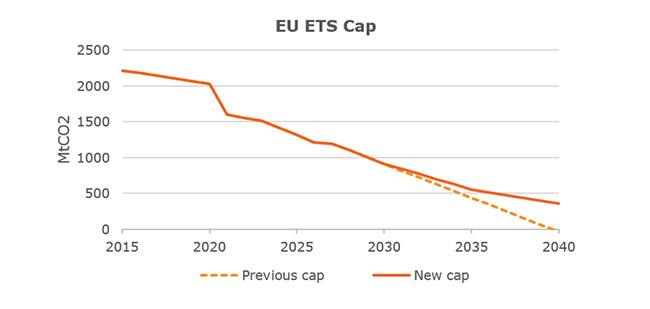
In practice, this change consists in lowering the Linear Reduction Factor (LRF), which determines how quickly the ETS cap declines. The previous trajectory was a 4.4% LRF during the 2031-2040 period, leading ETS emissions to reach zero by 2039. The Commission proposes to modify the LRF to 3.7% for 2031-2035 and 1.7% for 2036-2040.
This approach creates additional emissions space in the 2030s while maintaining consistency with the overall EU 2040 climate target. If the 1.7% value is maintained after 2040, this corresponds to ETS emissions reaching zero around 2050, hence postponing the ETS end game by a decade.
Figure 1: EU ETS Cap trajectory with the LRF change
Source: Enerdata, Carbon Price Projections
International credits make their return
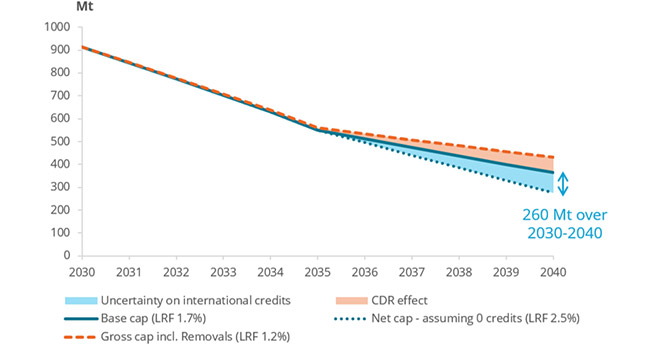
The European Commission proposes to bring international credits back into the climate architecture, although in a controlled and indirect way. Up to 260 million high-quality international credits could be purchased by the EU between 2036 and 2040. The purchasing would be realised through a central authority and backed by the sale of a corresponding number of EUAs. Market participants would therefore not access the credits themselves: the compliance would remain entirely based on EUAs.
This effectively enabled the Commission to propose a relaxed ETS cap after 2035, as the 260 million credits are already accounted for in the 1.7% LRF calculation. Overall, international credits could represent around 4-5% of the cumulative EUA supply over the 2030s decade. If enough high-quality high-integrity credits are not available, a fallback mechanism would bring the LRF back to 2.7%.
In the proposal, the integration of these international credits is considered binary: either the 260 million credits are purchased, which gives an LRF of 1.7% for 2036-2040, or no credits are bought and the LRF would be changed to 2.7%. Some actors wonder if it would be possible to partially incorporate these 260 million credits, so the actual LRF could probably be adjusted somewhere between 1.7% and 2.7%.
Carbon Removals to enter the ETS
Another landmark reform is the integration of permanent Carbon Dioxide Removals (CDR) into the ETS. The Commission rejected a direct offsetting mechanism and instead proposes a controlled approach based on central purchasing. Only CRCF-certified BioCCS and DACCS removals are considered.
The Commission intends to purchase a cumulative 250 million removal units by 2040 financed through the auctioning of additional EUAs, with a 48 Mt annual target for 2040.
This creates a new dynamic, with a net cap remaining linked to the climate ambition but with a gross cap increased through removal-backed allowances. ETS sectors gain additional emissions space. This mechanism is already raising concerns regarding environmental integrity and the future cost of removals, which may significantly exceed EUA prices. The Commission will therefore most likely need to find complementary sources of financing for the purchase of removals, estimated in the tens of billions of euros. Accounting for removals changes the actual LRF from 1.7% to about 1.2% over 2036-2040.
Market impacts
Combined with international credits, removals could materially increase allowance availability and exert downward pressure on EUA prices during the 2030s.
Figure 2: EU ETS Cap trajectory with international credits and removals
Source: Enerdata, Carbon Price Projections
A new market stability reserve for a smaller market
The proposal recognises that the ETS is moving from historical oversupply towards future scarcity. The current Market Stability Reserve (MSR), initially mainly designed to absorb the allowance surplus, is therefore being reviewed.
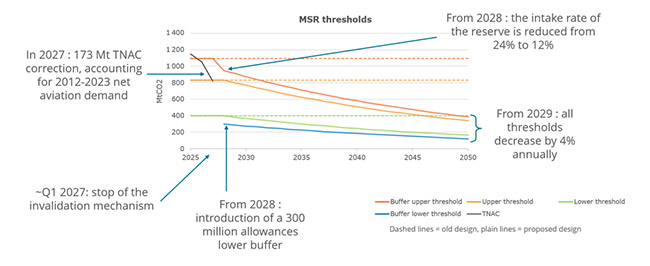
Key changes proposed include the end of allowances invalidation in 2027, a new lower buffer set at 300 million allowances, a MSR intake rate reduced from 24% to 12%, dynamic thresholds decreasing by 4% annually from 2029 onwards and a correction of historical aviation demand in TNAC calculations in 2027 with -173 Mt.
Figure 3: Changes expected for the Market Stability Reserve
Source: Enerdata, Carbon Price Projections
Strategic objective
By stopping invalidations, as the historical oversupply is no longer an issue, the Commissions aims to maintain a well-filled reserve that would provide greater flexibility for future interventions, ensuring sufficient room for action when market conditions change.
Correcting the TNAC would improve the measurement of the actual surplus, providing a more accurate representation of market fundamentals.
The introduction of a lower buffer, in the same way as the upper buffer, would help prevent threshold effects and ensure a smoother market response when the MSR starts releasing allowances.
Finally, dynamic thresholds would further enhance the system’s adaptability by allowing key parameters to evolve with changing market conditions, improving both stability and responsiveness over time.
The Commission is not introducing price controls such as a MSR with price-based criteria. Instead, it aims to create a smoother carbon price evolution through a stronger market liquidity and a better resilience against future shocks. All in all, the proposal should significantly reduce the risk of abrupt market tightening during the 2030s while preserving the ETS investment signal.
Large impacts on EU ETS price projections
These structural changes regarding the MSR, the EU ETS ambition and the larger scope integration have a major impact on the EU ETS price.
According to our own modelling results with the POLES-Enerdata model, the new EU ETS price projection rises to around 100€ in 2030 and 180€ in 2040. Compared to the actual market design, the proposed changes for the cap induce a bearish trend for the EU ETS price, of about 15% in 2030 and 30% in 2040.
International credits or removals integration would have a massive impact on the 2040 price. If no international credit is considered on the market (i.e. the 2036-2040 actual LRF would be more around 2.5% to 2.7%), the impact on 2040 EU ETS price is bullish. A 30% higher price could be expected in this case.
Likewise, if no removals end up being integrated in the EU ETS market up to 2040, the impact is also bullish with another 30% increase for the 2040 EU ETS price.
A new deal for boosting industry
Perhaps the most politically significant part of the reform concerns industrial competitiveness. The Commission explicitly states that industry needs stronger support to decarbonise while remaining competitive globally.
Free allocation survives longer
For sectors covered by the Carbon Border Adjustment Mechanism (CBAM), free allocations are being phased out gradually from 2026 to 2034, while CBAM is phased in. The proposal extends free allocation for these CBAM sectors until 2037 with the change of the « CBAM Factor » used to calculate the amount of free allocations, to phase-out those progressively. For non-CBAM sectors, the free allocation continues based on Benchmarks (no CBAM factor equivalent) and the proposition would stop the free allocation in end-2040. Hence, the carbon leakage protection continues, the carbon leakage list remains in place, and the benchmark-based allocation remains the basis of the system.
Stronger conditionality
The real revolution lies in conditionality. From 2031 onwards, installations will need to submit an: "Invest in EU Decarbonisation Plan" to access free allocation.
The mechanism works as follows: 80% of free allocation granted after submission and validation of the plan, while 20% granted only after demonstrated implementation and emissions reductions
Most importantly, the installations must invest an amount equivalent to 100% of the financial value of their free allocation into ETS-related decarbonisation projects.
This transforms free allowances from a simple carbon leakage protection tool into a direct industrial investment mechanism.
Benchmarks continue, but evolve
The benchmark system is prolonged until 2040. Benchmark updates are maintained, with min-max range reduced to 0.3%-2.0%/year. The Commission also proposes to introduce sector-specific fallback heat and fuel benchmarks. This responds to longstanding industry criticism that common fallback benchmarks do not reflect sectoral realities.
EU ETS price implications
The higher conditionality provisions of free allocations may have an impact on the EU ETS price. Indeed, a higher constraint may be seen in early 2030s as the distribution of 20% of free allocations would be delayed until emission reductions are measured in practice. In addition, the high conditionalities bring some uncertainty about whether all industrial players are able to meet the decarbonisation requirements, in order to actually get their free allocation.
Simulating this conditionality effect in POLES Enerdata leads to a 6% higher price in 2030 and a 3% lower price in 2040.
The EU ETS becomes an industrial investment platform
The proposal transforms the ETS from a carbon pricing mechanism into a major industrial policy instrument.
Industrial Decarbonisation Bank (IDB)
A new Industrial Decarbonisation Bank is created from 2028, with a political objective is to generate €100 billion of industrial decarbonisation investment. The IDB will start with a first phase named ETS Investment Booster over 2028-2031. From 2031, the second phase would see the IDB move towards competitive auctions, Carbon Contracts for Difference (CCfDs) and long-term investment support.
The ETS Investment Booster will allocate 400 million allowances to support industrial projects on a first-come-first-served basis. Support will come through a fixed carbon premia on verified emission reductions, with a payment in EUAs and with support up to 10 years per project. The 400 million EUAs set aside for the booster originate from unallocated leftovers from phase IV (from free allocation buffer and new entrants Reserve). It corresponds to a 6% additional EUA supply during the 2030s.
In its second phase, the IDB will be financed through 400 additional EUAs reserved from the auction pool.
In addition to the IDB, the Innovation Fund is maintained, with a plan to replenish its funding. While the Innovation Fund focuses on the development of early-stage technologies, the IDB will support the scale-up of mature technologies.
Finally, Member States will be required to dedicate at least 50% of ETS revenues to strategic decarbonisation priorities including electrification, hydrogen, CCS, CCU, industrial decarbonisation, grid reinforcement and innovation. The Commission hence responds to criticisms about Member States not following through on their commitments to use ETS revenues towards decarbonisation.
EU ETS price implications
The investment booster will definitely have an impact on the EU ETS as a massive additional supply of EUAs in the 2030s. The aim to decarbonise industrial actors has also an impact on the price, since industrials may have a lower EUA demand as they progressively decarbonise.
Simulating the investment booster program within POLES-Enerdata leads to a 2030 EU ETS price 40% lower as actors anticipate an increase of the supply in the 2030s. This program being implemented for 10 years, the impact would mostly have worn off by 2040.
KEY TAKEAWAYS
The Commission's ETS reform is not simply a climate package. It is a competitiveness and industrial transformation package built around the carbon market.
The proposal creates a fundamentally different ETS for the 2030s:
- slower cap decline, compatible with the EU 2040 climate targets;
- international credits indirect inclusion;
- carbon removals integration within the EU ETS market;
- more flexible market stability mechanisms;
- extended free allocation for industrials actors;
- strong investment conditionality;
- massively expanded industrial support.
If adopted broadly in its current form, the reform would mark the transition from a carbon market primarily designed to constrain emissions towards a hybrid system combining carbon pricing, climate policy, industrial competitiveness and investment support. This evolution could have profound implications for EUA prices, with globally bearish impacts compared to the projections done with the actual framework, for industrial investment decisions and the pace of Europe's clean industrial transition over the next two decades.