The emerging CCUS value chain: technologies, infrastructure and economics
Request the Brief in PDF format (Free)
CCUS (Carbon Capture, Utilisation and Storage) technologies have long been a subject of controversy. Yet the ground is shifting. In 2025, the world crossed a significant threshold: commercial-scale carbon capture began operating in hard-to-abate industrial sectors for the first time, with the commissioning of Heidelberg Materials' Brevik cement plant in Norway. Investment in CCUS has grown more than fifteenfold since 2020, exceeding USD 5 billion in 2025, and over 30 projects reached final investment decision in the past two years alone. Europe, in particular, is emerging as the global engine of deployment.
In this article, we examine the most promising technologies across the CCUS value chain, from point-source capture and carbon removal to CO2 transport and geological storage, and assess their realistic role in climate change mitigation. We also explore how certain processes may find applications beyond mitigation alone, generating economic value through CO2 utilisation pathways such as synthetic fuels, construction materials and low-carbon chemicals, a dimension that could prove decisive in establishing the long-term commercial viability of the sector.
Carbon capture various strategies and technologies
Carbon capture processes involve separating and removing CO2 from a mixed gas stream. The source of that stream defines two broad categories: point-source capture, which targets flue gases emitted by industrial facilities such as power plants or cement kilns, and direct air capture (DAC), which extracts CO2 directly from the atmosphere. This distinction has major implications for cost and energy intensity: CO2 concentrations in industrial flue gases typically range from 5% to 15% by volume, compared to just 0.042% in ambient air, making point-source capture significantly cheaper and less energy-demanding than DAC. Long regarded as an immature and peripheral technology, carbon capture is now experiencing rapid development. As global greenhouse gas emissions are still increasing, a growing consensus holds that carbon dioxide removal (CDR) technologies are becoming a necessary complement to emissions reduction efforts, both to achieve climate neutrality by 2050 and, ultimately, to draw down accumulated atmospheric CO2. The IPCC’s Sixth Assessment Report identifies CCS as one of several key mitigation levers and puts its 2030 potential at about 0.5 Gt CO2eq per year in the energy sector, 0.3 Gt for BECCS and 0.15 Gt for industrial CCUS, at costs of USD 50–200 per tonne, among the highest of the options assessed. These estimates rest on few sources for the energy sector (±50%), are not necessarily additive, and reflect what could be achieved at that cost rather than a deployment forecast 0.5 Gt1. Enerdata’s own estimates for total CO₂ capture globally by 2050 vary according to the scenarios (1 Mt for EnerBase, 1,366 Mt with EnerBlue and 2,500 Mt with EnerGreen). While those levels represent only a few percents of current global emissions (~38.4 Gt CO2 per year), CCS is considered essential for decarbonising hard-to-abate sectors such as cement, steel and chemicals where process emissions cannot be eliminated through electrification alone. Capture is cheapest for high-purity streams (around USD 15–25/tCO2 for processes such as natural gas processing or bioethanol production) and rises to roughly USD 40–120/tCO2 for dilute flue gases from cement plants and power generation2. Direct air capture remains substantially more expensive, with recent cost estimates of up to USD 340/tCO2 for liquid-solvent DAC and up to USD 540/tCO2 for solid-sorbent DAC, although these costs are expected to fall significantly as the sector scales up3.
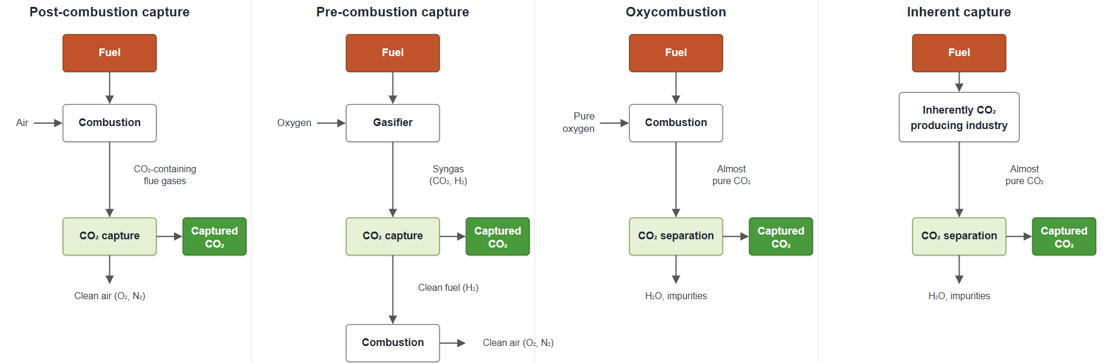
Regarding carbon capture at point source emissions, four main strategies can be adopted (Fig. 1):
- Post-combustion capture is the most widely deployed approach: CO2 is separated from the flue gases produced after the combustion of a carbon-containing fuel, whether fossil or biomass-based, the latter giving rise to the BECCS (Bioenergy with Carbon Capture and Storage) concept. Because it operates downstream of the combustion process, post-combustion capture can be retrofitted onto existing installations, making it particularly attractive for near-term industrial deployment.
- Pre-combustion capture takes the opposite approach, removing carbon from the fuel before it is burned: the fuel is first processed through a gasifier to produce a syngas rich in H2 and CO2, the CO2 is then separated and stored, and the remaining hydrogen is combusted as a clean fuel.
- Oxy-combustion eliminates the dilution problem altogether by burning the fuel in pure oxygen rather than atmospheric air, thereby avoiding the ~78% nitrogen content of air in the flue gas stream; the resulting exhaust consists almost entirely of CO2 and water vapour, from which CO2 can be separated at relatively low cost and energy penalty.
- Inherent capture is a category that encompasses industrial processes which, by their very nature, produce a concentrated or near-pure CO2 stream as part of their process chemistry, such as ammonia synthesis, natural gas processing, or bioethanol fermentation, and therefore require little more than compression and drying rather than full chemical separation, resulting in the lowest capture costs across the value chain.
Figure 1: Main carbon capture strategies for point source emissions
Source: Enerdata
CO2 separation processes
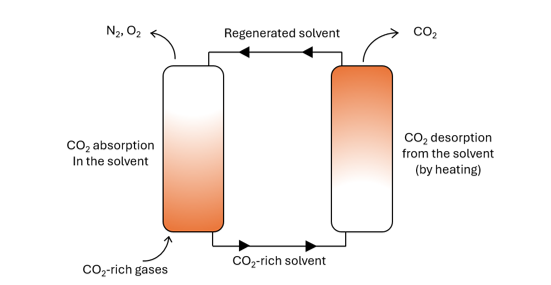
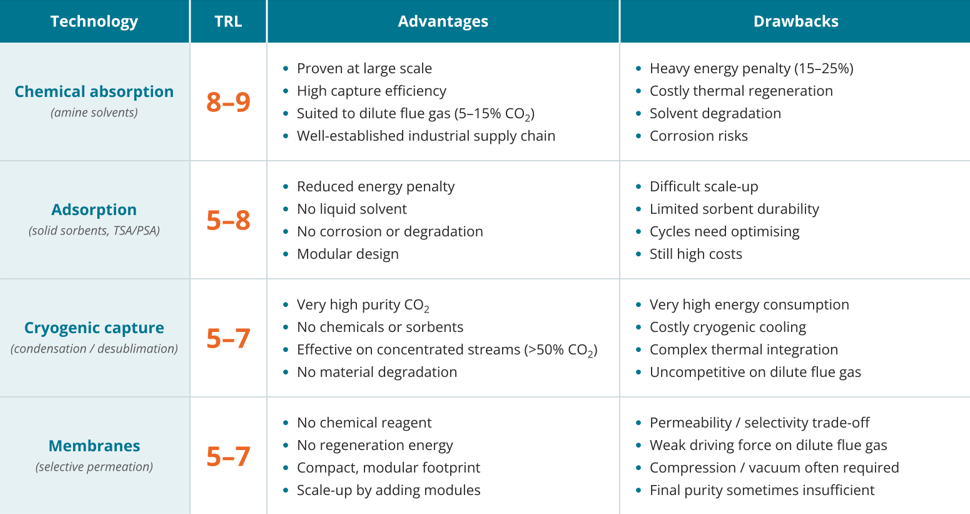
Chemical absorption (Fig. 2) captures CO2 by reacting to flue gas with an amine-based solvent that is then heated in a separate unit to release a concentrated CO2 stream and regenerate the solvent in a continuous loop. This is a mature technology whose main drawback is the high thermal energy cost of regeneration.
Figure 2: Chemical absorption
Source: Enerdata
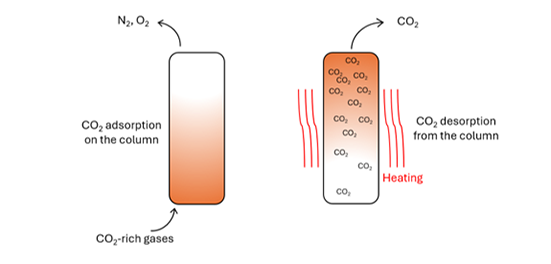
Adsorption-based capture (Fig. 3) binds CO2 onto solid sorbents that are then regenerated through temperature or pressure swings, offering a more modular and less energy-intensive alternative to chemical absorption, though still limited by scale-up and sorbent durability challenges (Technology Readiness Level (TRL) of 5–8).
Figure 3: Adsorption-based carbon capture
Source: Enerdata
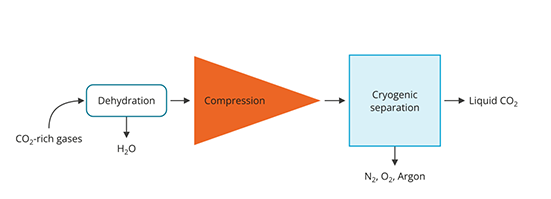
Cryogenic carbon capture (Fig. 4) separates CO2 by progressively cooling the flue gas until CO2 condenses or solidifies while other gases remain gaseous, yielding a high-purity stream without solvents or sorbents but at the cost of high refrigeration energy, making it most competitive for CO2-rich flue gases (above 50%) and currently at TRL 5–7.
Figure 4: Cryogenic carbon capture
Source: Enerdata
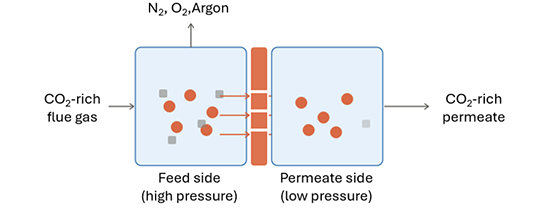
Membrane-based carbon capture (Fig. 5) separates CO2 by driving it through a selectively permeable barrier under a partial pressure differential, offering a compact, reagent-free and modular alternative to chemical absorption, but constrained by an inherent permeability-selectivity trade-off and the low CO2 concentrations of typical flue gases, with current maturity at TRL 5–7.
CO2 transport & storage options and challenges
Once captured and compressed, CO2 must be transported from the capture site to a utilisation facility or a geological storage site. This step involves several technical considerations relating to the physical state of CO2, the transport mode, and the quality specifications of the CO2 stream.
CO2 can be transported in four physical states: gaseous, liquid, dense/supercritical, and solid, though the latter is not relevant for large-scale transport. For pipeline transport, CO2 is preferably maintained in dense phase (above its critical pressure of 73.8 bar and critical temperature of 31.1°C), which combines the high density of a liquid with the low viscosity of a gas, maximising throughput efficiency and avoiding two-phase flow issues that could damage pipeline infrastructure. For shipping, CO2 is transported in liquid form at medium pressure (around 15 bar) and low temperature (around -30°C), similar to the conditions used in the established food-grade CO2 shipping industry4. Compression and conditioning typically add USD 11–28/tCO2 to the overall chain cost and must be carefully managed to meet pipeline and storage site specifications5.
A critical and often underestimated technical challenge is the purity of the CO2 stream entering the transport system. Captured CO2 inevitably contains impurities (mainly water, nitrogen, oxygen, hydrogen sulphide, SOx and NOx) whose presence affects pipeline integrity, compression requirements, storage reservoir behaviour and long-term monitoring. The acceptable levels of these impurities vary depending on the capture technology used, the transport mode and the storage formation, and no universally agreed international standard currently exists5. This lack of harmonised CO2 quality specifications is considered one of the key technical barriers to the development of open-access, multi-user CO2 transport networks in Europe, where streams from different industrial sources with varying compositions may need to be commingled.
Pipelines are the most mature CO2 transport technology (TRL 10), with over 9,500 km of CO2 pipelines currently in operation globally (primarily in the United States, where they have been used since the 1970s to transport CO2 for enhanced oil recovery4). CO2 pipelines share many design features with natural gas pipelines but require specific materials and coatings to withstand the corrosive effects of CO2 in the presence of water, as well as careful management of pressure and temperature to maintain dense-phase conditions throughout the line6.
In Europe, dedicated CO2 pipeline networks are still at an early stage: the Fluxys C-grid in the Port of Antwerp area, which began construction in May 2025, is one of the first open-access CO2 pipeline systems on the continent7. Several large cross-border pipeline projects are in planning, including a proposed 1,000 km CO2 Highway Europe connecting industrial clusters in Germany, Belgium and the Netherlands to Norwegian North Sea storage sites8.
CO2 shipping is emerging as a particularly relevant transport solution for Europe, given the geographical distance between many industrial emitters (notably in Southern and Eastern Europe) and the main offshore storage sites in the North Sea. The Northern Lights project in Norway is the world's first commercial-scale CO2 shipping operation, using three dedicated vessels of 7,500 m3 capacity each to transport liquefied CO2 from capture sites to an onshore receiving terminal before injection offshore. However, the current fleet of CO2 vessels is small and largely derived from the food industry, operating at medium pressure (15 bar). The next generation of purpose-built large-scale CO2 carriers, with capacities of 40,000 to 70,000 m3 operating at lower pressure (around 7 bar), is currently at prototype stage (TRL 6–7) and will be essential to achieving the economies of scale required for intercontinental or long-distance European transport4. A dedicated report on CO2 shipping concluded that CO2 shipping is poised for rapid growth as more projects opt for maritime transport over pipelines9.
While CO2 utilisation pathways are gaining interest, geological storage is expected to dominate at scale in the future. It is worth noting that today's reality differs sharply from the long-term target: roughly 73% of currently operating capture capacity is still linked to enhanced oil recovery (EOR) or industrial uses rather than dedicated permanent storage4. This structural shift from utilisation and EOR towards dedicated permanent storage is one of the defining transitions underway in the sector.
Several significant challenges remain on the storage front. Long lead times for site assessment (typically 3 to 10 years, involving subsurface modelling, seismic surveys, test drilling and regulatory approvals) mean that storage development must begin well ahead of capture project planning. The long-term liability for stored CO2, covering potential leakage, induced seismicity and post-closure monitoring obligations that can extend over decades, raises complex questions about risk allocation between operators, governments and society that remain largely unresolved in most jurisdictions. Under the EU's CCS Directive, operators must demonstrate that stored CO2 is fully contained before liability transfers to national authorities after a minimum 20-year post-closure period, a requirement that introduces significant uncertainty for project developers. Finally, public acceptance of storage infrastructure has proven to be a tangible obstacle in several European countries, most notably in the Netherlands where Shell's Barendrecht project was cancelled in 2010 following sustained local opposition, underlining the importance of early and transparent community engagement in any storage development process.
How Much Does Carbon Capture and Storage Cost in Europe?
The economics of CCS vary considerably across each step of the value chain, from capture through transport to geological storage10.
Capture consistently represents the largest share of total CCS chain costs and is primarily driven by the concentration of CO2 in the gas stream being treated. For industrial processes generating high-purity CO2 streams (such as ammonia production, natural gas processing or bioethanol fermentation), capture typically costs USD 11–34/t CO2, requiring only compression and drying rather than full separation5. For medium-concentration streams (cement kilns, steel blast furnaces, refineries and waste-to-energy plants), where CO2 typically represents 5–15% of flue gas, costs rise to USD 28–140/t CO2. Cement is at the upper end of this range4, with CCS increasing levelised production costs by 60–130%, while steel plants see cost increases of around 10–20%.
The choice of capture technology also influences costs. Chemical absorption with amine solvents, the most mature approach, remains cost-competitive but carries a significant energy penalty for solvent regeneration. Solid sorbent adsorption is emerging as a cheaper and less energy-intensive alternative for modular applications, while membrane separation promises lower energy use but currently faces higher capital costs at industrial scale6.
For carbon dioxide removal technologies, costs are significantly higher. BECCS ranges from USD 45–85/t CO2 depending on the sector of application. Direct Air Capture (DAC) is currently priced at USD 110–900/t CO2 and is considered unlikely to fall below USD 340/t CO2 even at gigaton scale5, although it is a very debated point and some believe that costs can go below USD 150/t CO211. Looking ahead, cost reductions of 20–40% are anticipated across most industrial capture applications by 2035 as technology matures and supply chains develop.
CO2 transport costs depend heavily on distance, volume, transport mode and degree of infrastructure sharing. Compression and conditioning prior to transport add a further USD 11–28/t CO2 regardless of mode5.
For pipeline transport, economies of scale are dramatic4: costs range from USD 9–11/t CO2 for a small 3 Mt/year line down to USD 2–3/t CO2 for a large 30 Mt/year network over 250 km. In Europe, CATF's geospatial cost modelling shows that, with only the announced (mostly offshore) storage sites and without pipeline access, transport and storage costs for cement and lime plants range from USD 38 to 240/t CO2 (median USD 120/t CO2). When pipeline access is enabled, 79% of plants achieve combined transport and storage costs below about USD 110/t CO2; if storage is also developed more widely, including onshore, 90% of plants fall below about USD 70/t CO2 (median USD 43/t CO2)12.
For CO2 shipping, current cost estimates range from USD 17–45/t CO2 for dedicated vessel connections, with significant reduction potential as fleet sizes grow13.
Overall, European transport costs are projected to fall by around 18% by 2030 and 37% by 2050 as infrastructure expands3. Transport thus weighs much less than capture for most emitters, but can rival it for sites located far from storage, and it is a more readily actionable lever: shared pipelines and more geographically distributed storage sites would reduce transport distances and open CCS to a broader range of industrial emitters.
Storage costs are the most variable component of the CCS chain, driven primarily by geological conditions. A recent modelling study by the Global CCS Institute identifies boundary conditions as the single most decisive cost driver: closed-boundary systems (where pressure cannot dissipate into surrounding formations) can cost up to four times more than open-boundary equivalents14.
For onshore saline aquifer storage, costs range from USD 2–15/t CO2 under favourable conditions to USD 10–58/t CO2 under the most challenging geological settings but rarely exceed USD 60/t CO2 even in worst-case onshore scenarios. Offshore storage carries a higher base cost due to additional infrastructure complexity, ranging from USD 5–31/t CO2 with open boundary conditions, but up to USD 147/t CO2 in constrained settings (closed boundaries, poor-quality reservoirs). Notably, offshore projects with open boundary conditions can achieve costs comparable to onshore sites and remain the preferred option across much of Europe given geological availability and social acceptance5.
When capture, conditioning, transport and storage costs are aggregated, end-to-end CCS costs currently range from around USD 25–60/t CO2 for the lowest-cost applications (high-purity streams with onshore storage) to USD 120–200/t CO2 or more for harder industrial sources with offshore transport and storage4,9. A presentation to the European Parliament estimated the average end-to-end cost for EU industrial CCS at between USD 170–340/t CO2.
These figures are telling when set against the current EU ETS carbon price, which averaged around USD 90–96/t CO2 (EUR 80–85/t) during the first semester of 2026, well below the full cost of CCS for most industrial applications. This gap explains why most operational CCS projects today still rely on blended public funding, Carbon Contracts for Difference (CCfD) or long-term offtake agreements to bridge the commercial viability gap, and why policy support remains indispensable to scaling the sector in the near term.
Beyond storage, the long-term value of carbon capture may also lie in treating CO2 as a feedstock rather than a waste stream. The most mature route is synthetic chemistry: combined with low-carbon hydrogen, captured CO2 can be converted into platform molecules such as methanol (whose downstream derivatives include formaldehyde, olefins, and synthetic fuels) as well as ethylene, formic acid, and polycarbonates, through thermocatalytic or, increasingly, electrochemical pathways16. Altogether, e-fuels and chemicals are expected to represent the vast majority of CO2 use, although other applications, such as building materials or precision fermentation represent further opportunities. LanzaTech, for instance, already sells protein derived from industrial gases and has set a roadmap toward commercial-scale CO2-to-protein production by 2028. Crucially, the economics of these applications improve markedly when CO₂ is valorised in short loops close to the point of capture: co-locating conversion units with high-purity emitters such as ammonia or ethanol plants cuts transport, compression, and purification costs, and integrated coproduction systems have been shown to lower both emissions and the effective cost of the captured18.
Targets, commitments & policy frameworks: EU’s strong ambitions by 2050
The European Union has moved decisively from voluntary ambition to binding legislative targets for CCS, marking a significant shift in the policy landscape. The Net-Zero Industry Act (NZIA), adopted in May 2024, is the cornerstone of this new framework. It sets a binding EU-wide target of 50 MtCO2/year of injection capacity by 2030, to be developed within storage sites located in the EU5. Crucially, the NZIA also places a mandatory obligation on 44 European oil and gas producers to collectively contribute to this target, calculated pro-rata based on each company's share of EU crude oil and natural gas production between 2020 and 2023 7.
Looking beyond 2030, the EU's Industrial Carbon Management Strategy (February 2024) sets more ambitious long-term targets: approximately 280 MtCO2/year by 2040 and 450 MtCO2/year by 2050 across the European Economic Area (the latter representing around 13% of the EU's 2022 total emissions). These figures are consistent with the JRC's POTEnCIA model projections of approximately 400 MtCO2/year of annual capture within the EU alone by 2050.
The Clean Industrial Deal (February 2025) further reinforced this direction by positioning industrial decarbonisation, as a central pillar of European industrial competitiveness and announced the creation of an Industrial Decarbonisation Bank planned for 2026 to help finance the transition7. The legal basis for CO2 storage remains the 2009 CCS Directive (2009/31/EC), complemented in May 2025 by a Delegated Regulation and a Decision under the NZIA setting out each oil and gas producer's contribution to the 2030 injection target19. In October 2025, the European Commission also launched a public consultation on new legislation for CO2 markets and infrastructure, signalling further regulatory developments to come.
Over the long-term, when the European economy reaches net zero, the total CO2 capture requirement is broadly estimated at 300–500 Mt/year, with the European Commission's own modelling pointing to approximately 450 Mt/year20. This breaks down across three main source categories: biogenic sources (BECCS) could realistically contribute 80–105 Mt/year, by equipping 38–50% of biomass CHP, power and heat plants, pulp & paper mills and waste-to-energy facilities (technical potential of about 220 Mt/year21), though sustainable biomass constraints cap the realistic ceiling well below the theoretical ~480 Mt/year potential. Hard-to-abate industrial sectors would represent the core of CCS activity, with cement alone averaging ~65 Mt/year (where CCS is essentially the only viable solution for process emissions), iron & steel ~50 Mt/year, and chemicals ~32 Mt/year (totalling roughly 143–280 Mt/year depending on the degree of competing decarbonisation pathways such as hydrogen-based steelmaking and electrification)22.
The remainder, needed to bridge the gap to the 450 Mt/year target, would come from other point sources and carbon dioxide removal (CDR) technologies, including waste-to-energy plants (up to 75 Mt/year), fossil-fuelled power with CCS (~30–55 Mt/year during the transition)23, and Direct Air Carbon Capture & Storage (DACCS), which could contribute up to 150–200 Mt/year in high-ambition scenarios24, albeit at significantly higher cost. Taken together, the assessment suggests that meeting net-zero targets in Europe would be difficult without significant CCS deployment. In this view, hard-to-abate industries would account for much of the capture activity, biogenic sources could contribute negative emissions, and DACCS might help address residual emissions where other options are limited or unavailable.
Beyond the EU-level framework, several Member States and associated countries have set their own national CCS targets and strategies:
- Norway anchors European storage rather than capture. The state covered roughly two thirds of the Longship/Northern Lights cost (about USD 2 billion), and Northern Lights began injecting in August 2025, the world's first open-access cross-border CO2 store. Phase 2, sanctioned in March 2025, lifts capacity to at least 5 MtCO2/year from 2028. Norway has set no national capture target.
- The United Kingdom runs Europe's most complete national programme: 20–30 MtCO2/year of capture by 2030 and over 50 Mt/year by 2035, backed by GBP 21.7 billion (about USD 29 billion) over 25 years for its two Track-1 clusters. Both reached financial close (East Coast Cluster in December 2024, HyNet's Liverpool Bay in April 2025). Its Carbon Contracts for Difference and its Regulated Asset Base model for transport and storage are now the reference templates in Europe.
- The Netherlands was the earliest EU mover, funding CCS through the SDE++ scheme (over USD 10 billion committed, USD 2.4 billion of it to Porthos) rather than through a headline target, with supported volumes initially capped at 7.2 MtCO2/year to 2030 under its Climate Agreement. Porthos is under construction and Aramis in advanced development, together up to 24.5 MtCO2/year.
- Denmark has committed DKK 28.7 billion (about USD 4.3 billion) in a single CCS tender requiring capture plants to be commissioned by end-2029 and 2.3 MtCO2/year captured and stored from 2030, on top of an earlier contract with Ørsted for 0.43 Mt/year. Greensand, in the Danish North Sea, is due to become the first operational CO2 store in the EU. Denmark has also signed cross-border CO2 transport agreements with Norway, Sweden, France and Belgium.
- Germany, Europe's largest industrial emitter, lifted its de facto ban only in November 2025, when the Carbon Dioxide Storage and Transport Act (KSpTG) replaced the 2012 statute that had confined CCS to demonstration projects. It permits commercial offshore storage, creates a first unified permitting regime for CO2 pipelines, and, with the London Protocol amendment ratified in January 2026, opens the way to CO2 export. Given a congested exclusive economic zone, export to Norway and Denmark is the near-term route. No capture target has been set.
- France published a national CCUS strategy in 2023 targeting 4–8 MtCO2/year captured by 2030 and 15–20 Mt/year by 2050, concentrated on two to four industrial-port hubs (Dunkirk, Le Havre, Fos-sur-Mer, Saint-Nazaire, the Rhône corridor). Support runs through tendered Carbon Contracts for Difference and the France 2030 low-carbon industrial zones programme. With no domestic storage expected before the 2030s, French emitters depend on North Sea capacity, which makes cross-border access the binding constraint.
What Is the Current State of CCUS Deployment in Europe in 2026?
Europe's CCUS industry has crossed a decisive threshold in 2025, moving from pilot-scale demonstration to commercial-scale deployment for the first time. In its 2026 Global Status report, the Global CCS Institute counts 15 operational CCS facilities in Europe and 21 under construction, with a development pipeline of 141 MtCO2/year25; operating capture capacity, still below 3 Mt/year in mid-2025, is expected to exceed 90 Mt/year by 2030 if the current project pipeline materialises26.
The most significant milestone of 2025 was the commissioning of Heidelberg Materials' Brevik CCS plant in Norway, the world's first commercial-scale carbon capture facility at a cement plant, capturing 0.4 Mt CO2/year and permanently storing it via the Northern Lights infrastructure in the Aurora saline aquifer beneath the Norwegian North Sea5.
Other major projects now operational or in advanced construction in Europe include:
- Northern Lights Phase 1 (Norway), the world's first open-access, cross-border CO2 transport and storage facility, operational since 2025 with 1.5 MtCO2/year of storage capacity, developed by Equinor, Shell and TotalEnergies with strong Norwegian government backing.
- Ravenna CCS Phase 1 (Italy), Eni's natural gas treatment plant capturing 25,000 tCO2/year in its initial phase, with expansion to 4 MtCO2/year by 2027 planned via the Ravenna hub in the Adriatic Sea.
- Porthos (Netherlands), the Port of Rotterdam CO2 Transport Hub and Offshore Storage project, currently under construction and targeting 2.5 MtCO2/year stored in depleted North Sea gas fields.
- Twence CCU (Netherlands): a capture plant at a waste-to-energy facility where captured CO₂ is supplied directly to the neighbouring greenhouse industry, representing one of Europe's first operational carbon utilisation projects at industrial scale.
Beyond these operational projects, ten projects reached Final Investment Decision in Europe between December 2024 and October 2025 alone, representing approximately 4 MtCO2/year of new capture capacity and 14 Mt CO2/year of new storage capacity7.
Despite the EU's ambitious framework, progress against the 2030 target remains significantly behind schedule. An analysis of 33 planned CO2 storage sites across the European Economic Area and the UK estimates mid-range injection capacity of only around 60 MtCO2/year by 2030, technically above the 50 Mt target, but highly dependent on projects currently in early development stages actually reaching FID and commissioning on time7. A study has estimated that existing and planned CCS projects in the EU and Norway are on track to deliver only around 10 MtCO2/year of storage capacity by the early 2030s, far below the NZIA target. Enerdata’s own estimates are that the EU will fall short of its 2030 targets, with no material volumes of CO2 captured by 2030 in all scenarios, although volumes grow from 2031 to 2050. In detail, the EnerBase scenario (conservative) sees total CO2 captured remain insignificant (below 1 Mt/year) up to 2050, while EnerBlue (implementation of current policies) sees volumes reach 35 Mt by 2040 and 139 Mt by mid-century. In EnerGreen, the most ambitious scenario, capture rates reach 46 MtCO2 by 2040 and even 254 Mt by 2050.
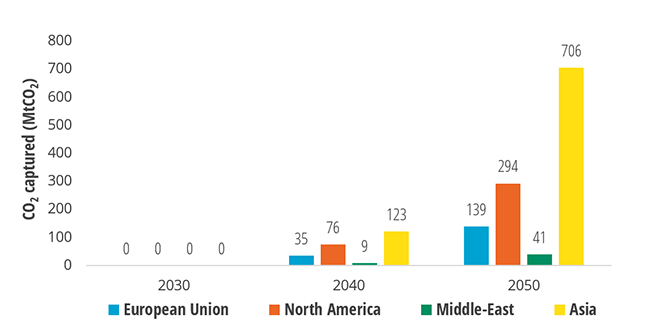
Source: Enerdata, EnerFuture
Beyond these scenarios, Enerdata also maps the industrial ecosystem behind CCUS deployment: its Global CCS Companies Database covers technology providers across the whole value chain, from capture (including direct air capture) to transport and storage, including emerging start-ups and turnkey (EPC) providers27.
Conclusion
No longer a long-term aspiration, CCUS has become a reality that materializes into tens of projects across Europe, covering all steps of the value chain, from capture to storage. If it remains true that electrification of various sectors (land transport, buildings heating and cooling, low-temperature industrial heat) using renewable electricity is by far the most cost-effective way to lower emissions, carbon capture could be interesting as a complement, mostly to decarbonise hard-to-abate industries (such as cement and steel) and to generate negative emissions (through BECCS). These hard-to-abate industries (steel, cement and chemicals) account for around 18% of energy-system CO2 emissions28, but CCUS is no silver bullet: in the IEA’s Net Zero Emissions scenario, it delivers only about 8% of cumulative emission reductions to 2050, far behind renewables, energy efficiency and electrification29. Decarbonisation will primarily come from reducing fossil fuel consumption, including through changes in consumption patterns, rather than from keeping fossil-fuelled plants running, or building new ones, on the promise that an emerging technology will curb their emissions. Beyond the mitigation of carbon dioxide emissions, the CCUS value chain may also grow in importance to the wider economy, as it could replace fossil fuels as a source of carbon for industries such as chemistry and liquid fuels (notably e-fuels), for which carbon is non-substitutable.
These prospects, however, should not obscure a critical condition: the technology still has to prove its economic competitiveness if CCUS is to become a durable pillar of decarbonisation rather than a passing trend. Several challenges remain before deployment ceases to be a financial burden. The capture technologies themselves need to become less energy-intensive. Robust value chains, including short loops between capture and use, have to be built to limit transport and conditioning costs. The regulatory framework requires further development to provide investors with clear and stable conditions. And substantial investment, public funding in particular, will be needed to bridge the gap until the technology reaches maturity. How these conditions are met will largely determine whether CCUS fulfills the role that current scenarios assign to it.
Notes:
- IPCC, Climate Change 2022: Mitigation of Climate Change, Working Group III, Chapter 12 (Table 12.3) and Supplementary Material 12.SM.1.2, 2022
- IEA, Is carbon capture too expensive?, 2021
- IEA, Direct Air Capture, 2024
- IEA, CCUS Policies and Business Models, 2023
- JRC, Clean Energy Technology Observatory: Carbon Capture, Utilisation and Storage in the European Union - 2025 Status Report on Technology Development, Trends, Value Chains and Markets, 2025
- Global CCS Institute, ADVANCEMENTS IN CCS TECHNOLOGIES AND COSTS, 2025
- CATF, Carbon capture and storage in Europe: Slow but significant progress in 2025, 2025
- IOGP, CO2 storage projects in Europe, 2025
- GCCSI, Needs, Opportunities and Prospects For CO2 Shipping in CCS Projects, 2025
- Amounts originally expressed in euros are converted into US dollars at the 2025 average ECB euro reference rate (EUR 1 = USD 1.13; GBP and DKK amounts at the corresponding 2025 average cross rates) and rounded to two significant figures, without adjustment for the price year of the original sources.
- World Economic Forum, Achieving net zero: Why costs of direct air capture need to drop for large-scale adoption, 2023
- CATF, Key insights on EU CO2 transport and storage costs from CATF's new interactive tool, November 2025
- Global CCS Institute, NEEDS, OPPORTUNITIES AND PROSPECTS FOR CO2 SHIPPING IN CCS PROJECTS, 2025
- Global CCS Institute, Cost of CO₂ Storage, December 2025
- Agora Industrie & Öko-Institut Consult GmbH, Carbon Capture and Storage (CCS) in der Energiewende zur Klimaneutralität — Der infrastrukturelle und regulatorische Rahmen für CO2-Transport und -Speicherung, 2026
- Chem & Bio Engineering, Green Methanol from CO2 Hydrogenation at Industrial Scale: Progress, Challenges, and Perspectives, 2025
- Trends in Biotechnology, Food production from air: gas precision fermentation with hydrogen-oxidising bacteria, 2026
- Environmental Science & Technology, Technoeconomic and Life Cycle Analysis of Synthetic Methanol Production from Hydrogen and Industrial Byproduct CO2, 2021
- European Commission, Commission identifies the EU oil and gas producers to provide new CO2 storage solutions for hard-to-abate emissions in Europe, 22 May 2025
- EC, Industrial carbon management, 2025
- BEST & Bioenergy Europe, BECCS: Bioenergy with carbon capture and storage, basics and opportunities, April 2025
- JRC, The Role of Carbon Capture Across Hard-to-Abate Industries in the EU: A Review of Projections for 2030 and 2050, 2024
- European Commission, 2040 climate target, 2026
- CATF, Vision for CCUS in the EU, 2023
- Global CCS Institute, Global Status of CCS 2026, October 2026
- Global CCS Institute, Global Status of CCS 2025: Staying the Course (Executive Summary), October 2025
- Enerdata, Global CCS Companies Database, January 2026 update
- IEA, The challenge of reaching zero emissions in heavy industry, 2020
- IEA, CCUS, Net Zero Roadmap: A Global Pathway to Keep the 1.5 °C Goal in Reach, 2023
About the author
Cyril Aselmeyer joined Enerdata in 2023 as a consultant in the Cleantech team. His work focuses on developing expertise in technologies including solar PV, wind power, hydrogen and its derivatives, ammonia, e-fuels, biofuels, batteries, electric mobility, carbon capture and storage, and electricity grids. He applies this expertise to client assignments and the development of commercial products, reports and training programmes.
During his first two years at Enerdata, Cyril worked on clean ammonia, solar PV, wind power, CCUS and hydropower.
Before joining Enerdata, Cyril began his career in academic research and completed a PhD on third-generation biofuels. He subsequently studied energy economics to broaden his expertise.
Cyril holds a PhD in biochemistry from Aix-Marseille University and an MSc in Energy Economics from Université Grenoble Alpes.