According to the Global Wind Energy Council (GWEC), global wind installations should continue to follow an upward trend between 2016 and 2020, with a constant increase in capacity addition: from 63 GW installed in 2015 to 64 GW in 2016 and to nearly 80 GW to be installed in 2020. Accordingly, the cumulative wind capacity should grow from 433 GW at year-end 2015 to 497 GW at year-end 2016 and 792 GW in 2020.
Asia should continue to lead global installations, with 35-36 GW of new wind capacity added every year between 2016 and 2020, reaching 210 GW of installed capacity in 2016 and 353 GW in 2020. Europe and North America should follow: capacity additions will range between 13 and 15 GW per year in Europe, raising European capacity from 148 GW in 2015 to 161 GW in 2016 and 219 GW in 2020. North America should add between 10 and 14 GW per year over the 2016-2020 period, reaching 99 MW at year-end 2016 and 149 GW at year-end 2020. Capacity additions should be more modest in Latin America (+4.5-8 GW/year, raising capacity from 12 GW in 2015 to 17 GW in 2016 and 43 GW in 2020) and in Middle East and Africa (+1.5-5 GW/year, raising total capacity from 3.3 GW in 2015 to 4.8 GW in 2016 and to 19 GW in 2020).
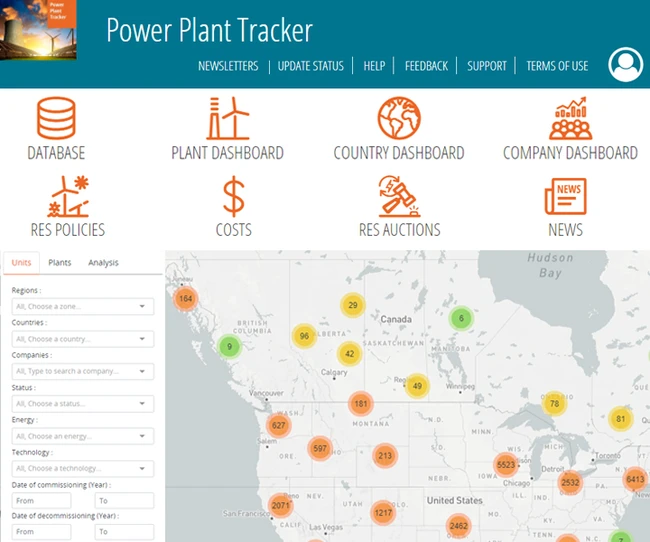
Interested in Power Plants?
Enerdata has developed a market research service to screen, monitor and analyse the development of power generation assets.
Power Plant Tracker offers an interactive database and a powerful search engine covering power plants worldwide – including both installed and planned capacities for renewables and fossil fuels.