South Stream Transport, a joint venture of Gazprom (50%), Eni (20%), Wintershall and EDF (15% each), has signed two agreements for the construction of the first two lines of the offshore section of the South Stream gas pipeline. The offshore section will consist of four parallel lines, each longer than 930 km, across the Black Sea from the Russian coast to the Varna Port in Bulgaria. Each line will be made up of over 75,000 12-meter pipes. Saipem will be in charge of the project documentation and of the construction of the first offshore line and of process facilities; the contract is estimated at about €2bn. Marubeni-Itochu and Sumitomo consortium, United Metallurgical Company and Severstal will supply pipes for second line of South Stream’s offshore section; the contract is about €800m.
In December 2012 the South Stream gas pipeline construction started near Anapa in the Krasnodar Territory (Russia). In October 2013 the first joint was welded at South Stream's Bulgarian section and the construction of the gas pipe started in Serbia in November 2013. Offshore construction will start in autumn 2014. The construction of the first offshore line will last until the third quarter of 2015. At the end of the same year the first line will be commissioned. The gas pipeline will reach its full capacity of 63 bcm/year in 2018.
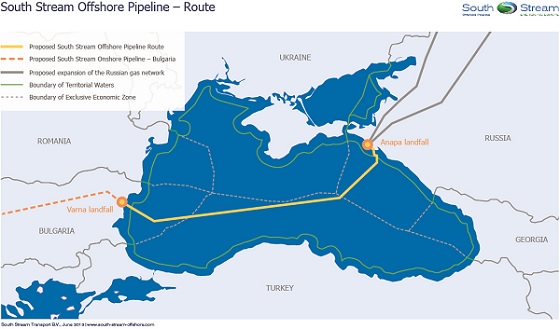
Source: South Stream
-
-
Energy and Climate Databases- The most comprehensive and up-to-date annual energy database.
- Monitoring of technology providers in H2 supply chain.
- Monthly energy data on key energy markets.
- Monitoring of Hydrogen and Derivatives Projects
- The most reliable and up-to-date power generation database.
- The essentials of LNG trade at your fingertips.
- Global monitoring of new and existing refineries.
- Analyse energy consumption and efficiency trends at world level. Benchmark countries.
- Have your database developed by a recognised expert of both energy and IT.
-
Energy - Climate Forecasts- Future carbon costs with reliable price forecasts
- Instant access to energy and emissions forecasts.
- Annual projections of wholesale prices up to 2050, based on a 360° approach of the energy markets, enabled by the globally recognised POLES model.
- Wedges module showing a breakdown of the levers enabling to reduce emissions between two scenarios.
- Unique, independent projections of consumption by end-use.
- GHG Marginal Abatement Cost Curves.
- Benefit from proven models to draw your own energy scenarios and anticipate tomorrow’s challenges.
-
Market Intelligence- 110 Energy and climate country reports.
- Tracking trends, EPCs, and national subsidy schemes for residential buildings.
- Daily brief covering the entirety of the turbine industry.
- A newsletter to receive the latest updates on evolving technologies and policies.
- Global energy news and analyses curated daily.
- Enerdata’s experts bring you the essentials about your market and competitors.
-
-
-
Market Analysis- Understanding key consumption trends and drivers across sectors.
- Granular and exclusive insight to address the most pressing business and strategic issues.
- Expertise in strategic and business intelligence, with fine-tuning to the market’s specificities.
-
Energy - Climate Scenarios- Providing the outlook of an energy commodity in mid to long term time horizons.
- Sector and driver specific energy demand forecasting.
- Assess the evolution of energy prices on the international and regional markets, as well as end-users prices.
- Enerdata guides you through pathways to reach climate targets.
- Supporting local authorities in their decarbonisation strategies.
-
Climate Strategy and Policy Evaluation- Cutting-edge quantitative tools and relevant indicators to monitor and evaluate evolutions on worldwide energy markets.
- Analysis of the most cost-effective options to reduce emissions.
- Quantified simulation and analysis of pledges for climate change negotiations.
- Breakdown of carbon markets and evaluation of the climate change impacts on the carbon price.
- Enerdata guides you on the most beneficial policy or investment options.
- Turning climate objectives into concrete action plans.
-
Training- Understand different policy targets and measures on energy efficiency.
- How to measure energy savings?
- Energy Forecasting is a 2 days training to learn to design and interpret energy forecasts.
- Energy statistics training allowing to create energy balance with supply, transformation and consumption and understanding the international energy statistics regulations.
- Initiation to EnerMED level 1is the training to approach on the most powerful energy demand forecasting model.
-
-
Resource Centre